
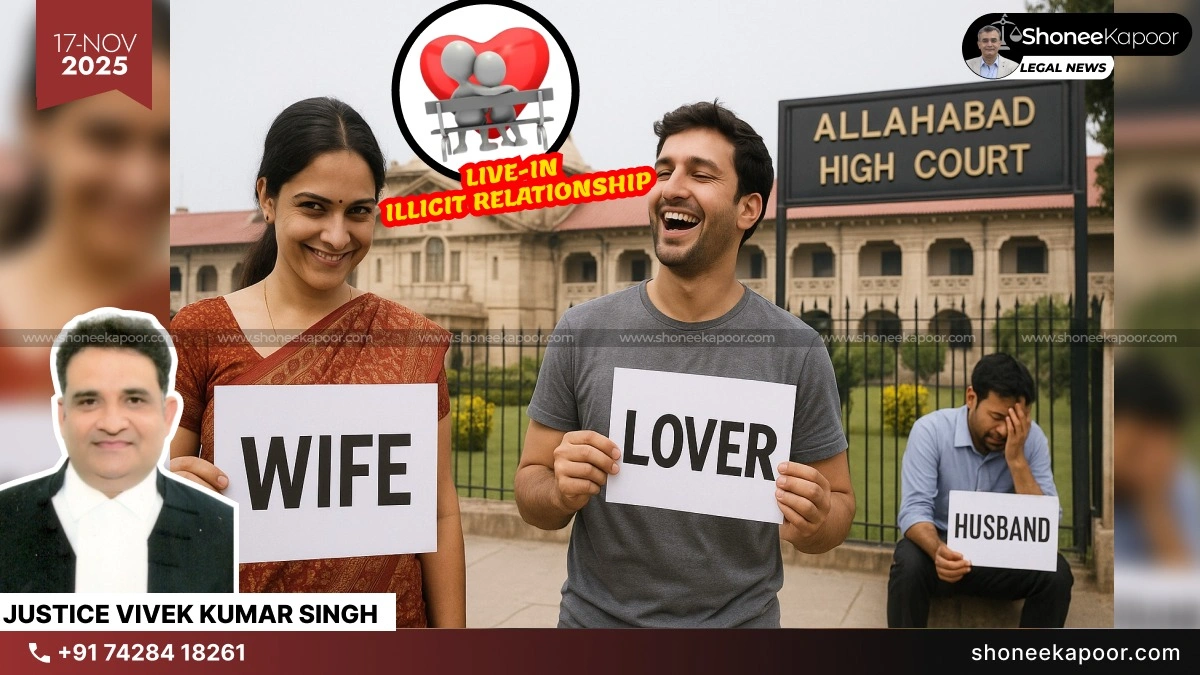
The Allahabad High Court denied protection to a woman and her partner who claim safety to be in a live-in relationship, noting that she was still legally married. The Court said it cannot support relationships that may amount to bigamy or crime under Indian law.
Claim Safety for Illicit Relationship: The Allahabad High Court refused to give police protection to a woman and a man who said they were living together in a live-in relationship. The Court found that the woman was still legally married to another man and had not taken a divorce.
Because of this, the Court said that giving protection would indirectly mean supporting something that may be a crime like bigamy or cheating under Indian law.
The Court dismissed their request asking that police should not interfere in their relationship.
The Court clearly stated:
“No law-abiding citizen who is already married under the Hindu Marriage Act can seek protection of this Court for illicit relationship, which is not within the purview of social fabric of this country.”
The couple had told the Court that both of them were adults living together with free consent, and that respondent no. 4—who is the woman’s legally wedded husband—was disturbing their peaceful life. They wanted the State authorities to stop any interference and give protection.
As per the papers filed in Court, the woman had earlier submitted an application to the Senior Superintendent of Police, Saharanpur, on 25 September 2025. In that application, she openly admitted that she was married to respondent no. 4 but was now in a relationship with petitioner no. 2. She also said that her husband was threatening her. This application was attached with the writ petition.
During the court proceedings, the State told the judge that this was the woman’s second marriage, and that she and the petitioner had been living together for two years. The State also said that they did not face any real threat from the woman’s husband. The government lawyer further informed the Court that the woman had not produced any marriage certificate showing remarriage and that her divorce case against her husband was filed only on 30 October 2025—after the Court earlier asked her to file proof of divorce. That divorce case is still pending and no final order has been passed. Legally, the marriage still exists.
The judge relied on the Division Bench ruling in Asha Devi v. State of U.P. (2020), where the Court had answered two important questions:
“(i) Whether the petitioners, who claim themselves to be living together as husband and wife; can be granted protection when the petitioner No.1 is legally wedded wife of someone else and has not taken divorce sofar ?
(ii) Whether protection to petitioners as husband and wife or as live-in-relationship can be granted in exercise of powers conferred under Article 226 of the Constitution of India, when their living together may constitute offences under Sections 494/495 I.P.C. ?”
The Court again referred to the Supreme Court’s decisions in D. Velusamy v. D. Patchaiammal, where the Supreme Court had said:
“32. In our opinion not all live in relationships will amount to a relationship in the nature of marriage to get the benefit of the Act of 2005. To get such benefit the conditions mentioned by us above must be satisfied, and this has to be proved by evidence.
If a man has a keep whom he maintains financially and uses mainly for sexual purpose and/or as a servant it would not, in our opinion, be a relationship in the nature of marriage`.”
The bench also noted that the Supreme Court in Indra Sarma v. V.K.V. Sarma and A. Subhash Babu v. State of A.P. had clearly said that relationships based on bigamy, adultery or polygamy cannot be treated as “relationships in the nature of marriage”. Such relationships cannot receive legal protection.
The Court further observed that under Indian law, a marriage continues to exist unless a competent court dissolves it. If a person enters into another relationship while the marriage is still valid, it can lead to criminal charges under Sections 494 and 495 IPC (bigamy). The Court said that the woman here is still the legally wedded wife of respondent no. 4, so the relationship with petitioner no. 2 cannot be considered a live-in relationship that law recognises.
The judge also pointed out that to get protection under Article 226 of the Constitution, the petitioners must show a legal right that needs protection. But nothing was shown to prove that they were living like husband and wife—there were no joint bank accounts, no joint property, and no financial arrangements.
Without any such proof, the Court held that the couple had no right to ask the High Court for protection. Granting such protection would indirectly mean helping an act which may be a criminal offence.
The Court also reminded that a writ of mandamus can be issued only when there is a clear legal right. It said that a writ cannot be issued to defeat any law, especially criminal law. The power under Article 226 is based on fairness and discretion, and it cannot be used to protect unlawful activities.
In light of these reasons, the Court decided not to give any protection to the petitioners. It stated that since the woman is still legally married and her marriage has not been dissolved, their claimed relationship cannot be protected under Article 226 or under the principles laid down in earlier judgments. Finally, the Court dismissed the writ petition.

Explanatory Table Of All Laws & Sections Mentioned In This Case
| Law / Case / Section | Full Name | What It Means (Simple Explanation) | How It Applies in This Case |
| Section 494 IPC | Bigamy | Marrying someone while already having a living spouse. | Court said the woman is still married. Living with another man can amount to bigamy. |
| Section 495 IPC | Bigamy with concealment | Bigamy committed by hiding the fact of existing marriage. | Relationship may fall under this offence if marriage was concealed. |
| Section 17, Hindu Marriage Act, 1955 | Punishes bigamy under Hindu law | A Hindu cannot marry again without divorce; second marriage becomes void and criminal. | Since no divorce, her relationship with petitioner is illegal. |
| Article 226, Constitution of India | High Court’s power to issue writs | Used to protect legal rights. But Court cannot protect illegal activities. | Court refused to use Article 226 to protect an illicit relationship. |
| Asha Devi v. State of U.P. (2020) | Allahabad High Court Division Bench judgment | Held that protection cannot be given when one partner is still married. | This case directly governs the present matter. |
| D. Velusamy v. D. Patchaiammal (2010) | Supreme Court judgment on live-in relationships | Defined which live-in relations resemble a marriage. Casual/illicit relationships do NOT qualify. | Court used this to say this relationship isn’t “in nature of marriage.” |
| Indra Sarma v. V.K.V. Sarma (2013) | SC ruling on domestic violence & live-ins | Relationships involving bigamy/adultery are NOT protected. | Court applied this to deny protection. |
| A. Subhash Babu v. State of A.P. (2011) | Supreme Court | Confirmed that bigamous relationships are criminal and not protected as live-ins. | Used as supporting precedent. |
| Shayara Bano v. Union of India (2017) | SC (Triple Talaq case) | Reiterated polygamy & bigamy as punishable under IPC. | Court referred to this to highlight illegality. |
| Lily Thomas v. Union of India (2000) | Supreme Court | Conversion to another religion cannot be used to marry again illegally. | Court cited this on sanctity of valid marriage. |
| Director of Settlement, A.P. v. M.R. Apparao (2002) | Supreme Court | Explained when writ of mandamus may be issued. | Court used it to say petitioners have no legal right. |
| Kalyan Singh v. State of U.P. (1962) | Supreme Court | Mandamus requires a clear legal right on date of filing. | Petitioners had no such right. |
| Domestic Violence Act, 2005 Reference | Relevant to defining “relationship in the nature of marriage” | SC said not all live-ins get legal recognition. | Court applied this principle. |
Case Summary
- Case Title: Smt. Sonam and Another vs. State of U.P. and 3 Others
- Case Number: Writ – C No. 36027 of 2025
- Court: High Court of Judicature at Allahabad Court No. 78
- Date of Order: 7 November 2025
- Bench / Hon’ble Judge: Hon’ble Justice Vivek Kumar Singh
- Petitioners: Smt. Sonam and Another
- Respondents: State of U.P. and 3 Others
- Counsel for Petitioners: Imaran Ahmad
- Counsel for Respondents: C.S.C. (Chief Standing Counsel)
State represented by Sri Arvind Kumar Singh, Standing Counsel
- Relief Sought: A writ of mandamus asking-
- Police not to interfere in their “peaceful life”
- To give “protection” to the couple living together
- Key Facts
- Woman (Petitioner No.1) still legally married to Respondent No.4.
- She filed a police application on 25.09.2025 admitting she is the wife of Respondent No.4 but now living with Petitioner No.2.
- Divorce petition filed only on 30.10.2025—still pending.
- No decree of divorce produced.
- No proof of living like a married couple (no joint accounts, property, etc.).
- Court said protection cannot be granted for an “illicit relationship”.
- Final Outcome
- Petition dismissed.
Court refused protection.
Disclaimer: The views and opinions expressed in this article are those of the Indian courts and do not necessarily reflect the official policy or position of “ShoneeKapoor.com” or its affiliates. This article is intended for informational and educational purposes only. The content provided is not legal advice, and viewers should not act upon this information without seeking professional counsel. Viewer discretion is advised.
