
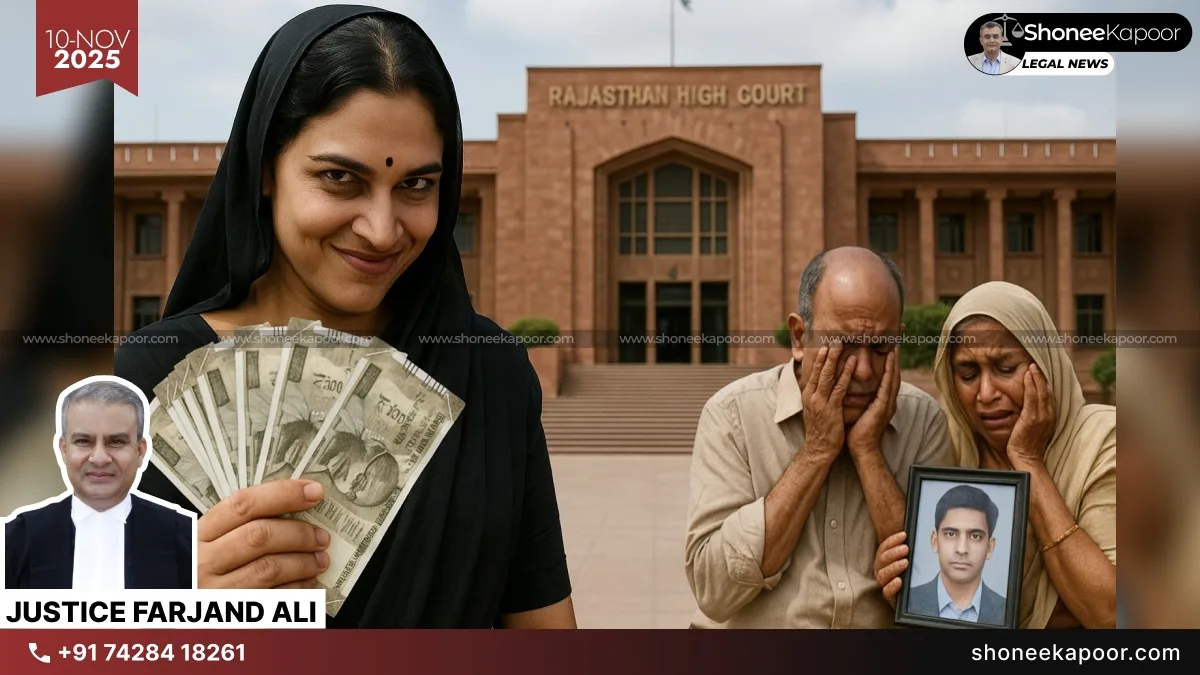
Rajasthan High Court ruled that a widow who secured a compassionate job after her husband’s death must support her in-laws. The Court ordered ₹20,000 to be deducted monthly from her salary for her father-in-law’s maintenance.
Jodhpur: In a landmark judgment, the Rajasthan High Court made it clear that a widow who accepts a compassionate appointment cannot escape her moral and legal duties toward her in-laws. The Court ordered the Ajmer Vidhut Vitran Nigam Limited (AVVNL) to deduct ₹20,000 every month from the salary of Shashi Kumari, the widow of Late Rajesh Kumar, and deposit it directly into the account of her father-in-law, Bhagwan Singh, for his maintenance.
The case was heard by Justice Farjand Ali in S.B. Civil Writ Petition No. 1149/2018 (Bhagwan Singh v. Suptd. Engineer, Pawas, & Ors.), pronounced on 29 October 2025.
ALSO READ: Child Custody | Maternal Grandparents Cannot Have Better Claim Than Father: Supreme Court
The Court observed:
“The employment granted to respondent No. 4 cannot be viewed as a personal entitlement earned through merit or competitive process; it is, rather, a consequence of an unfortunate eventuality, intended to protect the deceased employee’s family from deprivation. Having accepted the appointment under such a scheme, respondent No. 4 cannot be permitted to evade or repudiate her attendant responsibilities towards the other dependents of the deceased, for to do so would defeat both the letter and spirit of the compassionate appointment policy.”
Background of the Case
The petitioner, Bhagwan Singh, lost his son Rajesh Kumar, who was working as a Technical Assistant under AVVNL. After Rajesh’s death in 2015, both Bhagwan Singh and his daughter-in-law Shashi Kumari applied for compassionate appointment under the Rajasthan Compassionate Appointment of Dependents of Deceased Government Servants Rules, 1996.
Initially, the Department offered the job to Bhagwan Singh, but in an act of goodwill, he recommended that the appointment be given to his daughter-in-law instead. Shashi Kumari was thereafter appointed as a Lower Division Clerk (LDC) in 2016.
However, just 18 days after her husband’s death, Shashi Kumari left her matrimonial home and started living with her parents, cutting off all ties with her in-laws. The Municipal Board’s inquiry confirmed that Bhagwan Singh and his wife were aged, financially dependent, and living in distress.
The Court noted that Shashi Kumari had filed an affidavit dated 19.10.2015, promising to stay with and look after her in-laws and to take full responsibility for their care. The affidavit stated that if any dispute arose, she would be held responsible. However, she failed to honor this solemn assurance.
Court’s Reasoning
Justice Farjand Ali emphasized that compassionate appointments are not ordinary jobs or rewards based on merit but acts of grace meant to help the entire family of the deceased employee:
“It is settled law that compassionate appointment is not a vested right but an act of grace, intended to alleviate the financial hardship of the family of the deceased government servant. It is a welfare measure, not a mode of employment.”
The Court added that when a widow accepts such an appointment, she does so as a representative of the family, not as an individual beneficiary:
“The expression ‘family’ cannot be interpreted in a narrow or compartmentalized manner so as to mean the widow alone. It necessarily includes all those who were dependent upon the deceased employee at the time of his death — namely, the parents, spouse, and children; for they together constitute a composite family unit bound by mutual dependency and shared vulnerability.”
The Court remarked that the widow’s abandonment of her in-laws after getting the job and 70% of the compensation amount was “wholly antithetical to equity, conscience, and the solemn undertaking voluntarily made by her.”
It further stated:
“The respondent No. 4, having derived such employment on the strength of her solemn affidavit, cannot now resile from the promise that formed the very substratum of the benefit conferred upon her. To allow her to do so would amount to permitting a fraud upon the compassionate scheme itself.”
Justice Ali also highlighted that compassionate appointment carries a fiduciary obligation to ensure that all dependents are cared for:
“When one member of such a family is extended the benefit of compassionate appointment, the appointment is not conferred in an individual capacity but as a representative of the entire family. It therefore carries with it a corresponding moral and legal obligation to safeguard the interests of the other surviving dependents and to ensure their maintenance and well-being.”
Final Directions of the Court
Considering the age, medical condition, and financial dependence of Bhagwan Singh on his late son, the Court directed:
“From 01.11.2025 onwards, the respondent-department shall ensure deduction of ₹20,000 (Rupees Twenty Thousand only) per month from the salary of respondent No. 4, to be credited directly into the bank account of the petitioner towards his maintenance, which shall continue till his lifetime or until further orders of the competent authority.”
The Court also noted:
“Ignoring such moral duties would make a mockery of the very ethos of compassionate employment and erode public confidence in the fairness of administrative benevolence.”

The Rajasthan High Court’s ruling sends a strong moral and legal message that a widow who benefits from a compassionate appointment cannot abandon her in-laws who were dependent on the deceased employee.
The compassionate job is not a personal privilege, but a social responsibility meant to support the entire family of the deceased.
Explanatory Table of Laws & Rules Mentioned
| Article 226, Constitution of India | Empowers High Courts to issue writs for enforcement of fundamental and legal rights. | The petitioner filed a writ petition under Article 226 seeking directions for maintenance from daughter-in-law’s salary. |
| Rajasthan Compassionate Appointment of Dependents of Deceased Government Servants Rules, 1996 | State rules governing compassionate appointments for family members of deceased government employees. | The Court interpreted these rules to hold that the widow’s appointment was not personal but family-oriented, carrying duties toward all dependents. |
| Rule 10(2) of the 1996 Rules | Ensures compassionate appointment considers the welfare of all dependents of the deceased. | Petitioner argued that the appointment violated this rule because his welfare (as dependent parent) was ignored. |
| Concept of Promissory Estoppel (Common Law Principle) | Prevents a person from denying a promise made if another party acted upon it to their detriment. | Court held that since Shashi Kumari had sworn an affidavit promising to support in-laws, she was estopped from backing out. |
| Doctrine of Parens Patriae | Latin for “parent of the nation”; the State’s duty to protect vulnerable citizens. | The Court said compassionate appointment is a gracious act of the State under its parens patriae obligation. |
| Fiduciary Obligation (Trust Principle) | Legal duty to act in another’s interest, arising from trust or confidence. | Court held the widow held a fiduciary obligation to care for her in-laws after accepting the job. |
| Moral & Equitable Obligations (Equity Jurisprudence) | Principles of fairness applied when strict legal rights are insufficient. | Court emphasized moral duties toward dependent parents, linking it to equitable relief through salary deduction. |
Case Summary
| Case Title | Bhagwan Singh v. Suptd. Engineer, Pawas & Ors. |
| Neutral Citation / Case Number | S.B. Civil Writ Petition No. 1149/2018Neutral Citation: [2025:RJ-JD:45818] |
| Court | High Court of Judicature for Rajasthan, Jodhpur |
| Bench | Hon’ble Mr. Justice Farjand Ali |
| Date Reserved | 10 October 2025 |
| Date Pronounced | 29 October 2025 |
| Petitioner | Bhagwan Singh S/o Shri Gangaprasad |
| Respondents | 1. Superintendent Engineer, Pawas, AVVNL 2. Assistant Engineer, AVVNL (Partapur, Banswara Circle) 3. Assistant Engineer, Pawas, AVVNL 4. Shashi Kumari W/o Late Rajesh Kumar Sain (LDC, AVVNL) |
| For Petitioner(s) | Mr. Priyanshu GopaMr. Shreyansh Ramdev |
| For Respondent(s) | Mr. Mrigraj Singh RathoreMr. Rajesh PuniaMr. Madan Lal |
| Judgment Delivered By | Justice Farjand Ali |
| Order Type | Reportable |
| Uploaded On | 30 October 2025 |
| Key Direction | AVVNL to deduct ₹20,000/month from widow’s salary and deposit directly in petitioner (father-in-law)’s account until his lifetime. |
Key Takeaways
- Compassionate jobs are not personal rewards but family responsibilities.
- Widow cannot abandon her in-laws after securing such employment.
- Court upheld moral + legal duty to support aged dependents.
- Salary deduction of ₹20,000/month ordered for father-in-law’s maintenance.
- A clear reminder that “Compassionate appointment ≠ inheritance, it’s accountability.”
Would You Like Assistance In Drafting A Legal Notice Or Complaint?
CLICK HERE
FOLLOW US ON YOUTUBE FOR MORE LEGAL UPDATES
This Could Change Your Case-Get FREE Legal Advice-Click Here!
Disclaimer: The views and opinions expressed in this article are those of the Indian courts and do not necessarily reflect the official policy or position of “ShoneeKapoor.com” or its affiliates. This article is intended for informational and educational purposes only. The content provided is not legal advice, and viewers should not act upon this information without seeking professional counsel. Viewer discretion is advised.

she can remarry right
Legally, yes, she can remarry. This judgment does not stop her from remarrying.
What the Rajasthan High Court has said is something else: because she accepted a compassionate job after her husband’s death and swore an affidavit to take care of his dependants, she cannot then abandon the father-in-law. That’s why ₹20,000 is being deducted from her salary every month for his maintenance.
So her personal choice to remarry is separate. The deduction is linked to the responsibility that came with the compassionate job, not to whether she stays a widow or not. If circumstances change drastically, parties can always approach the court to seek a modification.