
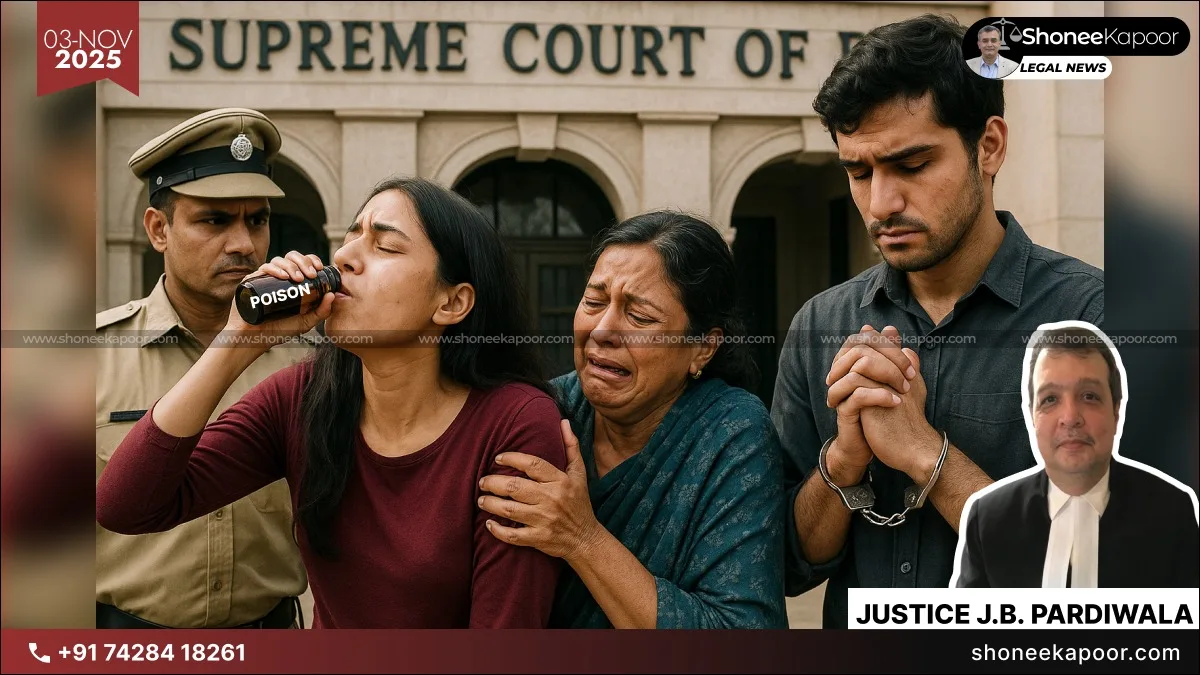
In a historic ruling, the Supreme Court held that refusing to marry cannot be treated as abetment of suicide under Section 306 IPC. The Court quashed the FIR against Punjab advocate Yadwinder Singh, affirming that heartbreak isn’t a crime and personal choices can’t be criminalized.
NEW DELHI: The Supreme Court of India ruled in a landmark decision that “mere refusal to marry” cannot be regarded as instigation or abetment to suicide, dismissing a formal complaint against a Punjab-based advocate under Section 306 IPC (abetment of suicide).
In Yadwinder Singh @ Sunny v. State of Punjab & Anr., a bench consisting of Justice J.B. Pardiwala and Justice K.V. Viswanathan rendered the decision, granting the appeal and overturning the Punjab & Haryana High Court ruling that had previously refused to quash the FIR. The Court reiterated that heartbreak and personal choice cannot be criminalized by the law by observing that, despite the tragedy of the incident, criminal liability under Section 306 requires clear evidence of intentional instigation rather than emotional rejection.
Facts of the Case
FIR Background and Allegations: On November 7, 2016, Smt. Surinder Kaur, the mother of the late Pardeep Kaur, a government advocate, filed a formal complaint at Police Station Chheharta in Amritsar City under Section 306 IPC (abetting suicide). She claimed that her daughter committed suicide by ingesting poison at home after being emotionally and physically abused by Yadwinder Singh @ Sunny, an advocate who later declined to marry her.
According to the complainant, Yadwinder Singh came to their house in 2015, declared his love for Pardeep Kaur, and promised to marry him after his father gave his approval. The deceased allegedly became upset and took her own life on November 6, 2016, after he later renounced that commitment.
Supplementary Statement of the complainant’s mother: Surinder Kaur made a supplementary statement under Section 161 CrPC two days after the FIR, asserting that her daughter had spoken on the phone with Yadwinder Singh several times prior to the incident. Yadwinder allegedly told her, “Do whatever you want, I don’t care if you die,”. She also added that her daughter had called Balwinder Singh, Yadwinder’s father, who likewise “did not care.” She also mentioned that CDs of their recorded conversations, which were part of the case evidence, were given to her by her daughter.
Relationship and Circumstances Leading to Death: The deceased Pardeep Kaur, aged 27, was a government advocate at Amritsar. Yadwinder Singh was a government advocate at Batala. Their friendship had developed into a romantic relationship with mutual intent to marry. However, Yadwinder Singh’s family allegedly opposed the marriage on social grounds, leading to postponements and ultimately to his withdrawal from the commitment.
On 6 November 2016, while studying at home, Pardeep Kaur consumed poison. She was found vomiting by her mother and neighbor and taken first to Arora Hospital and then to Escorts Hospital, Amritsar, where she died around 11 p.m.
Procedural History:
- Sessions Trial: The case was registered as Sessions Case before the Additional Sessions Judge, Amritsar.
- High Court Petition: Yadwinder Singh filed under Section 482 CrPC seeking quashing of the FIR, which the Punjab & Haryana High Court dismissed on 17 March 2025, holding that the issue required trial.
- Supreme Court Appeal: He then filed Special Leave Petition in the Supreme Court.
Supreme Court’s Analysis of Facts:
The Bench of Justice J. B. Pardiwala and Justice K. V. Viswanathan observed that even accepting the prosecution case prima facie, the essential ingredients of “abetment” under Sections 107 and 306 IPC were not satisfied. The Court noted that:
- The couple had mutual affection and desire to marry.
- Opposition from the accused’s family created pressure and hesitation.
- The accused’s refusal to marry did not demonstrate mens rea (intent) to provoke suicide.
- Emotional hurt or heartbreak cannot constitute instigation.
Thus, On 27 October 2025, the Supreme Court allowed the appeal, quashed FIR and the Sessions Case and set aside the Punjab & Haryana High Court’s order.
Court’s Findings
Delivering the judgment, Justice J.B. Pardiwala writing for the Bench also comprising Justice K.V. Viswanathan undertook a close examination of the ingredients of Section 306 IPC (abetment of suicide) read with Section 107 IPC (definition of abetment). The Court made it clear that criminal law cannot be invoked to punish emotional rejection or personal choices.
On Mere refusal to marry is not instigation the bench stated that:
“Even if the allegations in the FIR are accepted in their entirety, the act of refusing to marry the deceased does not satisfy the requirements of instigation or intentional aid as envisaged under Section 107 IPC. Emotional distress arising from a failed relationship, however unfortunate, cannot be stretched into criminal culpability.”
The Bench emphasized that abetment requires a positive act of instigation, conspiracy, or intentional aid, not a mere omission or emotional fallout.
The bench also observed that no evidence of mens rea (criminal intent) is present:
“For an offence under Section 306 IPC to be made out, there must exist mens rea, a clear intention to provoke or drive another to commit suicide. The material on record does not indicate that the appellant ever intended, or could have foreseen, such a result.”
The Court found that the prosecution failed to establish any communication or conduct showing that Yadwinder Singh had the intention to cause the deceased to take her own life. Phone conversations and messages relied upon by the complainant were considered inconclusive and circumstantial at best.

It was observed that the supplementary statement was an “improvement” on the original version. Justice Pardiwala observed that the supplementary statement filed days after the FIR, which added allegations of “mental and physical exploitation,” was an afterthought not borne out by the initial complaint or corroborated by independent evidence:
“The second version appears to be an embellishment, a subsequent improvement introduced after deliberation. Courts must be cautious before acting upon such improved statements, especially in matters touching personal relationships.”
From the facts the court observed that heartbreak cannot be criminalized. The Court reiterated that while the suicide of a young woman was tragic, criminal law must rest on intent and causation, not sympathy or moral outrage:
“Law cannot step into the private realm of emotions and treat rejection or heartbreak as an offence. To prosecute an individual merely for declining to marry would convert personal autonomy into criminal liability, a result wholly inconsistent with our constitutional ethos.”
According to the bench, Continuing the trial would be a travesty of justice:
“Allowing the prosecution to continue in the absence of any element of instigation would be nothing short of a travesty of justice. Even if the allegations are taken at face value, they do not disclose the offence alleged.”
Outcome: Consequently, the Supreme Court quashed the FIR and all consequential proceedings, concluding that the refusal to marry, even if proven, cannot attract criminal liability under Section 306 IPC. The Bench cited and reaffirmed principle of Each precedent underscored that a mere relationship dispute or rejection, without a deliberate act of provocation, cannot constitute abetment to suicide.
- S.S. Cheena v. Vijay Kumar Mahajan (2010 12 SCC 190)
- Geo Varghese v. State of Rajasthan (2021 19 SCC 144)
- Nipun Aneja v. State of U.P. (2024 SCC OnLine SC 4091)
“Mere refusal to marry, even if true, by itself would not amount to instigation as explained under Section 107 IPC. The appellant cannot be said to have intended the consequence of suicide; the continuation of the trial would be futile.”
Result:
- Appeal allowed.
- FIR and Sessions Case quashed.
- All pending applications disposed of.
Table of Sections and Cases Referred
| Law / Source | Section/ Citation | Explanation & Relevance in the Case |
| Indian Penal Code, 1860 (IPC) | Section 306 Abetment of Suicide | Core provision invoked in the FIR. The prosecution alleged that the accused’s refusal to marry amounted to abetment; the Supreme Court held otherwise, ruling that intent and direct instigation were absent. |
| Indian Penal Code, 1860 (IPC) | Section 107 Definition of Abetment | Defines “instigation, conspiracy, or intentional aid.” The Bench analysed this to conclude that emotional rejection cannot constitute instigation under this section. |
| Code of Criminal Procedure, 1973 (CrPC) | Section 482 Inherent Powers of High Court | Invoked by the appellant in his quashing petition (CRM-M No. 41256 of 2018) before the Punjab & Haryana High Court, which dismissed the plea. Later reconsidered by the Supreme Court. |
| Code of Criminal Procedure, 1973 (CrPC) | Section 161 Examination of Witnesses by Police | Supplementary statement of the complainant was recorded under this provision, later found to be an “improvement” and unreliable. |
| Constitution of India | Article 21 Right to Life and Personal Liberty | Then Court emphasised that personal autonomy and the freedom to choose one’s partner are protected under Article 21, and criminal law cannot curtail those freedoms. |
| Case Law (Precedents Cited) | S.S. Cheena v. Vijay Kumar Mahajan (2010 12 SCC 190) | Held that mere harassment or emotional distress without active instigation does not amount to abetment. Quoted to reinforce the absence of mens rea. |
| Geo Varghese v. State of Rajasthan (2021 19 SCC 144) | Clarified that conviction under Section 306 requires a clear nexus between act and suicide. Used to frame the legal test applied here. | |
| Nipun Aneja v. State of U.P. (2024 SCC OnLine SC 4091) | Held: “breakdown of a relationship, however painful, cannot by itself invite criminal prosecution under Section 306 IPC.” | |
| Gurcharan Singh v. State of Punjab (2017 1 SCC 433) | Held that to constitute abetment, there must be proof of a direct act of incitement; applied by analogy. |
Case Details
- Case Title: Yadwinder Singh @ Sunny v. State of Punjab & Another
- Court: Supreme Court of India
- Bench: Hon’ble Justice J.B. Pardiwala and Hon’ble Justice K.V. Viswanathan
- Counsel: – Appellant (Yadwinder Singh @ Sunny):
- Mr. P. S. Patwalia, Senior Advocate
- Mr. Karan Bharihoke, Advocate-on-Record
- Ms. Riya Bedi, Advocate
- Respondent No. 1 (State of Punjab):
- Mr. S. C. Sharma, Additional Advocate General (AAG), Punjab
- Respondent No. 2 (Complainant / Mother of Deceased):
- Mr. Maninder Singh, Advocate
- Case Type / Number: Criminal Appeal arising out of SLP (Crl.) No. 7309 of 2025
- Date of Judgment: 27 October 2025
- Appellant: Yadwinder Singh @ Sunny, Advocate, Punjab
- Respondents: State of Punjab & Surinder Kaur (Mother of Deceased Pardeep Kaur)
- FIR Details: FIR No. 273/2016 dated
- Police Station: Chheharta, Amritsar City
- FIR date: 07 November 2016
- Allegations in FIR: That the appellant refused to marry Pardeep Kaur after a relationship, allegedly driving her to suicide by poison consumption on 06 November 2016.
- Main Section Invoked in FIR: Section 306 IPC (abetment of suicide)
- High Court Order: Punjab & Haryana High Court dismissed the quashing petition on 17 March 2025.
- Supreme Court Proceedings: Appeal filed by Yadwinder Singh challenging the High Court order; admitted as SLP.
- Key Legal Provisions Examined: Sections 306 & 107 IPC; Sections 161 & 482 CrPC; Article 21Constitution of India
- Result / Outcome: FIR and all criminal proceedings quashed as no offence of abetment was made out.
- Final Observation of the Court: “Mere refusal to marry, even if true, by itself would not amount to instigation as explained under Section 107 IPC. Continuing the trial would be a travesty of justice.”
- Question in issue: Whether the refusal to marry a person with whom one had a consensual relationship can amount to “instigation” or “abetment” of suicide under Section 306 of the Indian Penal Code, 1860?
Disclaimer: The views and opinions expressed in this article are those of the Indian courts and do not necessarily reflect the official policy or position of “ShoneeKapoor.com” or its affiliates. This article is intended for informational and educational purposes only. The content provided is not legal advice, and viewers should not act upon this information without seeking professional counsel. Viewer discretion is advise.
