
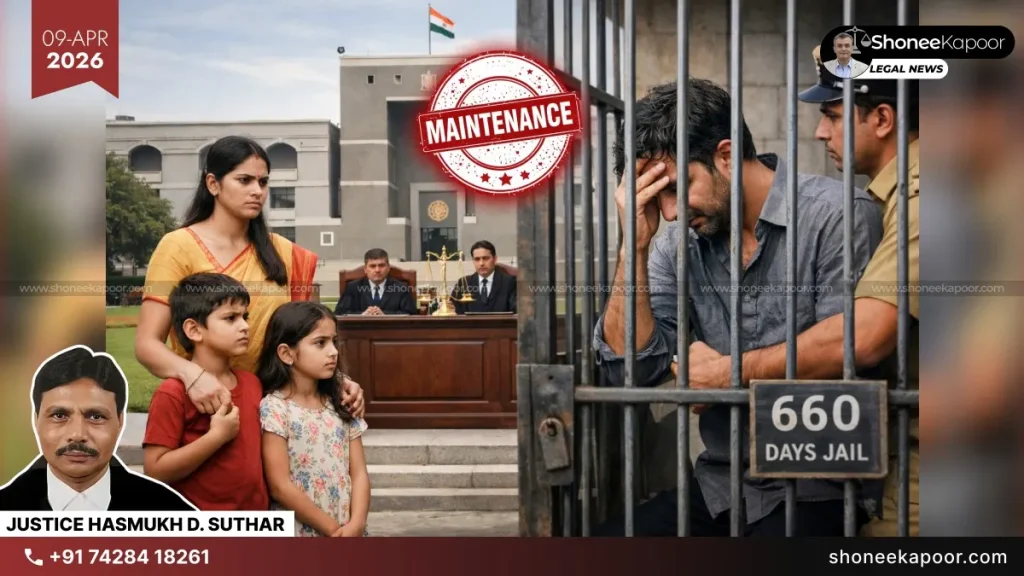
The Gujarat High Court refused to interfere with a 660-day sentence for maintenance default.
When inability to pay is openly acknowledged, does the law distinguish between financial incapacity and intentional neglect?
AHMEDABAD: The Gujarat High Court, in a judgment dated 06 April 2026, delivered by Justice Hasmukh D. Suthar, dismissed a husband’s revision plea and upheld a sentence of 660 days’ imprisonment for non-payment of maintenance, highlighting the strict approach adopted by courts in enforcing financial obligations on men.
The case arose from a Family Court order where the husband was directed to pay maintenance to his wife and children. Over time, the amount accumulated to around ₹3.97 lakh. When he failed to pay, recovery proceedings were initiated, leading to imprisonment.
The husband argued that his wife had left the matrimonial home and that he had tried to maintain the relationship. However, after the separation, the wife sought maintenance, which was granted. His continued default led to legal consequences.
A crucial aspect of this case is that the husband himself appeared before the Family Court and admitted his inability to pay. He clearly stated that he had no property and was not in a position to clear the dues. Despite this, he did not seek time and voluntarily surrendered, fully aware of the consequences.
The Court recorded that he admitted he had to pay maintenance of Rs. 3,97,000/- to his wife and children, and further admitted that he had received the notice but was unable to make the payment as he did not possess any movable or immovable property. The record also reflects that he stated he was unable to maintain the respondents and was not ready and willing to pay the said amount.
Despite this admission of financial incapacity, the Family Court imposed a sentence of 10 days’ simple imprisonment for each month of default. Since the default extended to 66 months, the total imprisonment came to 660 days.
While examining the case, the High Court found no fault in this approach and observed that:
“The sentence of ten days for each month of default cannot be said to be disproportionate.”
It also noted that the husband had voluntarily surrendered and accepted the consequences.
The Court took a strict view on the issue of maintenance and reiterated that:
“The husband cannot escape from his liability to maintain his wife or children because it is the legal and ethical duty of the husband to maintain them.”
The Court further added that:
“The wife and children would be entitled to the same standard of living, which they were enjoying while living with them”
Reinforcing the principle that maintenance is not merely subsistence but a right tied to prior living conditions.
This judgment highlights that mere inability to pay does not shield a man from imprisonment. Even after clearly stating that he had no financial capacity, the legal system proceeded with incarceration, raising questions about whether such enforcement becomes punitive rather than corrective.
The High Court ultimately held that there was no legal error or miscarriage of justice in the Family Court’s order, stating that the husband failed to show any grounds for interference. As a result, the revision application was dismissed and the sentence upheld.
Explanatory Table: Laws & Provisions Involved
| Law / Provision | Purpose | How Applied In This Case |
| Section 125 CrPC | Provides maintenance to wife, children, and parents if neglected | Wife and children were granted monthly maintenance |
| Section 125(3) CrPC | Enforcement of maintenance orders, including imprisonment for default | Used to recover arrears and impose 660 days imprisonment |
| Criminal Revision Jurisdiction | Allows High Court to review lower court orders for legality | Husband filed revision, but Court found no error |
| Supreme Court Judgment: Bhuwan Mohan Singh vs Meena (2015) | Establishes maintenance as a legal and moral duty | Relied upon to reinforce husband’s obligation |
| Supreme Court Judgment: Amit Kapoor vs Ramesh Chander (2012) | Defines scope of revision powers | Used to deny interference in Family Court order |
| Taj Mohammad vs State of UP (2023) | Allows court to decide even if applicant absent | High Court proceeded despite absence of husband |
Case Details
- Case Title: Jitendrakumar Ambalal Kondi vs State of Gujarat & Ors.
- Court: Gujarat High Court at Ahmedabad
- Case No.: Criminal Revision Application No. 624 of 2014
- Bench: Honourable Mr. Justice Hasmukh D. Suthar
- Neutral Citation: 2026:GUJHC:24201
- Date of Judgment: 06/04/2026
- Counsels:
- For Applicant: Advocate Notice Served
- For Respondents: Belaben M. Nayak, and Mr. Bhunesh C. Rupera
- For State: Ms. Shruti Pathak, APP
Key Takeaways
- Admission of inability to pay does not protect a man from imprisonment in maintenance cases.
- Courts treat maintenance as an absolute legal duty, regardless of the husband’s financial condition.
- Even voluntary surrender and honesty before the court can still result in long-term jail sentences.
- Enforcement under Section 125(3) CrPC can convert financial default into extended imprisonment.
- The system prioritizes entitlement of wife and children over assessing the man’s actual paying capacity.
This Could Change Your Case-Get FREE Legal Advice-Click Here!
Disclaimer: The views and opinions expressed in this article are those of the Indian courts and do not necessarily reflect the official policy or position of “ShoneeKapoor.com” or its affiliates. This article is intended for informational and educational purposes only. The content provided is not legal advice, and viewers should not act upon this information without seeking professional counsel. Viewer discretion is advised.