
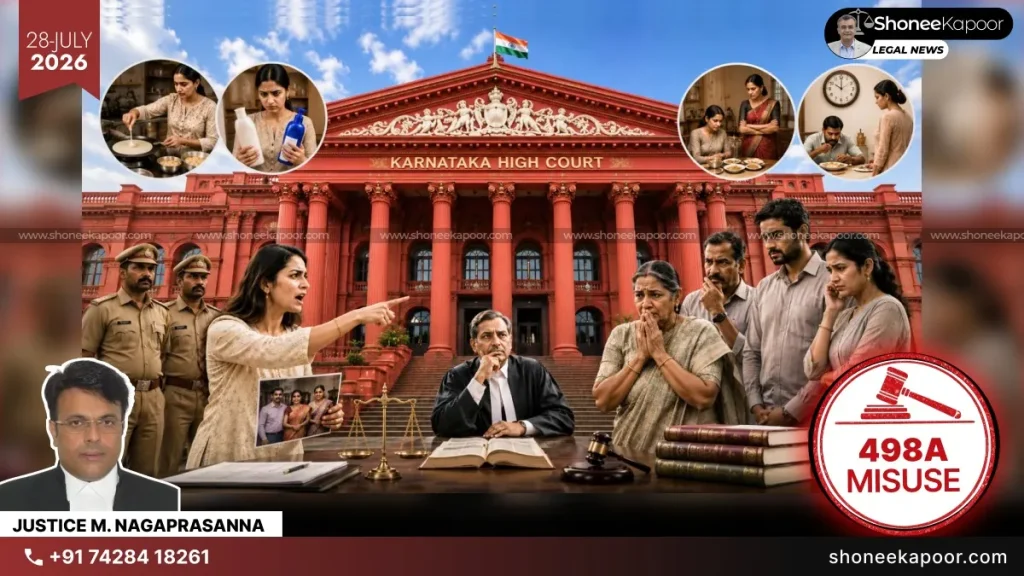
Can asking a wife to prepare dosa or ragi mudde, change her shampoo or wait until her husband finishes breakfast amount to criminal cruelty? The Karnataka High Court questioned whether ordinary household disputes were being converted into a Section 498A case against the husband’s relatives.
BENGALURU: The Karnataka High Court has questioned whether allegations relating to preparing dosa, making ragi mudde, changing shampoo, waiting for the husband to finish breakfast and suffering hair loss can legally amount to cruelty under Section 498A of the Indian Penal Code.
Justice M Nagaprasanna was hearing a petition filed by the mother-in-law and other relatives of the complainant seeking quashing of the criminal proceedings initiated against them.
The complainant, who is an advocate, appeared before the Court as a party-in-person and opposed the petition.
According to the complaint, the woman was subjected to physical and mental cruelty by her husband and in-laws. Her allegations included being asked to prepare dosa and ragi mudde, not receiving nutritious food and being made to wait until her husband completed his breakfast before she could eat.
She also alleged that the treatment at her matrimonial home caused serious hair loss and scalp-related problems.
While examining the allegations, the Court questioned whether such claims could satisfy the legal requirements of criminal cruelty under Section 498A IPC.
“Your hair loss, asking you to prepare dosa, asking you to prepare ragi ball, not giving you nutritious food – will that amount to harassment on demand of dowry or cruelty under Section 498A? … Mother-in-law asking you to make ragi ball for the husband is wrong? Hair loss is Section 498A?”
The Court also referred to the allegation that the husband had forced the complainant to change the brand of shampoo she used.
“‘He forced me to change my shampoo from Meera to Dove.’ What is this? All this nitty-gritty cannot become cruelty,”
During the hearing, Justice Nagaprasanna repeatedly asked the complainant to identify the specific acts that could legally justify criminal prosecution of the husband’s relatives.
“If you have an axe to grind, don’t project it as a 498A case. If you have really suffered something, please tell me. What is it that they have done against you?”
The complainant had further alleged that her mother-in-law required her to eat only after her husband had completed his breakfast.
According to her, the husband preferred hot dosas and usually finished eating at around 10 AM, after which she was permitted to have her food.
“‘I was asked not to eat until my husband ate and he preferred hot dosas. He would finish breakfast at 10 AM and only then I had my food.’ Can that be the ingredient of Section 498A? Is it not the kind of skirmishes that happen in a family?”
The Court orally observed that such allegations may be raised in divorce or matrimonial proceedings but may not automatically satisfy the stricter legal ingredients required for a criminal offence.
“All these allegations can be advanced in divorce proceedings. You cannot elevate them to the position of cruelty. All these nitty-gritty family issues cannot become matters of crime,”
The complainant maintained that she had suffered both physical and mental cruelty during the marriage.
She informed the Court that she possessed audio and video recordings which, according to her, supported the allegations made in the complaint.
She also referred to certain material allegedly produced by her husband before the family court.
The complainant alleged that she was not given nutritious food and was made to survive on “dosa, rice, soppu and dal every day” while other family members were allegedly provided better food.
She claimed that this treatment resulted in severe hair loss and scalp-related health issues.
The woman further alleged that her mother-in-law prevented her from entering the kitchen.
She also claimed that her salary was handed over to her husband, leaving her without independent access to her own income.
The complainant further alleged that her mother-in-law made the husband sleep separately, forcing her to remain confined to her own room.
According to the complainant, she stayed in the matrimonial home for about five-and-a-half months before leaving due to the alleged cruelty.
She also alleged that her in-laws questioned her character, publicly abused her and her family near her mother’s residence and spread allegations that she had run away with another man.
She claimed that these statements harmed her reputation and caused mental cruelty.
Advocate Manish Rao, appearing for the husband, informed the Court that the proceedings against the husband had already been withdrawn.
He clarified that the present petition concerned only the husband’s relatives, including his mother, two uncles and a friend.
After hearing the parties at length, the Karnataka High Court reserved its judgment.
EXPLANATORY TABLE OF LAWS AND SECTIONS
| LAW/SECTION | WHAT IT MEANS | RELEVANCE IN THIS CASE |
| Section 498A, Indian Penal Code, 1860 | It punished a husband or his relative for subjecting a married woman to legally defined cruelty. The provision covered grave wilful conduct and harassment connected with an unlawful demand for property or valuable security. | The criminal proceedings against the husband’s relatives were based on allegations of cruelty. The Court questioned whether complaints concerning food, shampoo, breakfast timings and hair loss satisfied the legal ingredients of this offence. |
| Explanation (a) to Section 498A IPC | It covered wilful conduct likely to drive a woman to suicide or cause grave injury or danger to her life, limb, mental health or physical health. | The Court examined whether the alleged household conduct was grave enough to meet this criminal threshold. |
| Explanation (b) to Section 498A IPC | It covered harassment intended to force a woman or her relatives to meet an unlawful demand for property or valuable security. | The Court specifically questioned whether the allegations were connected with any demand for dowry, property or valuable security. |
| Section 85, Bharatiya Nyaya Sanhita, 2023 | It is the present provision dealing with cruelty by a husband or his relatives against a married woman. It replaced Section 498A IPC under the new criminal law. | The report noted that Section 498A IPC has now been replaced by Section 85 BNS. The applicable law would depend on the date of the alleged acts and proceedings. |
| Section 86, Bharatiya Nyaya Sanhita, 2023 | It defines cruelty for the purpose of Section 85 BNS and broadly retains the earlier ingredients of Section 498A IPC. | The allegations must satisfy this legal definition before criminal prosecution can continue under the new law. |
| Section 482, Code of Criminal Procedure, 1973 | It gave the High Court inherent power to quash criminal proceedings to prevent abuse of the legal process and secure the ends of justice. | The husband’s relatives approached the High Court seeking quashing of the criminal proceedings. The exact provision invoked must be confirmed from the court order. |
| Section 528, Bharatiya Nagarik Suraksha Sanhita, 2023 | It is the corresponding provision under the new criminal procedure law preserving the inherent powers of the High Court. | Depending on the filing date, the quashing petition may fall under this provision. The actual petition or judgment is required for confirmation. |
| Matrimonial Cruelty In Divorce Proceedings | Conduct may amount to matrimonial cruelty for divorce even when it does not satisfy the stricter ingredients of a criminal offence. | The Court orally observed that the allegations could be raised in divorce proceedings but could not automatically be elevated into criminal cruelty. |
CASE DETAILS
| PARTICULAR | DETAIL |
| Case Title | Husband v. Wife |
| Court | Karnataka High Court |
| Presiding Judge / Bench | Justice M Nagaprasanna |
| Petitioners | Mother-in-law and other relatives of the complainant’s husband |
| Respondent / Complainant | Wife, appearing as party-in-person |
| Nature of Proceedings | Petition seeking quashing of criminal proceedings |
| Date of Hearing | 28 July 2026 |
| Status of Case | Judgment reserved |
COUNSELS APPEARED
| PARTY | COUNSEL |
| Husband | Mr. Manish Rao, Advocate |
| Complainant / Wife | Appeared in person as party-in-person |
KEY TAKEAWAYS
- Minor family disputes are not Section 498A cruelty — Food, household work or shampoo issues cannot automatically become crimes.
- Divorce complaints cannot become criminal cases by default — The legal standard for criminal cruelty is much higher.
- A husband’s whole family cannot be dragged in casually — Every accused relative must face specific and serious allegations.
- The process itself punishes men — Weak complaints can force husbands and their families into years of litigation.
- False or exaggerated cases harm genuine victims too — Routine marital friction should not be used as a criminal weapon.
This Could Change Your Case-Get FREE Legal Advice-Click Here!
Disclaimer: The views and opinions expressed in this article are those of the Indian courts and do not necessarily reflect the official policy or position of “ShoneeKapoor.com” or its affiliates. This article is intended for informational and educational purposes only. The content provided is not legal advice, and viewers should not act upon this information without seeking professional counsel. Viewer discretion is advised.