
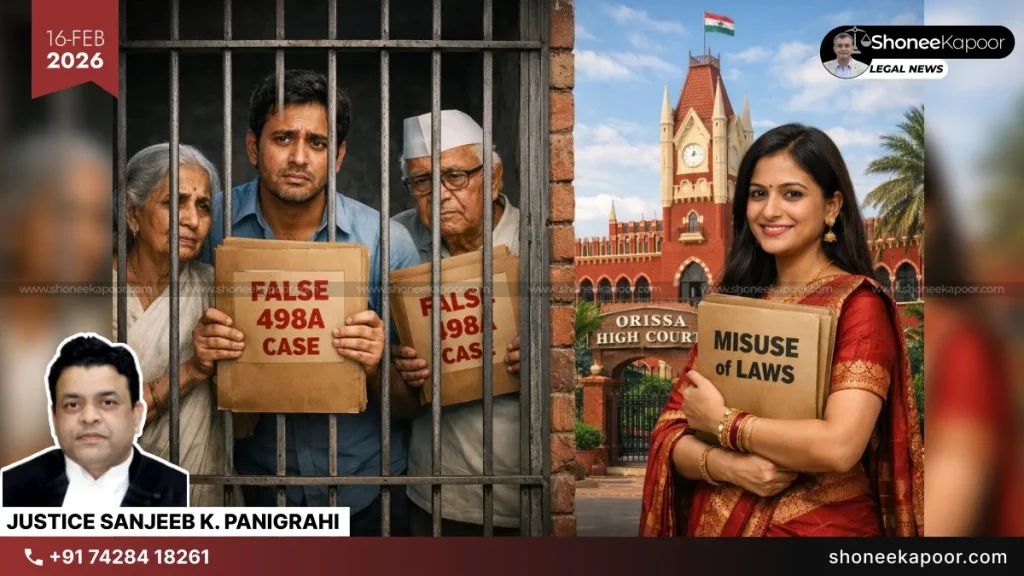
The Orissa High Court has quashed dowry harassment proceedings against the husband’s parents and sister, calling the allegations vague and unsupported. However, the husband will still face trial, even as the Court flagged concerns about misuse and over-implication in matrimonial disputes.
498A Misuse By Wife: The High Court of Orissa presided over by Dr. Justice Sanjeeb K. Panigrahi, delivered a significant judgment arising out of a matrimonial dispute between husband and his wife. The case involved a criminal FIR under Section 498A IPC and related provisions, along with a connected Domestic Violence case.
The marriage was solemnised on 07.07.2021 and later registered on 10.08.2021. Due to professional commitments, the couple lived in Mumbai and Pune. It was not disputed before the Court that the husband’s parents and sister were permanent residents of Delhi and never lived in the matrimonial home.
On 04.12.2023, the wife left the matrimonial home. On 19.01.2024, the husband filed a divorce petition before the Family Court at Pune. Thereafter, on 12.03.2024, the wife lodged FIR No.202/2024 at Chandrasekharpur Police Station, Bhubaneswar under Sections 294, 323, 498A, 406, 506 read with 34 IPC and Section 4 of the Dowry Prohibition Act.
The husband contended that the FIR was filed as a counterblast to the divorce case and that his parents and sister were falsely implicated to create pressure. The Court noted that the timeline raised concerns because the FIR came after the divorce petition. Though the Court clarified that delay alone does not destroy a case, it also observed that the sequence of events cannot be completely ignored.
While examining the scope of quashing under Section 482 CrPC, the Court relied on the Supreme Court judgment in Central Bureau of Investigation v. Aryan Singh and reproduced the following:
“As per the cardinal principle of law, at the stage of discharge and/or quashing of the criminal proceedings, while exercising the powers under Section 482 Cr.P.C., the Court is not required to conduct the mini trial. The High Court in the common impugned judgment and order has observed that the charges against the accused are not proved.
Read Also: Can Husband Record Wife Threats Legally in India? Supreme Court’s Answer Every Married Man Must KnowThis is not the stage where the prosecution / investigating agency is/are required to prove the charges.
The charges are required to be proved during the trial on the basis of the evidence led by the prosecution / investigating agency. Therefore, the High Court has materially erred in going in detail in the allegations and the material collected during the course of the investigation against the accused, at this stage.
At the stage of discharge and/or while exercising the powers under Section 482 Cr.P.C., the Court has a very limited jurisdiction and is required to consider whether any sufficient material is available to proceed further against the accused for which the accused is required to be tried or not.”
The Court also referred to Arnesh Kumar v. State of Bihar and reproduced this important observation:
“4. There is a phenomenal increase in matrimonial disputes in recent years. The institution of marriage is greatly revered in this country. Section 498-A IPC was introduced with avowed object to combat the menace of harassment to a woman at the hands of her husband and his relatives.
The fact that Section 498-A IPC is a cognizable and non-bailable offence has lent it a dubious place of pride amongst the provisions that are used as weapons rather than shield by disgruntled wives.
The simplest way to harass is to get the husband and his relatives arrested under this provision. In a quite number of cases, bed- ridden grand- fathers and grand-mothers of the husbands, their sisters living abroad for decades are arrested.”
The Court made it clear that it was not deciding guilt or innocence. However, it stressed that courts must be cautious when entire families are implicated without clear and specific roles.
After examining the FIR and charge-sheet, the Court found that there were certain specific allegations against the husband relating to quarrels, alleged abuse and dowry-related disputes. Therefore, at this preliminary stage, the Court held that a prima facie case existed against him. As a result, the proceedings against the husband were not quashed and will continue to trial, where evidence will be tested.
However, the position of the parents-in-law and sister-in-law was entirely different. They were living in Delhi and had no day-to-day connection with the couple’s matrimonial life. No specific incident, date or overt act was attributed to them. The FIR only contained a broad statement that “all the accused harassed her and demanded dowry”.
The High Court relied on Kahkashan Kausar @ Sonam v. State of Bihar and quoted:
“18. The above-mentioned decisions clearly demonstrate that this court has at numerous instances expressed concern over the misuse of section 498A IPC and the increased tendency of implicating relatives of the husband in matrimonial disputes, without analysing the long term ramifications of a trial on the complainant as well as the accused.
It is further manifest from the said judgments that false implication by way of general omnibus allegations made in the course of matrimonial dispute, if left unchecked would result in misuse of the process of law. Therefore, this court by way of its judgments has warned the courts from proceeding against the relatives and in-laws of the husband when no prima facie case is made out against them.”
The Court observed that allowing distant relatives to face criminal trial on vague and general allegations would amount to harassment and abuse of the legal process. It therefore quashed the proceedings against Petitioners No.2, 3 and 4, namely the parents-in-law and sister-in-law. This meant that they were relieved from the burden of a full criminal trial, which otherwise could have caused severe social, emotional and legal hardship despite lack of specific accusations.
In the connected Domestic Violence case (CMC No.432/2024), the wife had sought to recall herself as PW-1 to introduce additional documents after both sides had already closed their evidence and the matter was listed for final arguments. The trial court rejected this request.
The High Court referred to Rajaram Prasad Yadav v. State of Bihar and observed:
“Section 311 should not be allowed to degenerate into a tool for protracting trials or permitting afterthoughts to prevail, especially when the request comes at a very advanced stage of trial without adequate explanation.”
The High Court found that the wife had full opportunity earlier to produce documents but chose to close her evidence. The attempt to reopen the case at the final stage appeared to be an effort to fill gaps after realising weaknesses. The Court therefore upheld the trial court’s order and dismissed her petition, directing speedy disposal of the DV case.
In the final result, the High Court partly allowed the husband’s petition. The criminal case was quashed against his parents and sister, recognising that vague and sweeping allegations cannot justify dragging an entire family into criminal prosecution. However, the husband will face trial where evidence will be examined in accordance with law. The wife’s challenge in the Domestic Violence case was rejected.
Explanatory Table of All Laws and Sections Mentioned
| Law / Statute | Section | What It Deals With | How It Applied in This Case |
| Indian Penal Code (IPC) | Section 294 | Obscene acts and songs in public | Alleged abusive conduct by husband |
| IPC | Section 323 | Voluntarily causing hurt | Allegations of physical assault |
| IPC | Section 498A | Cruelty by husband or relatives | Core allegation of dowry harassment |
| IPC | Section 406 | Criminal breach of trust | Alleged retention of streedhan |
| IPC | Section 506 | Criminal intimidation | Alleged threats over dowry issues |
| IPC | Section 34 | Common intention | To implicate multiple accused jointly |
| Dowry Prohibition Act, 1961 | Section 4 | Penalty for demanding dowry | Alleged unlawful monetary demands |
| Code of Criminal Procedure, 1973 | Section 482 | Inherent powers of High Court | Used for quashing FIR/charge-sheet |
| Bharatiya Nagarik Suraksha Sanhita, 2023 | Section 528 | Inherent jurisdiction equivalent | Invoked along with Section 482 CrPC |
| CrPC | Section 311 | Power to summon/recall witness | Wife sought recall to introduce documents |
| BNSS | Section 348 | Corresponding recall provision | Referenced in DV proceeding |
| Protection of Women from Domestic Violence Act, 2005 | Section 28 | Procedure under DV Act | Governs procedural framework |
| Indian Evidence Act, 1872 | Section 138 | Examination of witnesses | Relevant to recall stage |
| Hindu Marriage Act, 1955 | — | Registration of marriage | Marriage registered under this Act |
Key Precedents Relied Upon
| Case Name | Citation | Principle Applied |
| State of Haryana v. Bhajan Lal | 1992 Supp (1) SCC 335 | Grounds for quashing FIR |
| Central Bureau of Investigation v. Aryan Singh | 2023 SCC OnLine SC 379 | No mini-trial at quashing stage |
| Arnesh Kumar v. State of Bihar | (2014) 8 SCC 273 | Misuse of Section 498A caution |
| Kahkashan Kausar @ Sonam v. State of Bihar | (2022) 6 SCC 599 | Vague omnibus allegations against in-laws |
| Preeti Gupta v. State of Jharkhand | (2010) 7 SCC 667 | Over-implication of husband’s family |
| Geeta Mehrotra v. State of U.P. | (2012) 10 SCC 741 | Quashing against distant relatives |
| Rajaram Prasad Yadav v. State of Bihar | (2013) 14 SCC 461 | Limits of recall under Section 311 |
Case Details
- Case Title: Anurag Sethi & Ors. v. State of Odisha & Anr. (Connected with Barsha Priyadarshini v. State of Odisha & Anr.)
- Case Numbers: CRLMC No. 3352 of 2025, Along with CRLMC No. 4690 of 2025
- Court: High Court of Orissa at Cuttack
- Bench (Coram): Dr. Justice Sanjeeb K. Panigrahi
- Date of Hearing: 28.01.2026
- Date of Judgment: 13.02.2026
Counsel Details
- For Petitioners (CRLMC No. 3352 of 2025): Mr. Rakesh Kailash Sharma, Advocate
- Legal Consultant for Husband & Family: Mr. Shonee Kapoor, Men’s Rights Activist.
- For Opposite Party No.1 (State): Mr. U.R. Jena, AGA
- For Opposite Party No.2 (Wife): Ms. Ayushi Mehta, Advocate & Mr. D.P. Singh, Advocate
- For Petitioner (CRLMC No. 4690 of 2025 – Wife): Mr. Merusagar Samantray, Advocate & Ms. Ayushi Mehta, Advocate
- For Opposite Parties 2 to 5 in connected matter: Mr. Rakesh Kailash Sharma, Advocate
Key Takeaways
- Entire Family Targeted Without Specific Allegations
The wife named parents and sister living in Delhi without mentioning any clear act, date or role. This shows how entire families are often dragged in to create pressure. - FIR Filed After Divorce Was Initiated
The complaint came only after the husband filed for divorce. The timing raises serious questions about retaliatory use of criminal law. - Court Called It “Sheer Harassment”
The High Court held that prosecuting distant relatives on vague allegations would amount to “sheer harassment,” recognising the trauma caused to innocent family members. - 498A Cannot Be Used as Pressure Tactic
The judgment reinforces that criminal provisions cannot be misused to rope in every relative just to strengthen bargaining power. - Late Evidence Move Rejected
The wife tried to reopen her evidence at the final stage of the DV case. The Court refused, stopping an attempt to fill gaps after realising weaknesses in the case
This Could Change Your Case-Get FREE Legal Advice-Click Here!
Disclaimer: The views and opinions expressed in this article are those of the Indian courts and do not necessarily reflect the official policy or position of “ShoneeKapoor.com” or its affiliates. This article is intended for informational and educational purposes only. The content provided is not legal advice, and viewers should not act upon this information without seeking professional counsel. Viewer discretion is advised.