
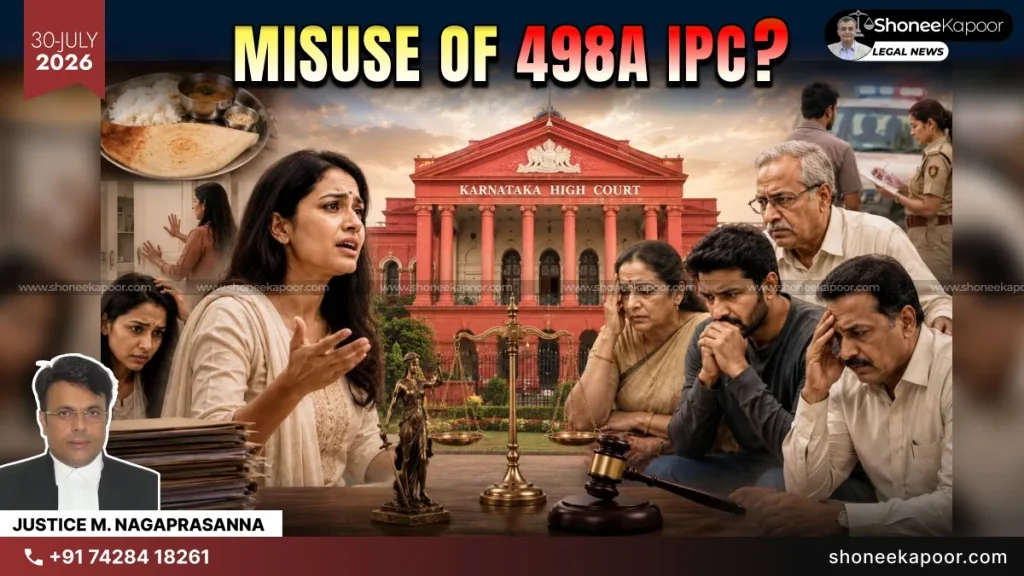
Can allegations of being served only dosa, rice and dal, resulting in alleged hair loss, expose a husband and his relatives to a criminal cruelty case?The Karnataka High Court questioned 498A Case filed Against Husband’s Family
BENGALURU: The Karnataka High Court has questioned whether allegations that a wife was denied nutritious food and suffered hair loss could legally amount to cruelty under Section 498A of the Indian Penal Code.
Justice M. Nagaprasanna was hearing a petition filed by four members of the husband’s family seeking the quashing of an FIR. The petitioners included the husband’s mother, father, brother and uncle.
The FIR was registered for offences under Sections 352 and 85 of the Bharatiya Nyaya Sanhita, 2023, read with Sections 3 and 4 of the Dowry Prohibition Act, 1961.
While examining whether the complaint contained the legal ingredients of cruelty, the Court orally remarked:
“…Hair loss, that’s 498A?… Isn’t that skirmishes that happen in a family?… all viscosities in a family cannot become matters of 498A.. Cruelty in view of the complaint is not cruelty. Cruelty in the eyes of the law is cruelty. You can’t bring in any grievance and elevate it to the offence of cruelty.”
The complaint was filed by the wife, who appeared before the Court as a party-in-person. She alleged that her husband and his family had subjected her to physical and mental cruelty.
One of her principal allegations was that she was not given rich or nutritious food. According to her, she was made to eat simple meals such as dosa, rice and dal every day, which allegedly caused her hair to fall.
She also claimed that her mother-in-law did not permit her to enter the kitchen. The wife alleged that her mother-in-law mocked her hair loss and suggested that she could be suffering from an illness.
At the beginning of the hearing, the Court attempted to understand the nature of the allegations and asked:
“Toxic mother-in-law?”
Justice Nagaprasanna then read portions of the complaint concerning the family’s food routine and observed:
“…He [Husband] prefers hot dosa. He will finish breakfast by 10 AM. Then I was supposed to eat… What is this…mother-in-law asking you to make raggi balls to the husband?”
The complainant clarified that her grievance was not merely about being asked to prepare food. She submitted:
“…The allegation is not that I was asked to make…I was not given rich and nutritious food…Just dosa, rice and dal everyday…I had hair loss milord.”
The wife further alleged that, at the insistence of her mother-in-law, her salary was handed over to her husband and no money remained in her own bank account.
She also alleged that she was confined to her room and prevented from entering the kitchen.
However, the Court repeatedly questioned whether these allegations, even when taken at face value, satisfied the legal definition of cruelty under Section 498A IPC.
The hearing brought attention to an important legal distinction. Every disagreement, unpleasant domestic experience or dispute over food inside a matrimonial home cannot automatically become a criminal offence. Cruelty under criminal law must fulfil specific legal ingredients and cannot rest only on a complainant’s personal understanding of cruelty.
The Court also examined another allegation relating to the husband allegedly asking the wife to change the brand of shampoo she used. Referring to the complaint, the Court remarked:
“He[husband] forced me to change my shampoo from Meera to Dove[reads from the complaint] …can this be…? Will that amount to harassment on demand of dowry or cruelty under 498A? All that is in the divorce proceedings, you can”
The complainant maintained that the dispute involved more than food and hair loss. She alleged that her in-laws had defamed her by presenting her as a woman who had deserted the matrimonial home and was of unsound mind.
She further claimed that the petitioners had misled the Court. According to her, she possessed audio and video recordings, some of which had already been placed by the husband before the Family Court.
The case was still at the FIR stage, and the investigating agency had not filed a chargesheet.
The High Court reserved its order on the family members’ petition seeking quashing of the FIR. It directed that the interim protection earlier granted to the petitioners would continue until the next date of hearing.
The Court has not yet delivered its final ruling on whether the allegations or the FIR should be quashed. It has also not finally determined whether the complainant’s allegations are true or false.
EXPLANATORY TABLE OF LAWS AND SECTION
| Law / Section | What It Means | Relevance in This Case |
| Section 498A, Indian Penal Code, 1860 | It punished cruelty by a husband or his relatives against a married woman. Cruelty included serious conduct likely to endanger her life or health, or harassment connected with an unlawful demand for property or valuable security. | The Court examined whether complaints about simple food, alleged hair loss and household disputes met the legal test of cruelty. |
| Section 85, Bharatiya Nyaya Sanhita, 2023 | It criminalises cruelty by a husband or his relative against a married woman and replaces the earlier Section 498A IPC framework for applicable offences under the new criminal law. | The FIR against the petitioners included Section 85 BNS. |
| Section 86, Bharatiya Nyaya Sanhita, 2023 | It defines cruelty for the purpose of Section 85, including grave wilful conduct and harassment linked to unlawful demands. | Although not expressly stated in the supplied case description as an invoked section, its definition is relevant when determining whether the allegations legally constitute cruelty under Section 85. |
| Section 352, Bharatiya Nyaya Sanhita, 2023 | It punishes intentional insult intended or likely to provoke a breach of peace or the commission of another offence. | The FIR was stated to have been registered under this provision along with Section 85 BNS. |
| Section 3, Dowry Prohibition Act, 1961 | It provides punishment for giving, taking or abetting the giving or taking of dowry. | The FIR invoked this section, though the Court questioned whether the allegations discussed during the hearing disclosed dowry-related cruelty. |
| Section 4, Dowry Prohibition Act, 1961 | It punishes a person for directly or indirectly demanding dowry. | The petitioners faced this provision as part of the FIR sought to be quashed. |
| Quashing of FIR | A High Court may quash criminal proceedings where the allegations do not disclose an offence, the legal ingredients are absent or continuing the case would amount to abuse of process. | The husband’s four relatives approached the High Court seeking quashing of the FIR against them. |
| Interim Protection | It is temporary protection granted by a court until the matter is finally or further considered. | The Court continued the interim protection already granted to the petitioners until the next hearing. |
| FIR Stage | At this stage, allegations are under investigation and have not yet resulted in a chargesheet or findings of guilt. | The Court noted that no chargesheet had been filed and reserved its order on the quashing petition. |
CASE DETAILS
| Particular | Details |
| Case Title | Esther Vedamani & Ors. v. State of Karnataka & Anr. |
| Case Number | Crl.P. No. 8190/2025 |
| Court | High Court of Karnataka |
| Bench | Justice M. Nagaprasanna |
| Petitioners | Husband’s mother, father, brother and uncle |
| Nature of Petition | Petition seeking quashing of the FIR |
| Petitioners’ Counsel | Advocate Ankith S. Reddy |
| Complainant-Wife | Appeared as party-in-person |
| State’s Counsel | Special Public Prosecutor; name not provided in the supplied material |
KEY TAKEAWAYS
- Every grievance is not cruelty: Complaints about ordinary food do not automatically make a Section 498A case.
- Entire families get dragged in: The husband’s parents, brother and uncle were forced into criminal proceedings.
- Family disputes should not become FIRs: Food, kitchen and hair-loss complaints cannot casually be treated as dowry cruelty.
- The legal process becomes punishment: Accused men and their families suffer stigma, expenses and years of litigation before guilt is proved.
- Courts must filter vague allegations: Genuine cruelty must be punished, but exaggerated complaints should not criminalise innocent families.
This Could Change Your Case-Get FREE Legal Advice-Click Here!
Disclaimer: The views and opinions expressed in this article are those of the Indian courts and do not necessarily reflect the official policy or position of “ShoneeKapoor.com” or its affiliates. This article is intended for informational and educational purposes only. The content provided is not legal advice, and viewers should not act upon this information without seeking professional counsel. Viewer discretion is advised.