
Does marital breakdown automatically make husband’s relatives criminally liable?
The Supreme Court held that mere familial association with the husband or failure to support the wife during matrimonial disputes does not by itself amount to criminal liability under Section 498A IPC.
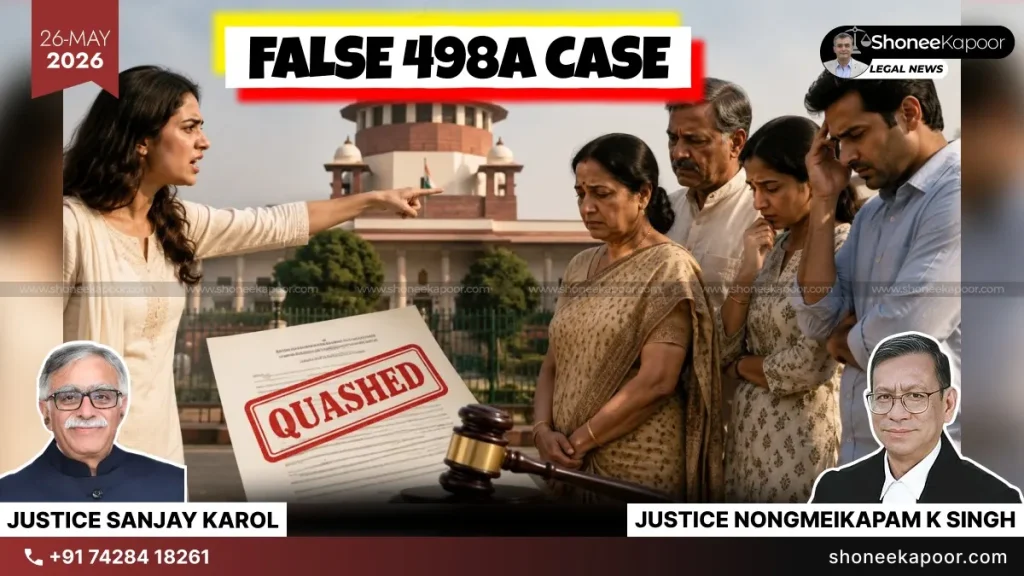
NEW DELHI: In a judgment dated May 25, 2026, Justice Nongmeikapam Kotiswar Singh and Justice Sanjay Karol of the Supreme Court quashed criminal proceedings initiated against a husband’s relatives under Section 498A IPC, Dowry Prohibition Act and the Domestic Violence Act after finding that the allegations against them were vague, general and unsupported by specific incidents.
The dispute arose out of a failed marriage, which later turned into multiple criminal and matrimonial cases. The wife alleged that huge dowry was given during marriage and that after some months, she was harassed for additional money. She claimed that she was mentally and physically tortured and was repeatedly told to bring money from her parental home.
Apart from the husband, cases were also filed against several relatives including the mother-in-law, sister-in-law, brother-in-law and wife of the brother-in-law. The High Court had earlier refused to quash the proceedings against them, after which the matter reached the Supreme Court.
While examining the case, the Supreme Court carefully studied the FIR, Domestic Violence complaint and the divorce pleadings filed by the wife herself. The Court noticed that most detailed allegations were actually against the husband alone.
The wife had accused the husband of abusing her, assaulting her, threatening her, locking her room, placing hidden cameras and neglecting her emotionally. However, when it came to the relatives, the allegations remained broad and repetitive without mentioning any exact incident or individual act.
The Court found that there were no clear allegations explaining which relative demanded dowry, when any specific incident took place or what exact role each accused person played.
The Supreme Court also noticed that the wife herself admitted in her divorce petition that she was mainly residing with her husband in his government accommodation at Sheopur and not continuously with the in-laws. This weakened the allegations that the relatives were constantly involved in harassment.
The Bench observed that in matrimonial disputes, entire families are often unnecessarily dragged into criminal litigation because of emotional breakdown of marriage and personal bitterness.
The Court observed:
“It is a matter of common judicial experience that matrimonial disputes are often accompanied by heightened emotions, strained relationships and deep-seated personal grievances.”
The Supreme Court further stated:
“Quite often, family members who may have remained passive spectators, failed to intervene, or merely sided with one party in a domestic disagreement, are also arrayed as accused.”
The Court warned that criminal law cannot be casually used against every family member without clear evidence of direct involvement. The judgment stated:
“Criminal law cannot be permitted to be set in motion against every relative of the husband merely on the basis of generalised and omnibus allegations lacking a specific factual foundation.”
The Bench further clarified:
“Mere familial association with the husband, or failure to support the complainant in a marital dispute, cannot by itself constitute a criminal offence in the absence of specific allegations disclosing active participation in acts amounting to cruelty, harassment or unlawful demand of dowry.”
The Supreme Court also reiterated that even after the filing of a charge-sheet, courts still have the power to quash criminal proceedings where no prima facie offence is made out and continuation of the case would amount to abuse of process of law.
After examining the entire material on record, the Supreme Court concluded that the allegations against the husband’s relatives were vague, omnibus and lacked specific details necessary for criminal prosecution.
Accordingly, the criminal proceedings against the relatives were quashed by the Supreme Court.
Explanatory Table: Laws & Sections Involved
| Law / Section | Purpose | How Applied In This Case |
| Section 498A IPC | Punishes cruelty, harassment and dowry-related abuse by husband or his relatives against a married woman | FIR was registered alleging mental and physical cruelty, dowry demands and harassment by husband and his family members |
| Section 34 IPC | Creates joint criminal liability where several persons act with common intention | Applied along with Section 498A IPC to allege that all accused family members acted together in harassing the complainant |
| Section 3, Dowry Prohibition Act, 1961 | Punishes giving or taking dowry | Wife alleged that huge dowry in cash, jewellery and household items was given during marriage |
| Section 4, Dowry Prohibition Act, 1961 | Punishes demanding dowry directly or indirectly | Wife alleged that husband and relatives repeatedly demanded additional money from her parental home |
| Section 12, Protection of Women from Domestic Violence Act, 2005 | Allows an aggrieved woman to approach Magistrate seeking protection, residence, maintenance and other reliefs | Wife filed Domestic Violence proceedings against husband and relatives alleging mental and physical abuse |
| Section 31, Domestic Violence Act | Punishes breach of protection orders passed under the DV Act | Mentioned by the High Court while discussing penal consequences under the DV Act |
| Section 2(q), Domestic Violence Act | Defines who can be treated as “respondent” in DV proceedings | High Court held that even female relatives of husband could be made respondents under DV proceedings |
| Section 2(f), Domestic Violence Act | Defines “domestic relationship” between parties living together in shared household | Supreme Court examined whether wife had domestic relationship with relatives who were residing separately |
| Section 2(s), Domestic Violence Act | Defines “shared household” under the DV Act | Court analysed whether wife was continuously living with in-laws or mainly residing with husband at Sheopur |
| Section 482 CrPC | Gives inherent powers to High Courts to quash criminal proceedings to prevent abuse of law | Relatives approached High Court and later Supreme Court seeking quashing of FIR and DV proceedings |
| Section 156(1) CrPC | Empowers police to investigate cognizable offences | Discussed in Bhajan Lal principles regarding validity of investigation |
| Section 155(2) CrPC | Requires Magistrate’s permission for investigation into non-cognizable offences | Referred to in Supreme Court discussion of quashing principles from Bhajan Lal case |
| Section 9, Hindu Marriage Act, 1955 | Remedy for restitution of conjugal rights between spouses | Husband had earlier filed proceedings seeking restoration of matrimonial relationship |
| Article 136, Constitution of India | Gives Supreme Court discretionary appellate powers | Supreme Court exercised jurisdiction to examine legality of continuation of criminal proceedings |
| Sections 3 & 4 IPC/Dowry Act combined allegations | Concern dowry demand and cruelty allegations | Court found allegations against relatives were omnibus and lacked specific overt acts |
Case Details
- Case Title: Arti Mehta & Ors. v. State of Madhya Pradesh & Anr.
- Court: Supreme Court of India
- Bench: Justice Nongmeikapam Kotiswar Singh | Justice Sanjay Karol
- Case Numbers:
- Criminal Appeal arising out of SLP (Criminal) No. 18345 of 2024
- Connected Criminal arising out of SLP (Criminal) No. 1234 of 2025
- Date Of Judgment: 25 May 2026
- Neutral Citation: 2026 INSC 533
- Police Case Details:
- FIR/Crime No. 0041/2023
- Police Station Guna, District Guna, Madhya Pradesh
- DV Case Details:
- D.V. Complaint No. 1752/2023 pending before Judicial Magistrate First Class, Guna
Key Takeaways
- Entire families cannot be treated as criminals merely because a marriage has broken down and allegations have been made against the husband.
- General, emotional and repetitive accusations without specific incidents, dates or roles should never be enough to destroy someone’s life through criminal prosecution.
- Supporting a family member during a matrimonial dispute does not automatically make parents, sisters or relatives guilty of cruelty or dowry harassment.
- Criminal law should protect genuine victims, not become a pressure tactic to drag every relative into years of police cases and court battles.
- Innocent family members also deserve protection from misuse of matrimonial laws, especially when allegations are vague, omnibus and unsupported by evidence.
This Could Change Your Case-Get FREE Legal Advice-Click Here!
Disclaimer: The views and opinions expressed in this article are those of the Indian courts and do not necessarily reflect the official policy or position of “ShoneeKapoor.com” or its affiliates. This article is intended for informational and educational purposes only. The content provided is not legal advice, and viewers should not act upon this information without seeking professional counsel. Viewer discretion is advised.