
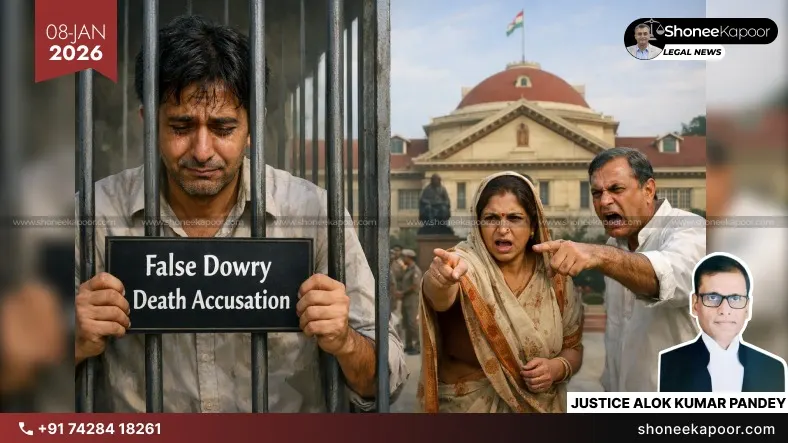
Patna High Court Clears Husband in Abetment of Suicide Case: Mere Allegations Not Enough Under Section 306 IPC

Written and analysed by Vaibhav Ojha
Head Of Legal CommunicationsThe Patna High Court ruled that without a clear act of instigation or intentional aid, a husband cannot be convicted for abetment of suicide under Section 306 IPC. Justice Alok Kumar Pandey set aside the conviction, reaffirming that criminal liability cannot rest on assumptions, emotions, or shifting allegations alone.
BIHAR: The Patna High Court recently examined whether a husband can be held criminally liable for abetment of suicide merely on the basis of family disagreements, inconsistent statements and emotional assumptions, without any direct proof of instigation or cruelty.
The Court analysed the entire trial record, medical evidence and witness testimony to determine whether the legal requirements of Section 306 of the Indian Penal Code were actually satisfied.
The case originated from a written statement on the basis of which an FIR was registered under Sections 304(B)/34 IPC. After investigation, a charge-sheet was filed under Section 304(B) IPC and charges were framed under Sections 304(B)/34 and 302/34 IPC.
During trial, four prosecution witnesses were examined, including the doctor who conducted the post-mortem, the informant father, one independent witness and the Investigating Officer. No defence evidence was produced and the accused denied all allegations in his statement under Section 313 CrPC.
The prosecution case was initially built on allegations of dowry-related disputes. Subsequently, the theory shifted to suggest that the deceased allegedly took the extreme step due to disagreements regarding livelihood. After trial, the court held that the prosecution failed to prove the charges of murder and dowry death and accordingly acquitted the accused under Sections 302 and 304(B) IPC. However, the trial court convicted the accused under Section 306 IPC for abetment of suicide.
Aggrieved by the conviction, the accused approached the High Court. It was argued that the conviction was illegal, based on assumptions and not supported by evidence. The defence submitted that no independent witness of the place of occurrence was examined. The doctor clearly stated that death was due to asphyxia caused by hanging. Even the informant admitted that villagers were saying the deceased had hanged herself.
It was further highlighted that no prior complaint of dowry demand or cruelty was ever made and the informant himself admitted that no dowry was demanded at the time of marriage. The Investigating Officer also admitted that there was no external injury on the body of the deceased. It was argued that no witness stated that the deceased was instigated to commit suicide and no suicide note existed. The defence further stated that the deceased was upset because the husband did not want to go outside for earning and during that period she allegedly took the extreme step on her own.
On the other hand, the State argued that the Investigating Officer had stated that the husband was not willing to go outside for livelihood despite repeated requests of the deceased, and that this circumstance was sufficient for the trial court to infer abetment.
The High Court framed the core issue for determination as:
“Whether the appellant has committed the offence punishable under Section 306 of the IPC in the light of given facts and circumstances of the case or not?”
While examining the evidence, the Court noted that the medical testimony clearly established death due to hanging. There was no external injury on the body of the deceased and no material suggesting homicide. Even the Investigating Officer admitted that the cause of death was hanging and not assault.
The Court observed that no clear act of instigation was attributed to the accused. There was no evidence to show that the deceased had been placed in such a situation where she had no other option except to commit suicide. Mere domestic disagreement or difference of opinion regarding livelihood cannot automatically amount to abetment under law.
The High Court specifically noted that no witness stated that the deceased was instigated, provoked or intentionally aided to commit suicide. There was no suicide note. Another prosecution witness stated that the deceased never raised any grievance against her husband and that the couple had discussed going outside for work. This evidence directly contradicted the prosecution theory of cruelty or sustained harassment.
The Investigating Officer admitted that the death occurred due to hanging and there was no external injury. The medical evidence fully supported the theory of suicide and not homicide. There was no material on record to show any intentional aid, instigation or conspiracy by the husband.
The trial court had relied upon the statement of the Investigating Officer that the husband was unwilling to go outside for earning despite the request of the deceased and inferred abetment from this circumstance. The High Court rejected this reasoning and held that refusal to migrate for livelihood, even if it caused emotional distress, cannot by itself constitute abetment of suicide in the absence of intention or instigation.
The High Court reiterated that for Section 306 IPC, the prosecution must establish a direct and proximate nexus between the conduct of the accused and the act of suicide. Mere suspicion, emotional disturbance, family disagreement or economic issues cannot automatically convert into criminal liability for abetment.
Reaffirming settled legal principles, the Court emphasized that abetment under Section 306 IPC requires a clear and proximate act of instigation, conspiracy or intentional aid. Mechanical attribution of criminal liability based on emotional narratives cannot be sustained in law.
The Court concluded that the prosecution failed to establish the essential ingredients of Section 306 IPC beyond reasonable doubt. The conviction was found to be based on conjectures and surmises rather than legally admissible proof. The judgment reinforces a vital safeguard in criminal law that suicide by itself does not automatically create criminal liability and courts must strictly scrutinize evidence before sustaining a conviction for abetment.
Explanatory Table – Laws & Sections Involved
| Law / Code & Section | Purpose | Applicability in This Case |
| Section 306 IPC | Punishment for abetment of suicide | Trial court convicted the accused; High Court examined whether there was any instigation, aid, or intentional conduct and found evidence lacking. |
| Section 304(B) IPC | Dowry death | FIR and charge-sheet were initially under this section; trial court held dowry cruelty was not proved and acquitted the accused. |
| Section 302 IPC | Murder | Charge framed but prosecution failed to prove homicidal death; accused was acquitted. |
| Section 34 IPC | Common intention | Added with Sections 302 and 304(B) but no common intention was established. |
| Section 313 CrPC | Examination of accused | Accused denied all allegations and claimed false implication. |
| (Cognizance & Commitment) CrPC | Procedural transfer to Sessions Court | After charge-sheet, trial court took cognizance and committed the case for trial. |
Case Summary
- Case Title: Nanhak Rai S/O Late Raja Rai Vs The State of Bihar, Criminal Appeal (SJ) No.3685 of 2025, Arising Out of PS Case No.-189 Year-2023
- Court: High Court of Judicature at Patna
- Date of Judgment: 22-12-2025
- Bench: Honourable Mr. Justice Alok Kumar Pandey
- Counsels:
- For the Appellant – Mr. Sanjay Kumar Tiwary, Advocate
- For the State – Mrs. Anita Kumari Singh, APP
Key Takeaways
- Suicide alone does not make the husband criminal; abetment must be strictly proved.
- Domestic disagreement or livelihood issues are not abetment under IPC 306.
- Contradictory statements and emotional allegations cannot replace legal proof.
- Dowry and murder charges failing weakens mechanical conviction under Section 306.
- Criminal law must punish intent, not assumptions, sympathy, or narratives.
This Could Change Your Case-Get FREE Legal Advice-Click Here!
Disclaimer: The views and opinions expressed in this article are those of the Indian courts and do not necessarily reflect the official policy or position of “ShoneeKapoor.com” or its affiliates. This article is intended for informational and educational purposes only. The content provided is not legal advice, and viewers should not act upon this information without seeking professional counsel. Viewer discretion is advised.
Related Articles
False 498A – 85 BNS Fear And Need Legal Help? The Law Changed, The Risk Remains, The Defence Must Change Too
If arrest is “not automatic” now, why are families still rushing for bail and protection? Is Section 85 BNS just a ne...
Karisma Kapoor – Sunjay Kapur Case Explained: Marriage, Divorce, 498A, Death & the Delhi High Court Property War
From a celebrity wedding to IPC 498A allegations, a Supreme Court-linked divorce settlement, and now a Delhi High Cou...
Can a ‘girlfriend’ of the husband be implicated under Section 498A?
From landmark Supreme Court rulings to ground-level misuse, this article unpacks how Section 498A defines ‘husband’ a...
Share Your Thoughts
Comments are moderated before publication.