
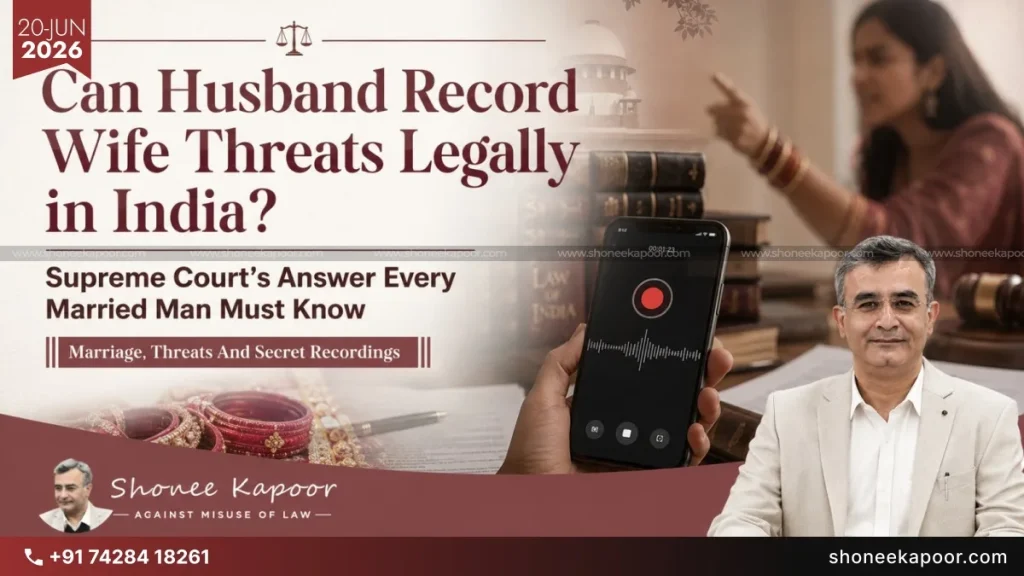
Can a husband legally record wife’s threats in India? Know Supreme Court’s 2025 ruling, electronic evidence rules, privacy limits, and how men should preserve proof.
NEW DELHI: Yes, a husband can record his wife’s threats in India when he is part of that conversation and the recording is being preserved for legal protection, police complaint, matrimonial case, criminal defence, or court proceedings.
But this answer has a very important condition.
Recording your own conversation is one thing. Hacking her phone, secretly accessing her WhatsApp, planting a spy device, recording private images, tapping a phone line, or uploading the audio on social media is completely different.
A man who wants to protect himself must understand this difference.
Evidence can save you. Illegal shortcuts can destroy your case.
In matrimonial disputes, many men come to court only with pain, screenshots, memories, and emotional stories. But courts do not decide cases on tears. Courts decide cases on evidence.
If your wife is threatening you with false cases, false dowry allegations, false domestic violence complaints, false rape allegations, false suicide threats, property pressure, child access pressure, or threats to destroy your family, then recording such threats can become very important evidence.
But it must be collected carefully, preserved properly, and used legally.
THE DIRECT LEGAL POSITION
A husband may record threats made by his wife during a conversation in which he himself is participating.
This may include:
- Phone calls between husband and wife
- In-person conversations where the husband is present
- Voice notes sent by wife
- Video/audio where the husband is part of the interaction
- Threats made during matrimonial negotiations
- Threats made regarding false cases, money, property, children, parents, or social reputation
But the recording should be used for legal protection, not public drama.
The moment a man starts circulating private recordings on WhatsApp groups, Instagram, YouTube, Facebook, or among relatives, he can create fresh legal trouble for himself.
Use evidence in court. Do not turn evidence into content.
SUPREME COURT 2025: SECRETLY RECORDED SPOUSAL CALLS CAN BE ADMISSIBLE
The biggest development came in 2025 when the Supreme Court dealt with the admissibility of secretly recorded conversations between husband and wife in a matrimonial case.
In Vibhor Garg v. Neha, the Supreme Court held that secretly recorded conversations between spouses can be considered in matrimonial proceedings, depending on relevance, authenticity, and legal admissibility.
The Court did not accept the idea that privacy can automatically block every such recording.
The Court recognised that when a marriage has reached the stage where one spouse is recording conversations to prove cruelty, threats, conduct, or matrimonial breakdown, that itself may show the level of distrust and collapse in the relationship.
The important principle is clear:
Privacy is important, but privacy cannot become a weapon to suppress relevant evidence in a fair trial.
This judgment is extremely important for men facing matrimonial litigation because false allegations often come without warning, but threats usually come before the case.
If a man ignores those threats, he may later stand empty-handed in court.
RECORDING IS NOT AUTOMATICALLY ILLEGAL, BUT METHOD MATTERS
Indian courts have repeatedly taken the view that a tape-recorded conversation can be admissible if it is relevant and reliable.
The older Supreme Court cases on tape-recorded evidence laid down practical safeguards.
The court will generally look at:
- Whether the conversation is relevant
- Whether the voice can be identified
- Whether the recording is accurate
- Whether the recording is complete
- Whether there is any sign of editing, tampering, cutting, mixing, or manipulation
- Whether the original device or file is available
- Whether electronic evidence certification is complied with
This means the court is not interested in your drama. The court is interested in reliability.
A recording is not magic. It must be proved.
WHAT IF WIFE SAYS “THIS VIOLATES MY PRIVACY”?
She can raise that objection.
But privacy is not an automatic shield against evidence in every matrimonial case.
The right to privacy is a constitutional right, but it is not absolute. Courts balance privacy with fair trial, justice, and the right of a party to prove his case.
In matrimonial litigation, especially where allegations of cruelty, threats, blackmail, false cases, extortion-like demands, or coercion are involved, the court may consider such recordings if they assist in deciding the real dispute.
This is where Family Courts Act, Section 14 becomes very important.
Family Courts have wider flexibility in receiving material that helps them effectively decide matrimonial disputes. That does not mean fake evidence will be accepted. It means the court can look beyond technical objections where the material helps reveal the truth.
DELHI HIGH COURT: PRIVACY BREACH DOES NOT AUTOMATICALLY KILL EVIDENCE
In Deepti Kapur v. Kunal Julka, the Delhi High Court dealt with a situation where the husband produced an audio-video recording involving the wife.
The wife objected on privacy and tampering grounds.
The Court discussed the balance between privacy and fair trial and held that evidence does not become inadmissible merely because there is an allegation that it was obtained in breach of privacy.
The Court also made it clear that authenticity and genuineness must be tested strictly.
This is the real legal position.
A husband cannot say, “I have a recording, so I have won.”
He must be able to show that the recording is genuine, relevant, complete, and legally produced.
CURRENT LAW: ELECTRONIC EVIDENCE MUST BE PRESERVED PROPERLY
Under the current evidence framework, electronic records have legal recognition, but they must be produced properly.
If a husband records a threat, he must preserve:
- Original phone or recording device
- Original file
- Date and time details
- Call logs, if available
- Backup copy
- Transcript of the recording
- Names of persons who can identify the voice
Any connected WhatsApp messages, emails, or call records
Certificate required for electronic evidence
- Do not edit the recording.
- Do not crop it.
- Do not add background sound.
- Do not convert it repeatedly.
- Do not send it casually to ten people.
- Do not rename it in a confusing manner.
- Do not delete the original and keep only forwarded copies.
In court, the other side may say the audio is fabricated. If you have destroyed the original file, you have weakened your own case.
A man must think like a litigant before the case begins.
WIFE THREATENING FALSE CASE: IS THAT CRIMINAL INTIMIDATION?
Under Indian criminal law, criminal intimidation broadly covers threats to a person, reputation, property, or someone in whom that person is interested, when the intention is to cause alarm or force that person to do or not do something.
If a wife threatens:
“I will ruin your career.”
“I will file false cases unless you transfer money.”
“I will trap your parents also.”
“I will make sure you lose your job.”
“I will not let you meet your child unless you obey.”
“I will file false dowry case if you do not leave your parents.”
“I will accuse you falsely unless you give property.”
Such statements can become legally relevant.
But remember one thing.
A wife saying, “I will take legal action,” is not automatically criminal intimidation.
Every citizen has the right to approach the police and court.
The legal issue begins when the threat is false, coercive, malicious, extortion-like, or used to force an unlawful demand.
That is why recording matters.
Without recording, it becomes your word against hers.
With recording, the court can examine the actual words, tone, context, and intention.
CAN RECORDING HELP IN DIVORCE?
Yes.
Recordings of threats can help in divorce proceedings when they show cruelty, mental harassment, coercion, false implication threats, parental alienation, financial pressure, or breakdown of marriage.
Mental cruelty is often difficult to prove because it happens inside the house.
- There may be no eyewitness.
- There may be no neighbour.
- There may be no written document.
In such cases, audio recordings, call recordings, messages, emails, CCTV, and other digital evidence may become crucial.
A man should not wait for the false case to arrive.
He should start preserving evidence from the first serious threat.
CAN RECORDING HELP IN 498A, DOMESTIC VIOLENCE, MAINTENANCE OR CUSTODY CASES?
Yes, depending on facts.
In a 498A case, recordings may help show prior threats, planned allegations, contradictory statements, settlement pressure, money demand, or misuse strategy.
In a domestic violence case, recordings may help show who was threatening whom, whether allegations are exaggerated, and whether there was pressure to create a false narrative.
In maintenance proceedings, recordings may sometimes show income admissions, employment details, lifestyle, voluntary separation, refusal to cohabit, or pressure tactics.
In custody disputes, recordings may show child access obstruction, parental alienation, coaching, threats, or misuse of the child as a bargaining tool.
But evidence must be relevant.
Do not dump 300 recordings in court and expect the judge to listen to everything.
Select the important recordings. Prepare transcripts. Mark dates. Explain context. Use your lawyer properly.
CAN HUSBAND RECORD WIFE WITHOUT INFORMING HER?
If the husband is himself a participant in the conversation, secret recording may still be admissible in court depending on facts, authenticity, relevance, and legal compliance.
But secretly recording does not mean everything is allowed.
You should not:
- Hack her phone
- Access her email without permission
- Install spyware
- Record her private conversations with third parties
- Tap phone lines
- Place hidden cameras in private spaces
- Record private body images
- Publish intimate or private material
- Share recordings online to shame her
- Use recordings for blackmail
This is where many men make a mistake.
They collect evidence correctly, then destroy their legal position by sharing it publicly.
Your goal is protection, not revenge.
PHONE TAPPING IS DIFFERENT FROM RECORDING YOUR OWN CONVERSATION
Phone tapping is a serious privacy issue.
A private person cannot start intercepting phone lines or secretly monitoring someone’s communications like a surveillance agency.
Recording your own conversation with your wife is different from tapping her phone or intercepting her calls with someone else.
Do not confuse the two.
If you are part of the conversation, the legal position is stronger.
If you are secretly intercepting someone else’s communication, you may be inviting legal consequences.
WHAT SHOULD A HUSBAND DO WHEN WIFE THREATENS FALSE CASES?
- First, do not react violently.
- Second, do not abuse back.
- Third, do not threaten her.
- Fourth, do not make a fake counter-narrative.
- Fifth, preserve evidence.
If she is threatening false cases, record the conversation calmly where legally possible. Save messages. Take screenshots. Export chats. Preserve call logs. Keep copies of emails. Write a dated incident note immediately after the threat.
Then consult a lawyer.
Depending on facts, legal steps may include:
- Police complaint
- Non-cognizable complaint
- Complaint to senior police officials
- Anticipatory bail preparation
- Divorce petition on cruelty
- Defence in 498A or DV case
- Custody or visitation application
- Application to produce electronic evidence
- Preservation of CCTV or call records
- Defamation or perjury-related remedies, where legally maintainable
Do not run to social media first.
Social media applause will not protect you in court.
Evidence will.
HOW TO PRESERVE WIFE’S THREAT RECORDING CORRECTLY
A husband should follow this basic evidence discipline:
- Keep the original file on the original device.
- Create a backup but do not delete the original.
- Note the date, time, place, and context.
- Write a short transcript.
- Do not edit or trim the recording.
- Do not use third-party apps that alter metadata unnecessarily.
- Do not forward the original file casually.
- Do not post it publicly.
- Keep connected evidence like messages, call logs, bank transfers, emails, complaint copies, and settlement demands.
- When filing in court, follow the electronic evidence certificate requirement.
- If the matter is serious, get legal advice before producing the recording.
Good evidence is clean evidence.
Dirty evidence gives the other side a chance to attack you instead of answering the truth.
THE BIGGEST MISTAKE MEN MAKE
Many men record threats and then immediately send the audio to relatives, friends, WhatsApp groups, or social media pages.
This is foolish.
If you publish private material, the wife may shift the entire case from her threats to your alleged privacy violation, defamation, harassment, or cyber misuse.
Do not give the other side a new case.
Use recordings as a shield in court, not as a sword on social media.
CAN POLICE ACCEPT SUCH RECORDINGS?
Yes, police may consider recordings as supporting material.
But police will not always register a case only because you have an audio clip.
They may ask for context, complaint, supporting material, witnesses, and verification.
Give a proper written complaint.
Mention date, time, place, exact threat, background, and why you fear false implication or harm.
Attach transcript and recording copy.
Preserve original.
Take receiving copy of complaint.
If police do not act, consult a lawyer for further remedies.
CAN COURT REJECT THE RECORDING?
Yes.
A court can reject or ignore a recording if:
- It is irrelevant
- It is inaudible
- It is edited
- Voice is not proved
- Context is missing
- Original is not preserved
- Certificate is defective
- Transcript is inaccurate
- Recording appears manipulated
- The recording was obtained through serious illegality
- The recording does not prove what the husband claims
So the real question is not just “Can I record?”
The real question is:
Can I prove the recording properly?
PRACTICAL EXAMPLES
Example 1: Legally Useful Recording
Wife calls husband and says, “Transfer the flat to my name or I will file false dowry case against you and your parents.”
Husband records the call. He preserves the original file, call log, transcript, and later produces it in court through proper procedure.
This may become very useful evidence.
Example 2: Risky Recording
Husband secretly installs spyware in wife’s phone and records her calls with other people.
This can create legal trouble for the husband.
Example 3: Evidence Destroyed by Social Media
Wife threatens false cases. Husband records it. Instead of giving it to lawyer or court, he uploads it on Instagram with insulting captions.
Now the issue may shift from wife’s threat to husband’s public circulation of private material.
This is bad strategy.
Example 4: Weak Recording
Husband produces a 12-second clipped audio with no date, no original file, no transcript, and no proof of voice.
The court may not give much value to it.
MEN MUST LEARN EVIDENCE BEFORE LITIGATION
False cases are not defeated by anger.
They are defeated by preparation.
A man should preserve:
- Audio recordings
- WhatsApp chats
- Emails
- Bank records
- Medical records
- Travel records
- CCTV footage
- Call logs
- Complaint copies
- Settlement talks
- Witness details
- Timeline of incidents
The side with better evidence usually has a stronger chance of exposing the truth.
IMPORTANT LEGAL WARNING
This article does not mean husbands should start secretly recording everything in marriage.
Marriage is not supposed to become a surveillance project.
But when threats begin, when false cases are openly discussed, when parents are being dragged, when money or property is demanded under fear, when child access is used as pressure, and when reputation is being attacked, a man has every right to legally protect himself.
The law does not expect a man to stand silently and get destroyed.
But the law also expects him to act within limits.
FINAL ANSWER
A husband can legally record wife’s threats in India when he is part of the conversation and the recording is preserved for lawful use in police complaint, matrimonial litigation, criminal defence, or court proceedings.
Such recordings can be admissible, especially after the Supreme Court’s 2025 ruling recognising that secretly recorded spousal conversations may be considered in matrimonial cases.
But the husband must not hack, tap, spy, record private visuals, manipulate the file, or publish the recording publicly.
The correct rule is simple:
Record for protection. Preserve for evidence. Produce in court. Do not misuse it for revenge.
Men must understand one brutal truth.
In matrimonial litigation, the man who has evidence fights.
The man who has only emotions begs.
FAQs
Yes, if he is part of the conversation and records it for legal protection. But hacking, tapping, spyware, or public sharing can create legal trouble.
Yes. It can help prove cruelty, coercion, false case threats, or matrimonial breakdown, subject to authenticity and relevance.
No. Privacy is important, but it is not an automatic bar against relevant evidence in a fair trial.
No. That is risky. Use the recording before police, lawyer, or court. Do not convert legal evidence into social media content.
Preserve the original file, make a transcript, save call logs and messages, avoid editing, and consult a lawyer before using it in court.