
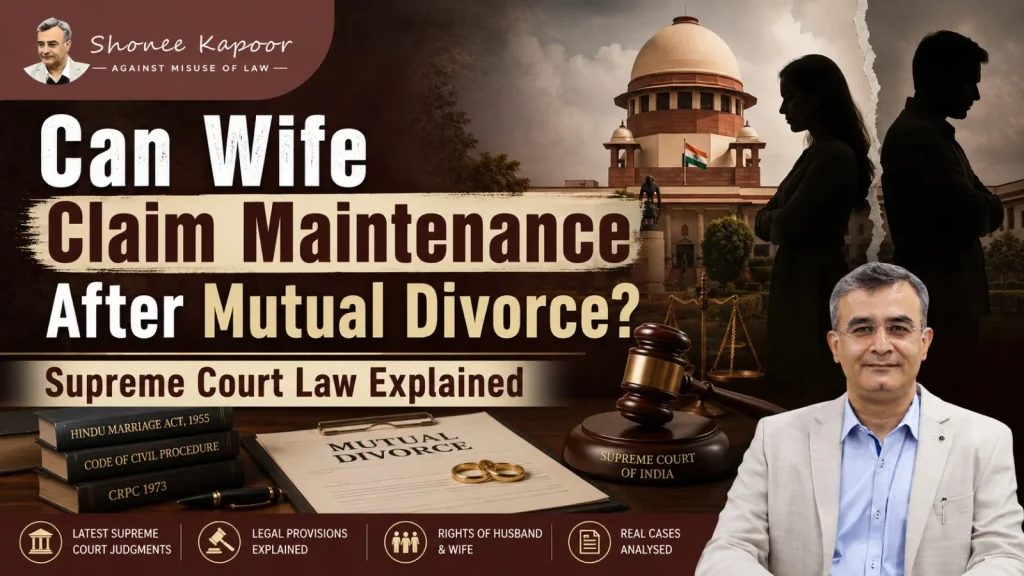
Can maintenance be claimed after mutual divorce in India? Know when an ex-wife can claim, when she cannot, and how courts treat full and final settlements.
NEW DELHI: A man thinks mutual divorce means closure. The decree is passed. The settlement amount is paid. The wife signs that she has no future claim. The husband walks out thinking the matter is over.
But in Indian matrimonial litigation, closure is not what you feel. Closure is what your documents, court statements, payment proof, and legal drafting can survive.
The simple answer is this: yes, maintenance can still be claimed after mutual divorce in some situations. But no, it is not automatic. It depends on the settlement terms, the law under which maintenance is claimed, whether the woman has remarried, whether she can maintain herself, whether full and final alimony was actually paid, and whether the earlier settlement was clear, voluntary, and accepted by court.
Under the Hindu Marriage Act, Section 25 allows permanent alimony and maintenance at the time of passing any decree or even later. This means divorce by itself does not erase the court’s power to consider maintenance. The court can order a gross sum, monthly amount, or periodical amount depending on income, property, conduct of parties, and facts of the case.
Under Section 144 of the Bharatiya Nagarik Suraksha Sanhita, 2023, which replaced Section 125 CrPC, a “wife” includes a woman who has been divorced by, or has obtained divorce from, her husband and has not remarried. This is where many husbands get shocked. They think “divorced” means “not wife anymore.” But for maintenance law, a divorced woman who has not remarried may still fall within the definition.
This does not mean every ex-wife will win maintenance after mutual divorce. The court will examine whether she is unable to maintain herself, whether the husband has sufficient means, whether there was neglect or refusal, whether a lump sum settlement was already paid, and whether she had waived future claims in clear terms.
The most important protection for a husband is not anger. It is documentation.
In mutual divorce, the settlement must clearly mention permanent alimony, stridhan, maintenance, child support, pending cases, future claims, criminal complaints, DV cases, 498A, Section 144 BNSS, HMA proceedings, execution rights, and consequences of breach. Vague words like “matter settled” are dangerous. They create future litigation.
The Supreme Court has repeatedly recognised that a divorced wife may claim maintenance if the statute permits it. In Rohtash Singh v. Ramendri, the Supreme Court held that even a wife divorced on the ground of desertion could claim maintenance as a divorced wife under Section 125 CrPC after divorce. The logic continues under Section 144 BNSS, because the definition still includes divorced women who have not remarried.
In Dinesh Kumar v. Reena, decided on 10 January 2025, the Supreme Court again referred to Rohtash Singh and clarified that a woman who becomes a divorced wife may claim maintenance under the statutory definition. The court noted that the divorced status itself can change the legal position.
This is why husbands must understand the difference between divorce and financial finality.
A mutual divorce decree ends marriage. It does not automatically end every future financial claim unless the settlement is carefully drafted, acted upon, and recorded before the court.
If the wife has received a proper one-time full and final settlement, has made a clear statement before court, has withdrawn pending cases, has accepted the amount voluntarily, and the decree records that there will be no future maintenance or alimony claim, the husband gets a strong defence.
But if the amount was unpaid, partly paid, vaguely described, not linked to permanent alimony, or settlement terms were not properly recorded, the ex-wife may attempt another claim.
Courts generally do not like endless litigation after full and final settlements. But courts also do not blindly reject a maintenance claim merely because mutual divorce happened. They examine facts.
A husband must also understand that child maintenance is different. Even if wife waives her own maintenance, she cannot usually waive the legal rights of minor children. Child support can still be claimed, modified, or enhanced based on education, medical needs, inflation, and financial capacity of parents.
Another common mistake is mixing wife’s alimony and child support in one unclear amount. This creates future disputes. The settlement should separately mention wife’s permanent alimony, child maintenance, education expenses, medical expenses, custody, visitation, and future extraordinary expenses.
If the wife remarries, her claim as a divorced wife for maintenance from the former husband is seriously affected. Under Section 25 HMA, remarriage is a ground to vary, modify, or rescind maintenance. Under Section 144 BNSS also, the protection is for a divorced wife who has not remarried.
If she is earning well, financially independent, or has sufficient assets, the husband must bring evidence. Courts do not work on WhatsApp allegations. Salary slips, ITRs, bank statements, LinkedIn profile, company details, business records, property documents, travel records, lifestyle evidence, social media proof, and previous admissions matter.
The biggest problem for men is not law alone. It is poor strategy. Many men pay in haste, sign in pressure, record weak statements, and later complain that the system is biased. The system may be harsh, but bad drafting makes it worse.
A man should never sign a mutual divorce settlement unless every pending and future claim is mapped. Maintenance, alimony, DV Act, 498A, stridhan, dowry articles, child custody, visitation, school fees, passports, property, jewellery, bank accounts, criminal cases, civil cases, execution rights, contempt, and default clauses must be written clearly.
In Dhananjay Rathi v. Ruchika Rathi, the Supreme Court dealt with a matrimonial settlement connected with mutual consent divorce where the husband had agreed to pay ₹1.5 crore towards full and final settlement of claims arising out of matrimonial discord. The case shows how settlement terms, performance of obligations, and withdrawal from mutual consent can become serious courtroom issues if parties later dispute compliance.
The lesson is simple. Mutual divorce is not a WhatsApp breakup. It is a legal exit. If the exit document is weak, litigation can return through another door.
For men, the correct approach is this: do not merely chase divorce. Chase finality.
Before paying a single rupee, ensure the settlement says whether the amount is towards permanent alimony, past maintenance, present maintenance, future maintenance, stridhan, child support, litigation costs, or all claims. Ensure payments are made only through traceable banking channels. Ensure statements before first motion and second motion repeat the same terms. Ensure the decree records the settlement. Ensure certified copies are preserved.
- Can maintenance be claimed after mutual divorce?
Yes, it can be claimed in certain cases.
- Can it be defeated?
Yes, with proper settlement, proof of payment, proof of wife’s financial capacity, proof of remarriage, proof of waiver, and strong legal strategy.
The law does not reward emotional men. It protects prepared men.
Mutual divorce should not become mutual destruction. It should become final closure. But closure has to be drafted, recorded, paid, proved, and protected.
FAQ’s
Yes, she can try, especially if she has not remarried and claims she cannot maintain herself. But a proper full and final settlement is a strong defence.
It can, if clearly drafted, voluntarily accepted, fully paid, and recorded before the court. Weak settlement language can create future litigation.
She may file, but the husband can oppose it by showing payment proof, settlement terms, court statements, and waiver of future claims.
Yes. A mother’s waiver usually cannot destroy a minor child’s legal right to support, education, and medical expenses.
A detailed settlement, separate heads of payment, court-recorded statements, banking proof, withdrawal of cases, and a clear no-future-claims clause.