
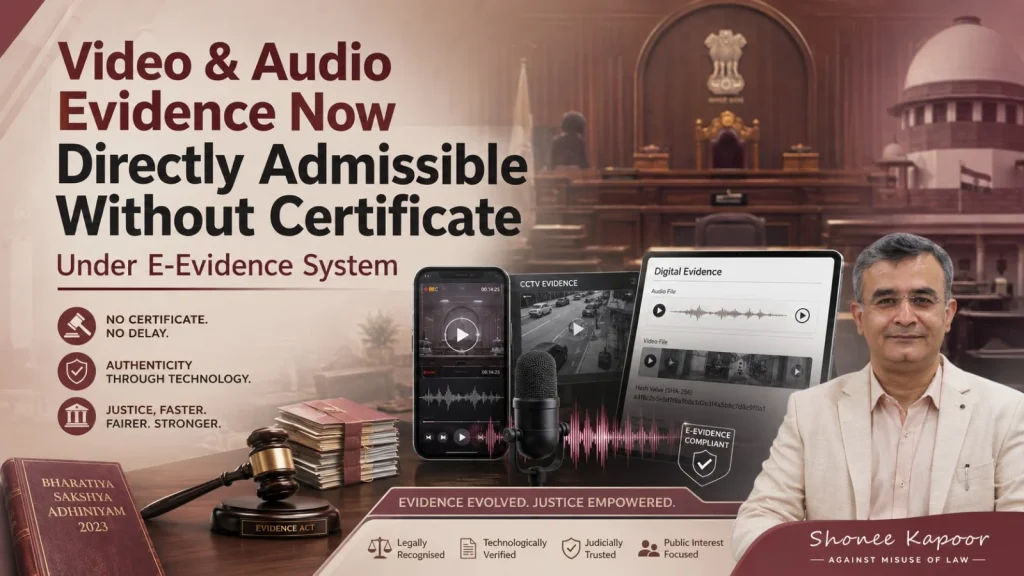
MP’s e-Sakshya system changes how video, audio and photo evidence reaches court. Know BSA Section 63, BNSS rules and Supreme Court law.
NEW DELHI: For years, Indian courts have seen one common drama in criminal and matrimonial litigation: one party brings a video, audio clip, WhatsApp chat, CCTV footage or phone recording, and the other side attacks it as “edited”, “fake”, “without certificate” or “not legally proved”.
Many genuine victims lost valuable evidence because it was not preserved properly. Many accused persons also suffered because digital material that could have exposed false allegations was not collected in time. In men’s rights cases, this is not a technical issue. This is often the difference between liberty and arrest, custody and alienation, maintenance and financial ruin, truth and narrative.
Now Madhya Pradesh has moved towards a more structured digital evidence system through e-Sakshya, where authorised use of video, audio, photos and digital records can make evidence collection faster, cleaner and more verifiable. The official e-Sakshya platform is described as a system for recording events under the new criminal laws, collecting digital evidence, recording statements, uploading material in real time, and storing investigation data securely through Sakshya Locker.
But let us be very clear: this is not a free licence to dump random screenshots in court and call them proof.
Digital evidence has become powerful. It has not become lawless.
WHAT HAS CHANGED WITH E-SAKSHYA?
The core idea behind e-Sakshya is simple: instead of depending on loose pen drives, copied videos, missing devices and disputed screenshots, evidence can be captured, uploaded, stored and accessed through a government-backed digital framework.
The official platform states that the e-Sakshya mobile application helps capture critical evidence at the crime scene, record statements and upload evidence in real time. It also refers to secure storage through Sakshya Locker, with encryption and integrity protections.
This matters because in criminal litigation, the biggest fight over digital evidence is usually not only “what does the video show?”
The bigger fight is:
Was it edited?
Who recorded it?
When was it recorded?
Which device was used?
Was the original preserved?
Was there tampering?
Was the chain of custody broken?
If a proper e-Sakshya workflow is followed, the court may get a better answer to these questions through upload logs, official capture, authorised access, secure storage and digital audit trails.
The Inter-Operable Criminal Justice System also connects police, courts, jails, prosecution and forensic systems to reduce duplication, improve data flow and make investigation and trial processes more efficient.
THE BIGGEST LEGAL POINT: “WITHOUT CERTIFICATE” DOES NOT MEAN “WITHOUT LAW”
This is where many people will misunderstand the news.
Under the Bharatiya Sakshya Adhiniyam, 2023, Section 61 says electronic or digital records cannot be denied legal effect merely because they are electronic. But Section 62 says the contents of electronic records must be proved according to Section 63.
Section 63 then lays down the legal conditions for proving electronic records. Most importantly, Section 63(4) says that a certificate must be submitted along with the electronic record at each instance where it is submitted for admission. That certificate must identify the electronic record, describe how it was produced, give particulars of the device involved, and be signed by the person in charge and an expert.
So, the correct legal position is this:
If evidence is captured through an authorised e-Sakshya system, the platform itself may help establish authenticity, custody, source and integrity.
But if a private person wants to rely on WhatsApp chats, mobile recordings, CCTV clips, call recordings, screenshots, pen drives or downloaded files, Section 63 compliance remains critical.
No serious lawyer should tell a litigant that certificates are now irrelevant. That is legally dangerous.
NEW CRIMINAL LAWS HAVE ALREADY MADE AUDIO-VIDEO EVIDENCE CENTRAL
The new criminal laws came into effect from 1 July 2024. Under the Bharatiya Nagarik Suraksha Sanhita, 2023, audio-video electronic means are now expressly recognised for several criminal justice processes.
BNSS Section 105 requires the process of search and seizure, including preparation of the seizure list and signatures of witnesses, to be recorded through audio-video electronic means, preferably by mobile phone, and forwarded without delay to the Magistrate.
BNSS Section 185 also requires search by a police officer to be recorded through audio-video means, preferably by mobile phone.
BNSS Section 176(3) provides that in offences punishable with seven years or more, a forensic expert should visit the crime scene and videograph the process on a mobile phone or electronic device, subject to state notification within the statutory timeline.
BNSS Section 530 goes even further. It allows trials, inquiries, proceedings, issue and service of summons and warrants, examination of complainants and witnesses, recording of evidence, and appellate proceedings to be held in electronic mode.
This means video and audio are no longer side issues. They are now built into the criminal justice process.
SUPREME COURT LAW ON ELECTRONIC EVIDENCE: STILL BINDING, STILL IMPORTANT
Even after the new laws, the principles laid down by the Supreme Court remain essential for understanding how courts treat electronic evidence.
In Anvar P.V. v. P.K. Basheer, the Supreme Court held that secondary electronic records are inadmissible unless the statutory certificate requirement is satisfied. CDs produced without the required certificate were held inadmissible. The Court also clarified that if the original electronic record itself is produced as primary evidence, the certificate issue may not arise in the same way.
In Arjun Panditrao Khotkar v. Kailash Kushanrao Gorantyal, the Supreme Court reaffirmed Anvar and held that the certificate requirement for secondary electronic evidence is mandatory. The Court also clarified that if the original device is produced, that is primary evidence, and the certificate requirement is not attracted in the same way.
The Supreme Court has also recognised that non-production of the certificate at an earlier stage can, in appropriate cases, be a curable defect if the trial is not over and no prejudice is caused.
In Ravinder Singh @ Kaku v. State of Punjab, the Supreme Court reiterated that the certificate requirement is a condition precedent for admissibility of secondary electronic evidence, and oral evidence cannot replace the statutory certificate.
In Sonu @ Amar v. State of Haryana, the Supreme Court held that objections to the mode or method of proof must generally be raised when the evidence is tendered, because some defects can be cured at that stage. A party cannot always sleep over the objection and raise it later after the trial has moved ahead.
The lesson is simple: digital evidence is powerful only when it is legally preserved, legally produced and legally proved.
WHY THIS REFORM MATTERS FOR MEN FACING FALSE CASES
In false 498A, domestic violence, maintenance, child custody, false promise to marry, sexual allegations and matrimonial criminal litigation, digital evidence is often the only neutral witness.
A chat can show threats.
A recording can show extortion.
A CCTV clip can show presence or absence.
A bank record can show payments.
A location trail can destroy a false story.
A video call record can expose child alienation.
A message chain can show coaching, manipulation or settlement pressure.
For men, this reform is not only about technology. It is about survival inside a system where allegations often travel faster than verification.
But there is also a warning.
Do not edit clips.
Do not crop chats.
Do not forward original files randomly.
Do not delete context.
Do not depend only on screenshots.
Do not wait until CCTV footage is overwritten.
Do not assume the judge will accept “Sir, it is in my phone” as proof.
The court does not run on emotion. It runs on admissible material.
COURTROOM REALITY: WHAT WILL NOW BE FOUGHT?
This is not a fabricated transcript. This is the practical courtroom pattern that will emerge from the law.
Earlier, the objection was usually simple:
“Where is the Section 65B certificate?”
“Who made this CD?”
“Where is the original phone?”
“How do we know this was not edited?”
Now, in e-Sakshya-backed evidence, the objection will become more technical:
Who captured the video?
Was the person authorised?
Was the device registered?
What was the upload time?
Was the file stored in Sakshya Locker?
Is the hash value intact?
Is the access log available?
Was the complete recording uploaded or only a selected part?
Is there any gap between capture and upload?
This is a better courtroom fight. Instead of vague shouting over “fake video”, the court can examine custody, metadata, logs and authenticity.
That is how truth should be tested.
TAMPERING WITH DIGITAL EVIDENCE CAN BECOME A CRIMINAL PROBLEM
People must also understand the other side of this reform.
If someone destroys, deletes, hides or tampers with electronic evidence to prevent its production in court, criminal consequences may follow.
BNS Section 241 punishes secreting, destroying, obliterating or rendering illegible any document or electronic record that may be required as evidence in court or public proceedings, when done with intent to prevent its production or use as evidence.
BNS provisions on false evidence and fabricated evidence can also cover false entries and electronic records meant to mislead a court or public servant.
Forgery provisions under BNS also extend to electronic records, including false electronic records and use of forged electronic records as genuine.
So the message is clear: digital evidence can save you, but digital manipulation can destroy you.
PRACTICAL CHECKLIST FOR LITIGANTS
If you are relying on digital evidence in any matrimonial, criminal or family court case, follow this discipline:
- Preserve the original device.
- Keep full chats, not selected screenshots.
- Export data properly with date, time and sender details.
- Do not trim audio or video unless the original is also preserved.
- Save CCTV footage immediately before it is overwritten.
- Move written applications for preservation of CCTV, CDRs, server logs, bank records, UPI records or platform data.
- Prepare the Section 63 BSA certificate wherever required.
- Maintain a clear chain of custody.
- Give your lawyer the original context, not only the dramatic portion.
- Never manufacture, edit or plant evidence.
This is especially important in cases involving 498A, domestic violence, maintenance, child custody, false sexual allegations, extortion, threats, settlement pressure and parental alienation.
One wrong handling of digital evidence can turn a strong defence into a technical failure.
MY LEGAL VIEW
MP’s e-Sakshya push is a strong reform, provided it is implemented honestly and uniformly.
If police searches, seizures, statements, crime scenes and digital uploads are properly recorded, then false implication becomes harder. Selective investigation becomes easier to challenge. Custody disputes over pen drives and copied files reduce. Courts get cleaner material. Litigants get faster verification.
But the system must not use technology only against the accused. It must also preserve evidence that helps the accused.
A man falsely accused should have the same right to digital truth as a complainant.
Because justice is not gendered. Evidence is not feminist or patriarchal. Evidence is either authentic or it is not.
The real reform is not that videos and audios will be “accepted directly”. The real reform is that courts may now get a better digital trail to decide whether the video, audio or photo is genuine.
That is good for justice.
And that is dangerous for falsehood.
FAQs
Not generally. Under BSA Section 63, electronic records still require proper legal proof and a certificate when submitted for admission, unless the original device is produced as primary evidence in the legally recognised manner.
e-Sakshya is a government digital evidence platform for recording events, capturing crime-scene evidence, recording statements, uploading digital material in real time and storing investigation data securely.
Yes, if they are relevant, authentic, properly preserved and proved under the Bharatiya Sakshya Adhiniyam. Screenshots alone are weak unless supported by proper source, certificate and context.
Yes. BNSS Sections 105 and 185 require audio-video recording of search and seizure processes. Non-compliance can be used to challenge fairness, custody and credibility, depending on case facts.
It can be. BNS Section 241 punishes destruction or concealment of an electronic record intended to prevent its production or use as evidence in court or public proceedings.