
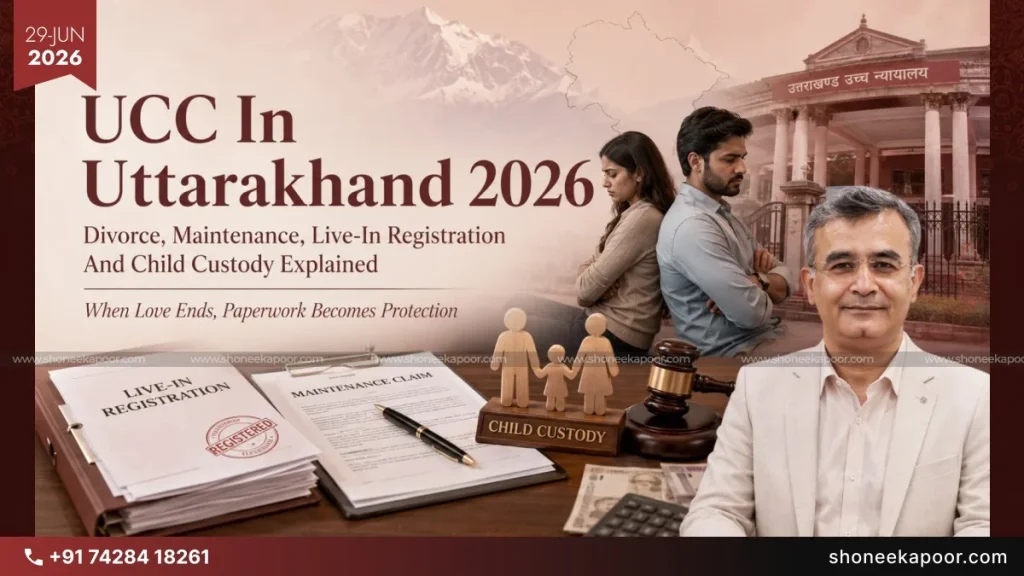
Complete 2026 explainer on Uttarakhand UCC: divorce grounds, maintenance, live-in registration, penalties, child custody and men’s rights perspective with Indian case laws.
NEW DELHI: Uttarakhand’s UCC – Uniform Civil Code is no longer just a political debate. It is now an operational legal framework.
It affects marriage, divorce, maintenance, live-in relationships, child legitimacy, custody, succession and registration duties. For ordinary people, especially men trapped in matrimonial disputes, the most important part is not ideology. The most important part is documentation.
Because in Indian family courts, emotions do not win cases. Evidence does.
A man may be morally right, socially ruined, financially drained and still lose if he has no documents, no trail, no compliance and no strategy.
That is why Uttarakhand UCC must be understood practically, not emotionally.
As of 2026, Uttarakhand has the Uniform Civil Code Act, Rules, amendment rules and the 2026 amendment framework. The Code came into force in January 2025, and the 2026 amendment exercise has added further procedural, administrative and penal seriousness to the regime.
So the question is simple:
What changes for divorce, maintenance, live-in registration and child custody?
Let us break it down.
1. WHAT IS UTTARAKHAND UCC?
The Uniform Civil Code of Uttarakhand is a state law intended to create a common civil framework for residents of Uttarakhand in matters such as marriage, divorce, succession, live-in relationships and related family law issues.
This means that many personal law differences based on religion are replaced by a uniform statutory framework within the scope of the Code.
Important point: The Code applies throughout Uttarakhand and also extends to residents of Uttarakhand living outside the State, subject to the statutory scheme. Scheduled Tribes are exempted as per the Code and Rules.
So this is not merely a “registration law.” It is a civil status law.
It tells you:
- who can marry;
- how marriage and divorce are to be registered;
- when divorce can be sought;
- when maintenance can be claimed;
- how live-in relationships are to be registered;
- what happens to a child born from a live-in relationship;
- how custody and maintenance of children may be dealt with.
For men, the message is direct: informal arrangements are becoming legally risky. If you marry, divorce, separate, cohabit or terminate a live-in relationship, paperwork will matter.
2. MARRIAGE UNDER UTTARAKHAND UCC: BASIC CONDITIONS
Under the Uttarakhand UCC framework, marriage is treated as a union between a man and a woman, subject to statutory conditions.
Broadly, the marriage conditions include:
- Neither party should have a spouse living at the time of marriage.
- Consent should be legally valid.
- The man should have completed 21 years of age.
- The woman should have completed 18 years of age.
- Parties should not fall within prohibited degrees of relationship, unless permitted by valid custom and not against public policy or morality.
- The marriage should not violate any other legal prohibition.
This means polygamy is not protected under the UCC structure. A second marriage during subsistence of the first marriage is legally dangerous.
For men, this is important because many matrimonial cases begin with confusion, social pressure, family compromise, undocumented customs, second relationships or concealed marital status.
Under the UCC structure, that casualness can become criminal or civil liability.
3. DIVORCE UNDER UTTARAKHAND UCC 2026: GROUNDS EXPLAINED
Divorce under the Uttarakhand UCC is not “instant divorce.” It must follow the statutory grounds and procedure.
A marriage can be dissolved only in accordance with law. The Code also recognises that divorce, judicial separation and nullity decrees require proper registration.
Major divorce grounds include:
Adultery
If one spouse has voluntary sexual intercourse with another person after marriage, it may become a ground for divorce.
Cruelty
Cruelty may be physical or mental. But every quarrel is not cruelty. Every argument is not cruelty. Every unpleasant marriage is not cruelty.
The Supreme Court in Samar Ghosh v. Jaya Ghosh made it clear that mental cruelty has no straight-jacket formula. The Court said matrimonial life must be assessed as a whole, and trivial irritations or normal wear and tear of married life cannot automatically become cruelty.
That principle is extremely important for men.
Because in real litigation, ordinary marital disagreements are often painted as cruelty, dowry harassment, domestic violence or unbearable torture. Courts are expected to examine facts, conduct, evidence and the cumulative effect — not accept allegations blindly.
Desertion
If one spouse deserts the other for a statutory period, it can become a ground for divorce. Under the Uttarakhand UCC, desertion for not less than two years is one of the major grounds.
Conversion
Conversion to another religion can be a ground under the Code.
Unsoundness of Mind / Mental Disorder
Serious mental disorder or unsoundness, subject to statutory conditions, may be a ground.
Venereal Disease
Certain serious communicable venereal diseases may be relevant under the divorce framework.
Renunciation
Renunciation of the world by entering a religious order may also be a ground.
Not Heard Alive For Seven Years
If a person has not been heard of as alive for seven years by those who would naturally have heard of him or her, it may become a ground.
Failure To Comply With Maintenance Order
Failure to comply with a maintenance order for the statutory period may also be relevant.
Wife-Specific Grounds
The Code also recognises certain wife-specific grounds, including where the husband has been guilty of rape or unnatural sexual offence, and certain situations connected with pre-Code multiple marriages.
Mutual Consent Divorce
Mutual consent divorce is also recognised. Parties must satisfy the statutory conditions, including that they have been living separately for the required period, are unable to live together, and have mutually agreed to dissolve the marriage.
But remember: mutual consent divorce is not just “sign paper and finish.” Settlement terms, permanent alimony, child custody, visitation, return of articles, criminal case closure and future claims must be drafted carefully.
Bad settlement drafting is one of the biggest disasters in matrimonial litigation.
4. MAINTENANCE UNDER UTTARAKHAND UCC: GENDER-NEUTRAL IN MARRIAGE, BUT NOT AUTOMATICALLY FAIR
The maintenance provisions under the Uttarakhand UCC are important because they recognise that either spouse may seek maintenance in matrimonial proceedings, subject to income, assets, circumstances and statutory conditions.
This is significant because maintenance should not be treated as an automatic punishment on the husband.
Under the Code, during matrimonial proceedings, a wife or husband who does not have sufficient independent income may seek litigation expenses and interim support. The court considers the income of both parties and relevant circumstances.
Permanent alimony or maintenance can also be ordered at the time of decree or after the decree. It may be granted as a gross sum, monthly payment or periodic payment for a term not exceeding the life of the applicant.
The court may consider:
- income of both parties;
- property and assets;
- conduct of the parties;
- mutual settlement, if any;
- surrounding circumstances;
- needs and liabilities.
This is where men must wake up.
Maintenance litigation is not won by shouting “she is greedy” or “men have no rights.” It is fought through income records, bank statements, liabilities, lifestyle evidence, employment proof, educational qualification proof and asset disclosure.
The Supreme Court in Rajnesh v. Neha gave detailed guidelines for maintenance proceedings and directed filing of affidavits of disclosure of assets and liabilities by both parties in maintenance cases. That judgment is important because it pushes courts towards transparency.
My view is simple: maintenance must be based on truth, not gender stereotypes.
A husband should not be reduced to an ATM. A wife should not be denied genuine support where legally entitled. But a capable, educated, earning or deliberately unemployed spouse should not be rewarded for litigation strategy.
Law must support need. It must not finance misuse.
5. LIVE-IN REGISTRATION UNDER UTTARAKHAND UCC 2026: THE MOST DEBATED PART
The live-in relationship provisions are the most controversial part of Uttarakhand UCC.
The Code defines a live-in relationship as a relationship between a man and a woman who cohabit in a shared household through a relationship in the nature of marriage, subject to the Code.
Under the UCC, partners in a live-in relationship within Uttarakhand must submit a statement to the Registrar. A resident of Uttarakhand living outside the State may also submit such a statement to the concerned Registrar.
The Registrar may conduct a summary inquiry and may either register the relationship and issue a certificate or refuse registration by written order.
The law also provides for termination of a live-in relationship through a statement of termination.
When Live-In Registration May Be Refused
Registration may be refused in situations such as:
- prohibited degrees of relationship;
- one partner already being married;
- one partner already being in another live-in relationship;
- one partner being a minor;
- consent obtained by force, coercion, undue influence, fraud or misrepresentation.
This matters because many disputes later turn into allegations of cheating, false promise of marriage, exploitation, domestic violence, maintenance and criminal complaints.
Registration creates a legal trail. It can protect genuine partners, but it can also expose hidden relationships, overlapping relationships and fraudulent arrangements.
Penalties For Non-Registration And False Statement
The UCC contains penalties for failing to submit the live-in statement, continuing in live-in without required submission, giving false statements or suppressing material facts. The 2026 amendment framework has further strengthened the seriousness of compliance in marriage and live-in related offences.
So do not treat live-in registration casually.
Today’s private relationship can become tomorrow’s FIR, maintenance case, custody battle or reputation destruction.
6. CHILD BORN FROM LIVE-IN RELATIONSHIP: LEGITIMATE UNDER UCC
One of the important provisions is that a child born from a live-in relationship is treated as legitimate.
This is a major civil consequence.
It means the law is not merely policing adults. It is also protecting the legal status of the child.
For men, this creates a direct legal responsibility. A live-in relationship is not just romance. It can create legal duties. If a child is born, paternity, maintenance, custody, education and welfare issues may follow.
Casual entry into live-in relationships without understanding legal consequences is a dangerous mistake.
7. MAINTENANCE FOR WOMAN IN LIVE-IN RELATIONSHIP
The Uttarakhand UCC also provides that a woman deserted by her live-in partner may claim maintenance from that partner through the competent court.
This is important and controversial.
Unlike matrimonial maintenance, the live-in maintenance provision is specifically framed for a woman deserted by her live-in partner. This means men entering live-in relationships must understand that legal exposure may arise even without marriage.
The Supreme Court in D. Velusamy v. D. Patchaiammal had earlier clarified that “relationship in the nature of marriage” is not the same as every casual live-in relationship. The Court said the expression used by Parliament was not simply “live-in relationship,” and courts cannot rewrite the statute in the name of interpretation.
That principle will remain important in disputes.
A weekend relationship, casual intimacy or temporary arrangement should not be mechanically equated with a marriage-like relationship. But under Uttarakhand UCC, the registration framework creates a different statutory layer. Therefore, facts and documents will decide the case.
Again, evidence wins.
8. CHILD CUSTODY UNDER UTTARAKHAND UCC: WELFARE IS PARAMOUNT
The Uttarakhand UCC allows courts to pass interim and final orders relating to custody, maintenance and education of children.
The Code states that the best interest and welfare of the child is the paramount consideration.
It also provides that custody of a child below five years shall ordinarily be with the mother.
This does not mean fathers have no rights.
It means fathers must litigate custody intelligently.
The Supreme Court in Gaurav Nagpal v. Sumedha Nagpal clearly held that in custody matters, the paramount consideration is the welfare of the child, not the legal right of either parent.
That principle must be used by fathers properly.
A father should not go to court merely saying “I am the father.” He must show:
- emotional bond with the child;
- stable residence;
- school continuity;
- medical care;
- time availability;
- financial responsibility;
- absence of alienation;
- child’s welfare plan;
- history of caregiving;
- mother’s conduct, if harmful;
- why shared parenting or custody serves the child.
In India, fathers often lose not because they love less, but because they document less.
A mother gets sympathy. A father needs strategy.
9. UTTARAKHAND HIGH COURT AND LIVE-IN PRIVACY DEBATE
The live-in registration provisions have also reached constitutional discussion before the Uttarakhand High Court.
During hearings on challenges to the UCC live-in provisions, the Court raised sharp questions on privacy and registration. The broad courtroom point was that the State was not prohibiting live-in relationships; it was requiring registration.
The debate is serious.
One side says registration protects rights, prevents fraud and creates accountability.
The other side says it intrudes into private choices, creates fear, and may expose couples to family and social pressure.
Both concerns cannot be dismissed casually.
But from a men’s rights perspective, one thing is clear: once the law mandates registration, non-compliance can be used against you.
Personal morality is one thing. Legal compliance is another.
Do not confuse both.
10. MEN’S RIGHTS PERSPECTIVE: UCC GIVES CLARITY, NOT AUTOMATIC JUSTICE
Many people think UCC will automatically solve men’s issues.
It will not.
Law on paper and law in courtroom are two different battles.
UCC may bring clarity in registration, divorce grounds, maintenance standards, live-in compliance and child legitimacy. But men will still face the same practical problems:
- exaggerated maintenance claims;
- false cruelty allegations;
- parental alienation;
- criminal pressure tactics;
- delayed trials;
- settlement blackmail;
- reputation damage;
- misuse of women-centric laws;
- emotional bias against fathers.
The UCC does not remove these realities.
But it gives men one weapon: documentation.
Marriage registration, divorce registration, live-in registration, termination statements, income affidavits, custody records, proof of expenses and compliance history can all become critical.
A man who follows the law and keeps records is in a stronger position than a man who relies on emotions and WhatsApp forwards.
11. PRACTICAL CHECKLIST FOR MEN IN UTTARAKHAND
If you are a man living in Uttarakhand, married in Uttarakhand, divorced in Uttarakhand, in a live-in relationship in Uttarakhand, or a resident of Uttarakhand living elsewhere, do not ignore the UCC.
Follow this checklist.
Before Marriage
Verify marital status, age, consent and prohibited relationship issues. Do not hide past marriage, pending divorce or existing relationship.
After Marriage
Register the marriage properly. Preserve proof of residence, ceremony, photographs, witnesses and registration.
During Dispute
Do not leave everything verbal. Communicate carefully. Preserve messages, bank transfers, medical records, rent receipts and child-related expenses.
In Maintenance Case
File accurate income and asset disclosures. Challenge false income claims through documents, not anger.
In Divorce
Choose the correct ground. Cruelty, desertion, adultery and mutual consent require different evidence.
In Live-In Relationship
Understand registration obligations. Do not enter live-in if already married or already in another live-in arrangement.
On Live-In Termination
Use the legal termination mechanism. Do not disappear and assume the relationship is over.
For Child Custody
Build a welfare plan. Courts care about the child’s future, not your emotional speech.
During Settlement
Draft everything properly: maintenance, alimony, custody, visitation, case withdrawal, streedhan, articles, future claims, default clauses.
Bad drafting today becomes litigation tomorrow.
12. FINAL WORD
Uttarakhand UCC 2026 is a major change in Indian family law.
It is not perfect. It is not a magic solution. It is not the end of misuse. It is not automatic justice for men.
But it does one important thing: it pushes relationships into legal documentation.
And that is where men must become smarter.
Do not wait for a false case to learn law.
Do not wait for a maintenance notice to arrange documents.
Do not wait for parental alienation to prove fatherhood.
Do not wait for a live-in dispute to understand registration.
In family law, ignorance is expensive.
And for men, it is often devastating.
FAQs
Yes. Uttarakhand UCC came into force in January 2025, and the 2026 amendment framework has further updated the law and procedure.
Yes. The UCC requires live-in partners covered by the law to submit a statement to the Registrar. Non-compliance or false information can attract penalties.
Yes. In matrimonial proceedings, maintenance provisions are framed in a way that either spouse may seek support if statutory conditions are satisfied.
Yes. The UCC provides legitimacy to a child born from a live-in relationship.
The Code recognises child welfare as the paramount consideration. Fathers can seek custody or visitation, but they must prove that their plan serves the child’s best interest.