
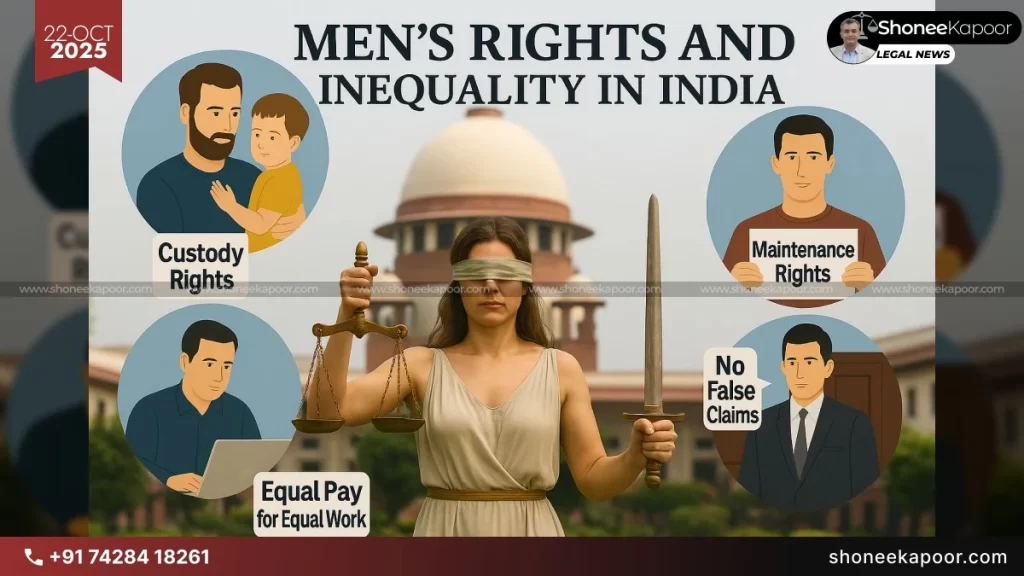
India speaks proudly of women’s empowerment but ignores the men who suffer in silence. With rising false accusations, biased family courts, and laws that presume men guilty, the balance of justice has tilted dangerously. True equality will only return when compassion, not gender, decides who deserves protection.
INTRODUCTION: The Untold Story of Indian Men’s inequality
India is a country that takes pride in its efforts to uplift the weak, protect women, and ensure justice for the oppressed. However, beneath this admirable goal is an unsettling reality: men in India have unwittingly fallen prey to the same system that claims equality.
Every day, men with case files in hand, sitting lonesome on wooden benches with hopeless eyes, can be seen in court hallways all over the nation. Some were charged with acts of cruelty that they had never engaged in. Some were made to pay for long-defunct marriages. Some fathers haven’t given their kids a hug in years. Their voice has no platform, and their pain has no name. In numerous instances, the law that was intended to protect women from injustice has been abused against men, ruining reputations, careers, and families.
Thousands of innocent husbands and in-laws are now plagued by Section 498A, which was intended to punish dowry abuse. Even when the wife is educated and employed, men are frequently burdened by maintenance laws under Section 125 CrPC, which are intended for those who are truly dependent. The fact that men can also become victims is rarely acknowledged by domestic violence laws, which are intended to protect victims.
However, the world labels a man’s suffering as weakness. Society labels it shame when he speaks up. The system claims that justice is served when he remains silent. According to the Delhi High Court in 2023, “equality means fairness for both, not just one gender’s privilege.” This is a call for balance, not a criticism of women. For far too long, India has equated justice for all with the protection of one gender. We need to talk about the other half that is the fathers, sons, and husbands who support their families, make silent sacrifices, and yet there is no law to listen to their cries. When one gender wins, that is not true equality. When both are able to stand before the law with equal rights, dignity, and voice, that is true equality.
The Truth We Don’t Talk About – The Hidden Inequality Facing Men
India takes pride in being a country that looks out for its weak. However, protection gave way to privilege at some point, and equality became unbalanced. Nowadays, a woman can enter a police station at any time and file a case for domestic abuse or dowry without any questions or preliminary investigation. However, there is no law, no form, and no helpline waiting to listen if a man experiences emotional abuse, harassment, or false accusations. Even if a wife is well-educated, employed, and financially stable, she may still be entitled to maintenance.
However, because the law presumes that only women require protection and that men are always capable, a husband cannot claim support, even if he is bankrupt or abandoned. Fathers are frequently treated like weekend visitors to their own children during custody disputes due to the extreme bias, as though fatherhood were a privilege rather than a right.
India has protection officers, state women’s commissions, a National Commission for Women, and women’s helplines. However, there isn’t a single Men’s Commission, a Men’s Helpline, or any shelter homes for men who have been abused domestically or in false cases. We still refer to it as equality. Justice turns into bias when only one side is heard. The protection of only one gender turns equality into exclusion. This is imbalance, not equality. A justice system cannot be considered fair if it only hears one side of the argument.
Men’s Rights in India: What Exists and What’s Still Missing
Indian men are not entirely unprotected despite this disparity. They are granted equality under the Constitution, and a few sporadic laws acknowledge their right to justice, fairness, and dignity. However, in practice, these rights are frequently only recognised on paper, obscured by stigmatisation and skewed interpretations.
Constitutional Rights
In India, all men are entitled to the same constitutional rights as other citizens. Men are given equal protection under the law thanks to Article 14 of the Indian Constitution, which guarantees equality before the law. Asserting that men cannot be excluded from opportunities due to their gender, Article 15 forbids discrimination on the grounds of religion, race, caste, sex, or place of birth.
Every man has the right to live with dignity, privacy, and self-respect under Article 21’s right to life and personal liberty. Courts have interpreted this to include defence against unjust treatment, arbitrary arrest, and emotional and physical abuse. Additionally, men are granted the freedom of speech, association, and profession under Article 19, which enables them to work, voice their opinions, and establish organisations to protect their rights.
Marriage and Divorce
Indian men have to deal with some of the most unfair and emotionally taxing legal battles when it comes to marriage, separation, or divorce. Although laws were created to shield women from real injustice, men are now legally cornered, socially shamed, and emotionally spent as a result of decades of abuse and gender bias
- Right to Seek Divorce: According to Section 13(1) of the Hindu Marriage Act of 1955, men may file for divorce on the grounds of cruelty, adultery, desertion, conversion, or mental illness. False counter-cases and interim maintenance claims are employed as pressure tactics during litigation, but the process is frequently drawn out and emotionally draining.
- Right Against Unfair Maintenance: A husband is required to provide for a wife who is incapable of supporting herself under Section 125 CrPC. Section 125 of the Criminal Procedure Code (CrPC) provides for maintenance to a “person having insufficient means,” which is gender-neutral in its wording. However, in practice, the law is interpreted almost exclusively in favour of wives, leaving men with little recourse even when they face financial hardship post-separation.
In Bhuwan Mohan Singh v. Meena (2015) 11 SCC 657, the Supreme Court emphasized that maintenance for a wife is a matter of social justice, but did not clarify entitlement for men, reinforcing the perception of bias. This gap underscores the need for reform to make maintenance truly gender-neutral, ensuring fairness for all spouses. - Right to Fair Treatment in Dowry Cases: One of the most frequently abused provisions in Indian criminal law is Section 498A IPC, which was first introduced to shield women from cruelty related to dowries.
Arnesh Kumar v. State of Bihar (2014) 8 SCC 273: The Supreme Court ruled that arrests under Section 498A IPC should not be automatic or routine. Police must follow Section 41A CrPC, issue notice before arrest (if punishment is under seven years), and record reasons for any arrest. This judgment aims to prevent misuse of matrimonial laws and protect innocent family members from arbitrary detention.
Sushil Kumar Sharma v. Union of India (2005) 6 SCC 281: The Supreme Court upheld the constitutional validity of Section 498A IPC, recognizing its importance in protecting women from cruelty and dowry harassment. At the same time, the Court acknowledged the potential for misuse and directed that proper investigation and magistrate approval are required before arrest, promoting a balance between protection of women and prevention of harassment of accused men. - Right to Custody and Visitation: Fathers have the right to request custody or visitation under the Guardians and Wards Act of 1890. In reality, however, fathers become visitors in their own children’s lives, and mothers are given preference in more than 90% of custody cases.
- Right to Protection from Mental Cruelty: Through seminal rulings such as Samar Ghosh v. Jaya Ghosh (2007) and V. Bhagat v. D. Bhagat (1994), Indian courts have acknowledged that emotional torture, humiliation, and false accusations amount to mental cruelty, which grants husbands grounds for divorce.
- Right to Dignity and Mental Health: A man fighting a fabricated case or divorce frequently experiences emotional collapse, career harm, and public humiliation. According to the National Crime Records Bureau (NCRB, Accidental Deaths & Suicides in India, 2023), men accounted for approximately 72.5% of total suicides in 2022–23, with marital and family issues being significant contributing factors.
Custody Rights
One of the most agonising aspects of matrimonial litigation is child custody disputes. In India, the mother is frequently granted custody of a minor child, particularly a young one, even though the father is acknowledged as the child’s natural guardian. Fathers are not entirely excluded by Indian law, though, as they are granted certain rights under a number of statutes and court rulings.
- Hindu Minority and Guardianship Act, 1956 (HMGA):
- Section 6(a): The father is the natural guardian of a minor legitimate child, and after him, the mother.
- Section 13: The welfare of the child is the paramount consideration in any custody decision.
- Guardians and Wards Act, 1890 (GWA)
- All religions are subject to this secular law. The Act gives the court the authority to determine guardianship and custody in the child’s best interests, taking into account the child’s wishes, age, gender, and parents’ financial situation. Even after a divorce or separation, fathers may use this Act to request guardianship or custody.
- Gaurav Nagpal v. Sumedha Nagpal (2009) 1 SCC 42: Supreme Court held that the child’s welfare is superior to all legal rights of parents, and custody should ensure emotional, educational, and social stability.
- Roxann Sharma v. Arun Sharma (2015) 8 SCC 318: Court clarified that both parents are equal natural guardians, but custody depends on welfare, not gender bias.
- Yashita Sahu v. State of Rajasthan (2020) 3 SCC 67: Even if custody is with the mother, the father has a fundamental right to visitation and communication (including online/virtual contact).
- Vivek Singh v. Romani Singh (2017) 3 SCC 231: Supreme Court recognized that denial of visitation rights can amount to mental cruelty to the father.
Rights of Fathers in Custody & Visitation:
- Fathers can file for custody or visitation under the Guardians and Wards Act, 1890.
- Even when custody is with the mother, the father retains:
- Right to educational and medical decisions (if designated natural guardian).
- Right to visitation and communication with the child.
- Right to apply for modification of custody if circumstances change.
Workplace Rights
According to the Factories Act of 1948 and other labour laws, men have the right to work in a respectable and safe environment. Men cannot receive less money for doing the same work as women, according to the Equal Remuneration Act of 1976. Additionally, they are safeguarded by a number of labour laws that guarantee them safe working conditions, equitable pay, and the ability to organise unions.
Sexual harassment is one area, though, where male employees continue to be at risk. Since the POSH Act (2013) only protects women, men who are subjected to workplace harassment or false complaints currently lack specific legal recourse. Men who are accused under this law, however, are entitled to a fair and unbiased investigation, and malicious complaints may be contested. In an effort to encourage shared parenting responsibilities, some private organisations voluntarily offer paternity leave, which is a right granted to government employees under service rules.
Legal Recourse in False Claims
The law offers a number of remedies for men who are falsely accused, such as under the Dowry Prohibition Act or Section 498A IPC (cruelty). If false evidence is presented, they may file defamation suits under Sections 499 and 500 of the IPC, seek anticipatory bail under Section 438 of the CrPC, and begin perjury proceedings under Sections 191–193 of the IPC. A man who has been wrongfully prosecuted may also be entitled to compensation under Section 250 Criminal Procedure Code (CrPC) which allows a court to award compensation to a person falsely accused of an offence, but only if a Magistrate specifically finds the accusation to be false and frivolous. In practice, this provision is rarely invoked, making it largely ineffective as a deterrent against the misuse of laws like Section 498A IPC.
The Rights Still Denied: What Indian Men Deserve Under True Equality?
Even though equality is guaranteed by the Indian Constitution, men’s reality is far from equal. In sharp contrast to the numerous institutions available for women, there is no National Commission for Men, no government department, and no statutory body devoted to hearing their complaints. Despite its good intentions, the Domestic Violence Act is still biassed and does not provide any protection to men or elderly parents who are subjected to emotional or physical abuse at home. In a society where equality is meant to be reciprocal, men are also legally denied the right to maintenance, regardless of whether they are unemployed, ill, or abandoned. Due to the lack of shared parenting laws in India’s legal system, fathers engaged in custody disputes are frequently treated as mere visitors in their children’s lives.
Furthermore, the lack of severe penalties for false cases promotes the abuse of laws that discriminate against women, such as the DV Act and Section 498A IPC, trapping innocent men in never-ending legal proceedings. In order to prevent families from being destroyed by unsubstantiated accusations, men need gender-neutral justice, which includes laws that protect the truth rather than the gender, legal aid and mental health support systems that acknowledge that men can also suffer, and mandatory enquiries prior to arrests in matrimonial disputes. Only when accountability and protection are extended to all, not just one gender, can equality be achieved.
No Protection Against Domestic Violence
Perhaps the biggest legal loophole in India is the absence of protection for men against domestic abuse. The Protection of Women from Domestic Violence Act of 2005 protects only women as “aggrieved persons” (PWDVA). Under this law, men who experience financial, emotional, or physical abuse at the hands of their spouses, partners, or family members are not directly protected by the law. Men can also become victims of domestic abuse, according to studies and court observations, but their complaints are frequently written off as “family disputes.”
Lack of Equal Parental and Custody Rights
When marriages break down, custody laws overwhelmingly favour mothers, leaving fathers with limited or no access to their children. Under the Guardian and Wards Act, 1890, the welfare of the child is the guiding principle but courts usually assume the mother is the “natural carer”. Fathers are often reduced to “weekend visitors” or denied contact altogether. Even progressive judgements like Roxann Sharma v. Arun Sharma (2015) and Master Ritesh (Delhi HC, 2018) have not led to consistent reform. There is still no statutory provision for joint custody or shared parenting in India.
Various family court studies and NGO reports indicate that in approximately 85–90% of child custody cases, mothers are granted primary custody, often leaving fathers with limited visitation rights.
No Financial Protection in Maintenance and Alimony
Sections 24 and 25 of the Hindu Marriage Act, CrPC 125, and the Protection of Women from Domestic Violence Act are examples of one-sided maintenance laws that presume the husband is the payer and the wife is the dependent. Courts usually order men to pay maintenance without a set period or income cap, even if the wife is educated or employed.
Under Sections 24 and 25 of the Hindu Marriage Act, 1955, either spouse may seek maintenance during or after proceedings for divorce or judicial separation. While the law is technically gender-neutral, in practice, courts rarely grant maintenance to men, reflecting a systemic bias favouring women. An exception is Rani Sethi v. Sunil Sethi (Delhi HC, 2011), where the court awarded maintenance to the husband, highlighting that men can claim support if the circumstances justify it. Such cases demonstrate the need for greater awareness and consistent judicial application of gender-neutral principles in matrimonial law.
Maintenance proceedings often reveal another aspect of gender imbalance in family law. In the landmark case Rajnesh v. Neha (2020) 14 SCC 150, the Supreme Court of India addressed misuse and lack of uniformity in maintenance claims. The Court directed both spouses to file detailed affidavits of income, assets, and liabilities, emphasizing that transparency from both sides is essential to prevent concealment and unfair maintenance orders.
This judgment was a major step toward ensuring fairness and accountability in maintenance cases protecting genuine claimants while deterring misuse. However, despite these guidelines, men often face prolonged litigation and financial strain due to biased presumptions in interim maintenance awards, underscoring the need for a gender-neutral maintenance framework.
No Gender-Neutral Workplace Protection
The Prevention of Sexual Harassment (POSH) Act, 2013 was enacted to ensure safe workplaces for women. However, it provides protection exclusively to female employees, leaving men and gender-neutral cases outside its scope. In a 2022 parliamentary reply, the Ministry of Women and Child Development confirmed that the POSH Act applies only to women, and that no equivalent statutory recourse exists for male employees facing workplace harassment. This legal gap highlights the need for gender-neutral workplace safety laws, ensuring that every individual regardless of gender has access to justice and dignity at work.
No Institutional Support for Men’s Mental Health
Mental health policies in India heavily focus on women and children, but male mental health remains invisible. Men face immense pressure as breadwinners and often suppress emotions due to social expectations. According to NCRB data, over 70% of suicides in India are by men, yet there are no national programs targeting male mental health or stress prevention.
Discrimination in Education and Scholarships
Most educational scholarships and welfare schemes are girl-centric, which were initially designed to correct gender disparity. However, in modern India, male dropout rates — especially in rural areas have risen, and boys now face higher educational neglect. There are no government scholarships or incentives exclusively aimed at supporting underprivileged boys. Education Section.
While much focus has been rightly placed on promoting girls’ education, an emerging concern is the increasing dropout rate among boys. According to the Unified District Information System for Education (UDISE+) 2021–22, the dropout rate at the higher secondary level is 12.6% for boys compared to 10.2% for girls. This data reflects a growing need to address the educational disengagement of boys, who are often pushed into early employment or face social pressure to become earners instead of learners.
No National Commission for Men
There is no comparable organisation for men in India, despite the country’s National Commission for Women (NCW) advising the government and helping women in need. The establishment of a National Commission for Men has long been a demand of men’s rights organisations, but the government has not taken any action. As a result, men lack the institutional means to voice their complaints, shape gender policy, or request government action.
Social and Legal Bias in Public Perception
Men are frequently depicted as aggressive in the media and in public discussions outside of the courtroom. Men are frequently mocked or ignored when they discuss false accusations, parental alienation, or domestic abuse. This social bias permeates the legal system and law enforcement, where compassion is frequently based on gender rather than facts.
Mental Health
Mental health concerns among men are often overlooked in policy and public discourse. According to the National Crime Records Bureau (NCRB) 2023, around 32% of male suicides are attributed to family and marital issues, reflecting the deep emotional and psychological toll that personal conflicts can have on men. Despite these alarming figures, there are no dedicated male helplines or support systems under the Mental Healthcare Act, 2017 framework, leaving a significant gap in mental health accessibility for men in distress. This calls for gender-inclusive mental health initiatives that recognize the unique challenges faced by men, particularly those arising from societal expectations and family pressures.
Maintenance Bias in Matrimonial Laws
Maintenance proceedings often reveal another aspect of gender imbalance in family law. In the landmark case Rajnesh v. Neha (2020) 14 SCC 150, the Supreme Court of India addressed misuse and lack of uniformity in maintenance claims. The Court directed both spouses to file detailed affidavits of income, assets, and liabilities, emphasizing that transparency from both sides is essential to prevent concealment and unfair maintenance orders.
This judgment was a major step toward ensuring fairness and accountability in maintenance cases protecting genuine claimants while deterring misuse. However, despite these guidelines, men often face prolonged litigation and financial strain due to biased presumptions in interim maintenance awards, underscoring the need for a gender-neutral maintenance framework.
Legal Frameworks and Gender Neutrality in India
The Protection of Women from Domestic Violence Act, 2005 (PWDVA) was enacted to safeguard women from abuse within domestic relationships. However, Section 2(a) of the Act defines an “aggrieved person” as only a woman, thereby excluding men from seeking similar protection or relief under this law even in cases where they may be victims of domestic abuse. Recognizing this legal asymmetry, multiple High Courts including the Karnataka High Court (2021) and the Delhi High Court (2023) have urged Parliament to consider making the law gender-neutral. These observations reflect a growing judicial awareness that domestic violence is not gender-exclusive and that legal protection should extend to all victims, irrespective of gender.
- In Men Too Are Entitled… (Delhi HC, Jan 2025) the court held that men who are victims of domestic or relationship violence must have equal protection under the law, emphasizing gender-neutrality in adjudicating violence.
- In interpreting other protection statutes (e.g., POCSO Act) the Karnataka HC has affirmed that the wording of the statute, though using gendered pronouns, must be read in context of its object and purpose to ensure gender‐neutral application.
These judgments, while not under the PWDVA directly, signal a judicial willingness to recognise and remedy gender‐asymmetries in protective legislation — thereby strengthening the argument that the PWDVA should be made gender-neutral.
Between the Law and Life: The Unseen Struggles of Indian Men
In theory, everyone is equally protected under the Indian Constitution. However, in reality, a man’s rights frequently hinge on how much society thinks he merits pity. Men are frequently ignored by the same system that rushes to protect women because it believes they cannot be victims. Men look for balance, not preferential treatment. They want justice that hears both sides, laws that protect based on truth rather than gender, and a society that understands that their suffering is also human. “When both men and women can demand justice and be heard, true equality will have begun.”
What the Numbers Say?
The data exposes the harsh reality behind India’s so-called gender equality, while emotions only tell one side of the story. The disparity is evident and agonising, per the National Crime Records Bureau (NCRB 2023) and numerous court studies: Men make up 72% of suicide victims in India. Every statistic has a backstory, whether it be one of emotional isolation, legal harassment, or family pressure In Section 498A cases, over 85% of accused men are acquitted, showing large-scale misuse of the dowry law (NCRB 2023).Accordingly, thousands of husbands and in-laws must fight false accusations for years before their innocence is acknowledged. Mothers are given preference in over 90% of child custody decisions. Fathers are frequently treated like weekend guests in their children’s lives, despite their emotional and financial capacity. These figures stand for suffering rather than privilege. They expose a legal system in which men are frequently assumed to be guilty and where social silence serves as their punishment. “When numbers cry louder than voices, it’s time for the law to listen.”
| Area | Reliable Statistic | Source |
|---|---|---|
| Male Suicides | 72.5% of total suicides | NCRB 2023 |
| 498A Conviction Rate | ~14% (86% acquittal) | NCRB 2023 |
| Custody Bias | 85-90% cases favour mothers | Family Court Observations |
| False Rape Allegations | ~13% found false | NCRB Crime in India 2023 |
| Paternity Leave | Only 15 days in govt sector | Central Govt HR Manual |
| Men’s Helplines | 0 official men’s helplines | Govt RTI Replies 2022 |
Judicial Recognition of Men’s Issues
While legislative reform for men’s rights remains pending, India’s higher judiciary has, over the years, acknowledged the misuse of gender-biased laws and the need for fairness. Several landmark judgments have paved the way toward recognizing men’s struggles within the framework of justice:
- Rajnesh v. Neha (2020, Supreme Court): The Supreme Court laid down detailed guidelines for maintenance, emphasizing transparency in income disclosure and preventing misuse of maintenance claims for financial gain.
- Preeti Gupta v. State of Jharkhand (2010, Supreme Court): The Court explicitly noted the growing misuse of Section 498A IPC, warning that false dowry harassment cases were leading to “legal terrorism” and causing immense suffering to innocent men and their families.
- V. Bhagat v. D. Bhagat (1994, Supreme Court): The Court recognized mental cruelty including false allegations and humiliation as a legitimate ground for divorce, protecting men from emotional abuse within marriage.
- Samar Ghosh v. Jaya Ghosh (2007, Supreme Court): The Court expanded the definition of mental cruelty, stating that sustained false accusations, denial of intimacy, or humiliation in public could amount to cruelty — a step forward in acknowledging men’s emotional trauma.
Reforms Needed for Men’s Rights in India:
- Make All Laws Gender-Neutral: Gender neutrality in the law must be the first step towards reform. Currently, only women are protected by laws pertaining to sexual harassment (POSH Act, 2013), cruelty (Section 498A IPC), domestic violence (PWDVA, 2005), and maintenance (CrPC 125). Women must continue to be protected, but everyone should be covered by the same laws, regardless of gender. Both men and women would be able to seek protection from emotional cruelty, abuse, and harassment under a gender-neutral domestic violence law. Men, women, and LGBTQ+ people should all be equally protected under workplace harassment laws.
- Establish a National Commission for Men: Just as women have the National Commission for Women (NCW), men need an equivalent institution. This body could investigate complaints, recommend policy reforms, and provide counselling and legal aid to men facing false cases, abuse, or alienation from children. It would also act as a research and data body gathering statistics on men’s mental health, suicide, workplace discrimination, and legal bias.
- Recognize Men’s Mental Health as a National Concern: Reforms must include: Free or subsidized mental health counselling for men, Awareness campaigns breaking the stigma around male depression, Workplace mental wellness programs targeting stress and burnout in men, Creating safe spaces for men to talk about emotional pain is not a luxury — it’s a necessity.
- Introduce Shared Parenting & Equal Custody Laws: One of the most painful injustices faced by separated fathers is loss of access to their children. India must reform custody laws to make shared parenting or joint custody the default option unless proven harmful to the child. Family courts should ensure both parents are equally involved in the child’s upbringing, education, and emotional life. The goal is not to take away mothers’ rights, but to give fathers equal emotional standing in their children’s lives.
- Make Maintenance and Alimony Fair and Time-Bound: Regardless of the wife’s qualifications or earning potential, current maintenance laws presume that the husband must always make the payment. Reforms should ensure that: Maintenance is income-based and time-bound, not a lifelong liability, Financial disclosures are mandatory for both parties (as per Rajnesh v. Neha guidelines), Courts should consider false allegations, desertion, or cruelty by the wife (Neha) while determining maintenance, If the wife remarries or starts earning, maintenance should automatically cease, This brings balance, fairness, and predictability into matrimonial disputes.
- Penalize False Allegations and Legal Misuse: When false dowry, domestic violence, or harassment cases are filed, they cause lifelong damage to men and their families. India needs strict consequences for malicious litigation including penalties, compensation, and perjury charges. Reform can include: Amendment to Section 498A IPC to differentiate between genuine and false cases, Empowering courts to compensate wrongfully accused men for legal costs and defamation, Police accountability for arrests without preliminary evidence.
- Building an Equal India: Truth must be the determining factor in equality, not gender. In India, men’s rights are a call for justice rather than privilege. Justice requires shared parenting, gender-neutral legislation, mental health awareness, and institutional recognition all of which are not radical concepts. One straightforward idea holds the key to the future of gender justice in India: “Justice must be balanced; it cannot have a gender.”
The Road Ahead: Towards True Gender Equality
In its quest for justice, India is at a turning point. Our country has spent decades fighting to end centuries of discrimination against women, and that fight must go on. However, as time went on, a new kind of inequality subtly emerged, one in which men’s suffering was written off as strength, their hardships as weakness, and their rights assailed by presumptions.
A society can never be considered equal if it only protects one gender. Equality requires fairness, not fear, compassion, not ease, and balance, not prejudice. It calls for all men who have been wrongfully accused, fathers who have been denied children, husbands who have been crushed by legal abuse, and sons who have been silenced by shame to be granted the same protection and voice that all women are entitled to. The first step on the path ahead is acknowledgement. To hear, document, and address men’s complaints, India requires a National Men’s Commission, a statutory body. Because abuse is not gender-specific, laws addressing domestic violence must be gender-neutral. In order to prevent custody disputes from emotionally orphaning children, shared parenting laws are necessary. False case penalties are necessary to uphold justice, not to undermine women’s rights. Additionally, men need legal assistance and mental health support because a man should never be forced to remain silent.
The goal of this movement is justice, not discrimination against women. One gender’s empowerment shouldn’t come at the expense of another’s emotional, material, or legal well-being. True equality will occur when both parties are safeguarded under the same legal umbrella, not when one side prevails. “Gender does not define justice. It only wears a blindfold; it doesn’t have a saree or suit. Additionally, it needs to be receptive to hearing both sides before making a decision.