
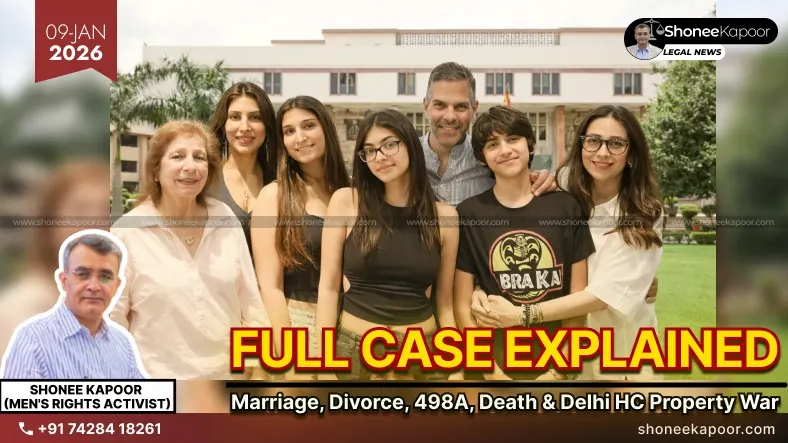
From a celebrity wedding to IPC 498A allegations, a Supreme Court-linked divorce settlement, and now a Delhi High Court inheritance battle after death, the Karisma Kapoor – Sunjay Kapur case shows a harsh truth. In India, divorce rarely means closure for men. Legal battles often survive marriage, settlement, and even death.
NEW DELHI: The story of Karisma Kapoor and Sunjay Kapur is no longer just a celebrity divorce story.
It has evolved into a multi-decade legal saga involving marriage, criminal complaints, settlement, death, inheritance, and a high-stakes property dispute before the Delhi High Court.
For Indian men, this case is a mirror of matrimonial reality:
- divorce does not end litigation
- settlement does not mean closure
- death does not stop disputes
This article documents what actually happened, step by step.
Marriage: A Bollywood–Business Alliance (2003)
Karisma Kapoor married Delhi-based industrialist Sunjay Kapur on 29 September 2003.
The marriage united a leading Bollywood family with one of India’s prominent business houses.
- Two children were born from the marriage:
- Daughter: Samaira
- Son: Kiaan
For several years, the marriage appeared stable in public.
Breakdown of Marriage & Separation (2014)
By 2014, serious marital discord surfaced and divorce proceedings were initiated.
What followed was not an amicable separation, but intense legal confrontation involving:
- Allegations of cruelty
- Financial disputes
- Custody and visitation issues
This phase marked the entry of criminal and civil law into the relationship.
Criminal Complaint: IPC 498A & Dowry Allegations (2016)
In February 2016, Karisma Kapoor filed a criminal complaint alleging:
- Cruelty
- Dowry harassment
Sections reportedly invoked included IPC 498A.
- Important legal clarity:
- Filing of a complaint is a fact
- Guilt or innocence is never presumed
- Allegations remain allegations unless proven by trial or final court finding
This distinction is often ignored in public discourse — but matters greatly in law.
Supreme Court–Backed Settlement & Divorce Decree (2016)
In June 2016, the marriage was legally dissolved.
- Key points widely reported as part of the settlement:
- Divorce by mutual consent
- Custody of both children with the mother
- Financial arrangements for children’s future, including reported high-value bonds
- Visitation rights for the father
Several reports state that criminal proceedings were quashed as part of the settlement, following consent terms.
This is crucial: The dispute was legally closed at that stage.
At least on paper.
Death That Changed Everything: Sunjay Kapur (2025)
On 12 June 2025, Sunjay Kapur collapsed during a polo match in the UK and passed away.
- Age: 53
- Location: Windsor, United Kingdom
- Funeral rites were later performed in Delhi
Different reports mentioned different medical narratives; therefore, it is legally safe to say: Sunjay Kapur died suddenly during a sporting event.
His death reopened legal questions that divorce had supposedly settled.
The Real Turning Point: Estate, Will & Inheritance Dispute
After Sunjay Kapur’s death, disputes emerged regarding:
- His will
- Control over assets
- Rights of his legal heirs
This dispute reached the Delhi High Court in 2025.
Delhi High Court Proceedings: What Is the Case About?
The litigation before the Delhi High Court is not a divorce case.
It is an estate and inheritance dispute.
- What has been reported:
- The children of Sunjay Kapur, represented through their legal guardian, approached the court
- Allegations were raised that:
- A will was forged or fabricated
- Legitimate heirs were being excluded
- The dispute involves Indian and foreign assets
- The court examined:
- Asset disclosures
- Jurisdiction over foreign properties
- Confidentiality of estate details
- Legal precision:
- The court has not declared any will forged
- These are issues under adjudication
- Final determination is still awaited
Why This Case Matters for Indian Men
This case exposes hard truths about Indian matrimonial and inheritance law:
- Divorce is not the end: Even after settlement, litigation can restart years later.
- Financial exposure never truly closes: Assets, properties, and estates remain vulnerable.
- Children become legal instruments: Inheritance disputes often reopen past marital battles.
- Men’s liability survives marriage — and sometimes even death: Few cases illustrate this more starkly.
From Marriage to Courtroom: A Clear Timeline
- 2003 – Marriage
- 2014 – Separation
- 2016 – IPC 498A complaint + Supreme Court-linked settlement + Divorce
- 2025 (June) – Death of Sunjay Kapur
- 2025 onward – Delhi High Court estate and property dispute
This is not chaos.
This is a pattern.
Final Words
The Karisma Kapoor–Sunjay Kapur case is not gossip.
It is a legal warning.
In India, marriage can end,
divorce can be granted,
settlements can be signed,
but a man’s legal vulnerability rarely ends.
Until matrimonial and inheritance laws become balanced and finality-driven,
Indian men — celebrity or common — will continue fighting battles long after relationships die.
Laws & Sections Involved — Explanation And Application
| Law / Section | What the Law Provides | How It Appears in This Case |
| IPC Section 498A | Criminal offence relating to cruelty by husband or his relatives against a married woman | A criminal complaint alleging cruelty/dowry harassment was reported to have been filed during matrimonial disputes prior to divorce. Filing is reported; outcome was linked to settlement |
| Dowry Prohibition Act, 1961 | Prohibits giving or taking of dowry and related harassment | Referenced in media reports as part of matrimonial allegations during separation phase |
| Code of Criminal Procedure, 1973 – Section 482 | Inherent powers of High Court to quash criminal proceedings to prevent abuse of process | Reportedly invoked for quashing of matrimonial FIRs as part of settlement/consent terms |
| Hindu Marriage Act, 1955 – Section 13B | Divorce by mutual consent | Divorce between parties was granted by mutual consent in 2016 |
| Guardians and Wards Act, 1890 | Governs custody and guardianship of minors | Custody of children granted to mother; father given visitation as per settlement |
| Indian Succession Act, 1925 | Governs wills, testamentary succession, probate | Central statute governing the current dispute relating to alleged will and inheritance |
| Code of Civil Procedure, 1908 | Governs civil suits, injunctions, jurisdiction | Applied in estate/property litigation and interim relief proceedings |
| Constitution of India – Article 226 | High Court’s writ jurisdiction | Invoked procedurally in Delhi High Court estate-related proceedings |
| Private International Law Principles | Jurisdiction over foreign assets and estates | Raised in arguments relating to overseas properties/assets of deceased |
| Sealed Cover / Confidentiality Jurisprudence | Court-controlled disclosure of sensitive material | Delhi High Court considered confidentiality of estate disclosures |
Death & Estate Context
| Particular | Details |
| Name of Deceased | Sunjay Kapur |
| Date of Death | 12 June 2025 |
| Place of Death | United Kingdom |
| Legal Significance | Triggered inheritance and estate disputes |
| Applicable Law | Indian Succession Act, 1925; Private International Law |
| Heirs Involved | Children from marriage with Karisma Kapoor and other legal heirs |
| Estate Nature | Indian and foreign assets |
Consolidated Timeline
| Year | Event |
| 2003 | Marriage |
| 2014 | Separation and initiation of disputes |
| 2016 | Criminal complaint; mutual consent divorce; settlement |
| 2025 (June) | Death of Sunjay Kapur |
| 2025 onwards | Delhi High Court estate and inheritance litigation |
FAQs
Yes, the divorce was granted by mutual consent after settlement, but later events show that settlement does not always bring legal finality for men.
A criminal complaint alleging cruelty/dowry harassment was reported during the matrimonial dispute; filing is a fact, guilt is a matter of law and evidence.
His death in 2025 triggered inheritance and estate issues, leading to fresh litigation regarding will and assets.
It is not a divorce case; it concerns inheritance, validity of a will, and control over Indian and foreign assets.
Because it shows that even after divorce, settlement, and death, men’s families can remain trapped in long legal battles.
Disclaimer
This article is based on publicly reported court proceedings and media reports. It is intended for informational and educational purposes only. All references to allegations are stated as allegations, not findings of guilt. The author does not claim personal knowledge of facts beyond what is available in the public domain, and the content should not be construed as legal advice or a statement on the merits of any pending or concluded case.