
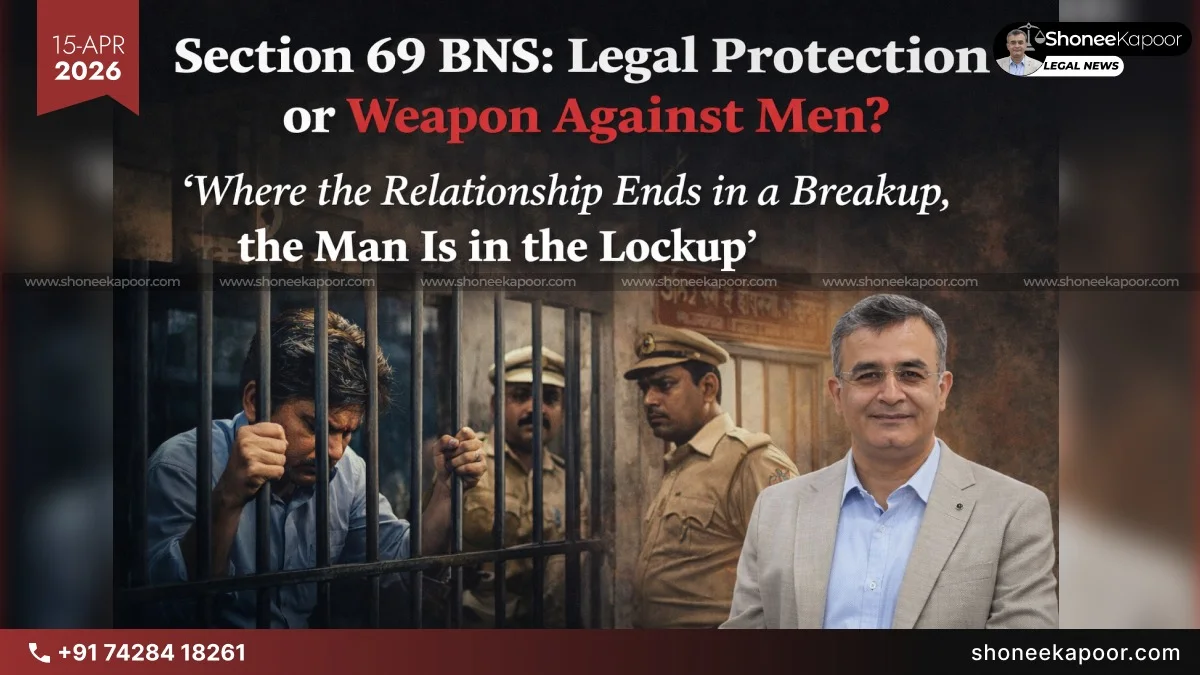
Section 69 BNS: Legal Protection or Weapon Against Men?

Written and analysed by Shonee Kapoor
Legal Consultant, Author & Men's Rights ActivistA new criminal provision was supposed to punish deception. In practice, it is already raising an older question in a new form: where does genuine fraud end, and where does a failed relationship get converted into a criminal case?
NEW DELHI: Section 69 of the Bharatiya Nyaya Sanhita, 2023 came into force on 1 July 2024. It creates a distinct offence where a man, by “deceitful means” or by a promise to marry made without any intention of fulfilling it, has sexual intercourse with a woman, even though the act does not amount to rape.
The punishment can extend to ten years and fine. The statute itself says “deceitful means” includes inducement by false promise of employment or promotion, or marrying by suppressing identity.
On paper, the provision looks simple. In reality, it sits on one of the most dangerous fault lines in criminal law: consent, motive, intimacy, and hindsight. The law is meant to punish fraud.
But the ground-level use of such provisions has always carried a second risk — that a breakup, family opposition, delay, change of mind, or later bitterness gets dressed up as criminal deception. That is exactly why courts, even before BNS, repeatedly insisted on one central test: was the promise false from the very beginning?
WHAT SECTION 69 BNS ACTUALLY SAYS
Section 69 does not criminalise every sexual relationship that does not end in marriage. It criminalises sexual intercourse obtained by deceitful means or by a promise to marry made without intention to fulfil it. That phrase matters. The offence is not “relationship ended.” The offence is deception at inception.
This is where public debate often becomes dishonest. One side pretends that any complaint under this provision is automatically genuine. The other side pretends the law has no legitimate role at all. Both positions are legally wrong.
There are real cases where concealment, fraud, or a knowingly impossible promise can amount to a serious criminal wrong.
There are also cases where the criminal process gets used as leverage after the relationship collapses. The law’s moral legitimacy depends on courts and police being able to tell those two categories apart.
THE SUPREME COURT HAD ALREADY LAID DOWN THE TEST LONG BEFORE SECTION 69
Indian courts were not entering empty territory when Section 69 was enacted. The Supreme Court had already developed a settled distinction between a false promise and a mere breach of promise.
In Pramod Suryabhan Pawar v. State of Maharashtra, the Court made it clear that consent is vitiated only where the promise was false at the time it was made and the woman’s consent was directly based on that misconception. A later failure to marry is not enough by itself.
In Dhruvaram Murlidhar Sonar v. State of Maharashtra, the Court drew the distinction even more sharply: there is a clear difference between rape and consensual sex, and also a difference between a false promise and a promise that could not later be fulfilled because of circumstances beyond control.
In Deepak Gulati v. State of Haryana, the Supreme Court warned that courts must examine whether the promise was false at an early stage and whether consent was given with full understanding of the nature and consequences of the relationship.
And in Mahesh Damu Khare v. State of Maharashtra in November 2024, the Supreme Court again focused on criminal intent at inception. It did not say every allegation is false. It said courts must be careful before converting a consensual relationship into a criminal prosecution merely because it later failed.
That is the legal spine of the issue. If intention from the beginning is missing, criminal law should not be used as therapy for emotional collapse.
WHY SECTION 69 BNS IS ALREADY BECOMING CONTROVERSIAL
The controversy is not hypothetical anymore. It is already visible in court.
Just days ago, the Karnataka High Court flagged the “mushrooming cases” under Section 69 BNS and recorded a line that should disturb anyone who cares about due process: where the relationship ends in a breakup, the man is in the lockup.
Justice M. Nagaprasanna stayed further investigation in the case before him and ordered release of the accused, who had been in custody for over six weeks. That is not men’s rights rhetoric. That is a High Court acknowledging a pattern serious enough to warrant immediate intervention.
At the same time, the Allahabad High Court has shown the other side of the line. In Vipin Kumar v. State of U.P., it refused to quash proceedings where the allegations included concealment of the accused’s existing marriage and sexual relations on a false promise of marriage. In other words, where the allegations indicate deceit from the outset, the case can proceed.
That is the correct legal position. Section 69 cannot be read as either always valid or always abusive. It has to be filtered through intent, facts, and evidence.
THE REAL DANGER FOR MEN: THE PROCESS STARTS PUNISHING BEFORE THE TRUTH IS TESTED
The biggest danger under provisions like Section 69 is not only conviction. It is accusation plus arrest plus social death.
That is why the Karnataka High Court’s observation matters so much. Once the FIR is registered, a man can lose liberty, employment, marriage prospects, family standing, immigration options, and negotiating power long before trial decides whether the promise was truly false from inception. In a country where criminal process itself becomes punishment, a vague and emotionally charged offence can be weaponised with frightening ease.
The Supreme Court itself has been warning against this broader trend.
In April 2025, while quashing a rape case against a former judge, it said that every consensual relationship where a possibility of marriage existed cannot later be coloured as a false pretext to marry after a fallout, and that such litigation can amount to abuse of process.
In February 2026, the Supreme Court also expressed concern over misuse of criminal law where a consenting relationship turns acrimonious, holding that a married woman cannot invoke false promise of marriage in the same manner when she herself was not legally free to marry during the subsistence of her marriage.
Those observations are not anti-woman. They are pro-law.
POLICE PRESSURE, COMPROMISE CULTURE, AND “MARRY HER OR FACE THE CASE”
This is where the system becomes uglier than the statute.
In many such complaints, the real battlefield is not the courtroom but the police station. The pressure is often informal, opaque, and impossible to prove neatly. The accused side alleges threats, moral lectures, family pressure, and coercive “settlement” conversations before the matter even reaches a meaningful judicial test.
A recent case from Uttar Pradesh illustrates how allegations of rape-case threats can be used as pressure in relationship disputes: a constable alleged that a woman coerced him to convert and marry her under threat of a rape case, and police registered a case on his complaint.
That case is not itself a Section 69 prosecution. But it captures the coercive ecosystem around intimate accusations in India. Once the threat of a sexual offence is put on the table, the leverage becomes immediate. Families panic. employers panic. police often stop acting like investigators and start acting like informal marriage counsellors with the power of arrest hanging in the background. The Karnataka High Court’s remark about breakup-to-lockup culture only reinforces why these complaints cannot be brushed aside as fantasy.
If the police response to a complaint becomes “get him to marry,” that is not justice. It is extortion with institutional backing.
GENUINE PROTECTION AND LEGAL OVERREACH CAN BOTH EXIST AT THE SAME TIME
Any honest article on Section 69 must admit an uncomfortable truth: there are real cases where the law is needed.
If a man knows from day one that he is already married, or that he will never marry the complainant, or that he is suppressing a legal or personal fact that makes the promise deceptive, the woman is not consenting to the true situation.
That is why courts have allowed prosecutions to continue where the allegations disclose concealment of existing marriage or conscious deception from inception. The Allahabad High Court’s February 2026 ruling reflects this clearly. So do recent police cases alleging concealment of prior marriage while inducing sexual relations.
But once that point is accepted, the opposite point must also be accepted with equal force: a relationship that lasted months or years, involved mutual intimacy, adult decision-making, and later collapsed due to family resistance, incompatibility, delay, or change of heart is not automatically criminal. The Supreme Court’s jurisprudence has consistently said so.
Law becomes unjust when it abandons distinctions.
THE COURTROOM EXCHANGE THAT MATTERS MORE THAN ACTIVISM
The most important “courtroom exchange” in this entire debate is not dramatic. It is doctrinal.
The recurring judicial question has effectively been this:
Was the promise dishonest from the beginning, or did the relationship fail later?
The Supreme Court’s answer has been consistent. In substance, the Court has said:
- a false promise made only to secure consent can vitiate consent;
- a mere breach of promise cannot automatically become a crime;
- courts must be careful not to criminalise consensual relationships after fallout.
That is the line police must learn. That is the line magistrates must enforce. That is the line defence lawyers must keep pressing.
SO, IS SECTION 69 BNS LEGAL PROTECTION OR A WEAPON AGAINST MEN?
The hard answer is this:
Section 69 BNS is a legitimate legal protection in cases of real deception, but it becomes a weapon against men the moment police and courts stop insisting on proof of fraudulent intent from the beginning.
The provision itself is not the only problem. The bigger problem is the ecosystem around it:
complaint-first policing, arrest-led morality, weak scrutiny at the FIR stage, social presumption of guilt, and pressure to “settle” by marriage. That combination can convert a narrowly drafted offence into a broad instrument of harassment.
And that is precisely why men need to stop treating these cases as private heartbreak. The moment criminal law enters a relationship dispute, the question is no longer romance. It is evidence, intention, chronology, chats, prior marital status, witness statements, and legal strategy.
Sympathy will not save a man from Section 69. Facts might.
WHAT SHOULD CHANGE NOW
The answer is not repeal-by-slogan. It is safeguards.
Police should be required to test basic indicators before rushing into coercive action:
- Was the accused legally free to marry?
- Was there concealment?
- Was there contemporaneous evidence of promise?
- Was the relationship long and consensual?
- Did independent circumstances later intervene?
Courts already ask these questions. Police often do not.
A law intended to punish deception cannot be allowed to become a punishment for failed relationships. If that line collapses, Section 69 will not protect women. It will damage the credibility of genuine complaints, deepen misuse, and turn criminal law into a revenge forum for adult intimacy gone wrong.
And once that happens, everybody loses — genuine victims first, innocent men next, and the justice system most of all.
FAQs
No. The key issue is whether the promise was false from the very beginning, not whether the relationship later failed.
Yes, a complaint can be filed. But courts have repeatedly said consensual relationships cannot automatically be turned into criminal cases after fallout.
Imprisonment up to ten years and fine.
Because accusation alone can trigger arrest, custody, reputational damage, and pressure to compromise even before trial decides intent.
Such coercive pressure is frequently alleged in real disputes, and recent cases show how rape-case threats can be used as leverage in relationship conflicts.

Shonee Kapoor
Indian men's rights activist, legal consultant and author focused on matrimonial law, 498A, maintenance, child custody, parental alienation and gender-neutral laws. He is not an advocate or lawyer.
Related Reading
 Legal Articles & News
How To File 498A Or Section 85 BNS Quashing Petition Under Section 528 BNSS?
 Legal Articles & News
How To Handle Stridhan & Dowry-Article Recovery Without Making A Criminal Admission?
 Legal Articles & News
Chargesheet Filed In 498A Or 85 BNS Case: What Should The Husband Do Next?
 Latest News


Share Your Thoughts
Comments are moderated before publication.