
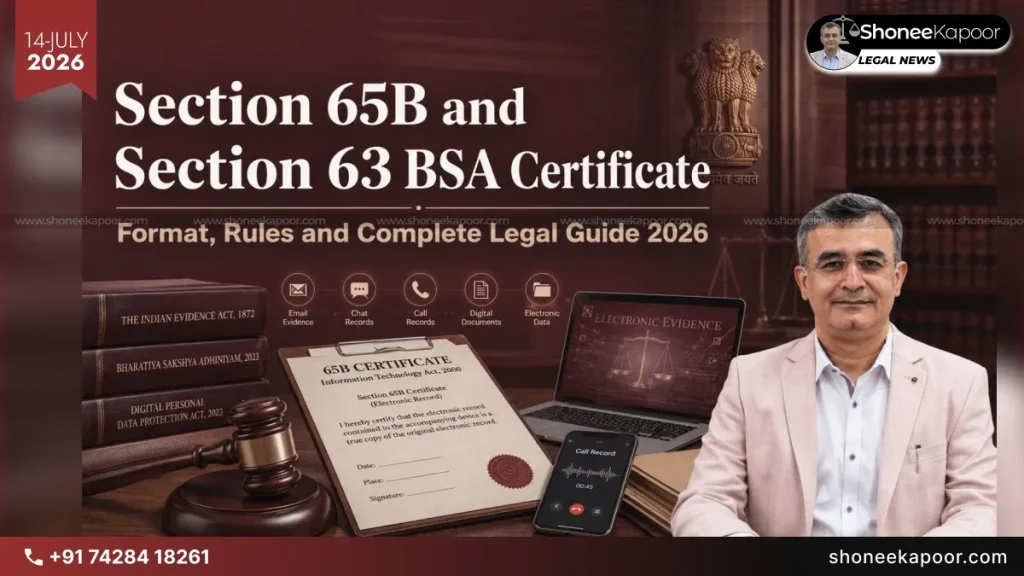
Your WhatsApp Chats Can Still Fail in Court: Section 65B and Section 63 BSA Certificate Guide 2026. Section 65B and Section 63 BSA certificate formats, hash-value requirements, signatories, Supreme Court rulings and filing checklist for electronic evidence.
NEW DELHI: A screenshot may show the truth. A recording may expose a threat. A WhatsApp conversation may dismantle a false allegation. But unless electronic evidence is collected, certified and proved according to law, the court may be compelled to ignore it.
This becomes particularly dangerous in matrimonial, domestic violence, dowry, maintenance, child-custody and sexual-offence litigation. A person may possess the most important conversation in the entire case and still lose the evidentiary battle because the file was improperly exported, the source device was not identified, the certificate was signed by the wrong person or the statutory hash report was missing.
Digital evidence is powerful. It is not lawless.
This guide explains the continuing relevance of Section 65B of the Indian Evidence Act, 1872, the new requirements under Section 63 of the Bharatiya Sakshya Adhiniyam, 2023, the prescribed certificate format, the role of an expert, hash values, filing stages and the latest Supreme Court position applicable in 2026.
The Bharatiya Sakshya Adhiniyam came into force on 1 July 2024. It repealed the Indian Evidence Act but expressly preserved the old Act for proceedings, applications, trials, inquiries, investigations and appeals that were already pending immediately before its commencement.
KEY HIGHLIGHTS
Section 65B has not disappeared completely. It continues to govern matters protected by the BSA’s savings clause.
Section 63(4) BSA is the new certificate provision. It introduces a prescribed statutory Schedule, hash-value disclosure, a hash report and separate declarations by the person controlling the device and an expert.
A certificate does not automatically prove that the contents are true. It addresses admissibility and the method by which the electronic record was produced. Identity, authorship, relevance, manipulation and evidentiary weight may still be contested.
The certificate should ordinarily accompany the electronic record whenever it is submitted for admission.
A person can certify only the system or process within his or her knowledge and control. A police officer who merely receives telecom records cannot ordinarily certify how the telecom company originally generated those records.
1. SHOULD YOU USE SECTION 65B OR SECTION 63 BSA?
The applicable provision depends upon the BSA’s commencement and savings clause.
Use Section 65B of the Indian Evidence Act when:
The relevant application, trial, inquiry, investigation, proceeding or appeal was already pending immediately before 1 July 2024 and therefore continues under the repealed Evidence Act.
Use Section 63 of the Bharatiya Sakshya Adhiniyam when:
The matter is governed by the BSA after its commencement on 1 July 2024.
The safest course is not to decide this merely from the date on which a screenshot was taken or a recording was created. Examine the date and legal status of the relevant proceeding, investigation or application under Section 170 of the BSA.
The correct legal description under the new law is a certificate under Section 63(4) of the Bharatiya Sakshya Adhiniyam, 2023. It is sometimes casually called a “63 BSA certificate”, but it should not be described as “Section 63B”.
2. WHAT IS AN ELECTRONIC EVIDENCE CERTIFICATE?
Electronic records are different from ordinary paper documents.
A printout, copied video, pen-drive file, downloaded email, screenshot, exported chat or compact disc is normally an output derived from an electronic system. The court needs legally recognised information about:
- the electronic record being produced;
- the device or source from which it came;
- how the copy or output was generated;
- whether the system was regularly used;
- whether it was functioning properly;
- who had lawful control over it; and
- under the BSA, whether the file’s hash value matches the accompanying report.
Section 61 BSA prevents an electronic record from being rejected merely because it is electronic. Section 62 states that its contents are to be proved according to Section 63. Section 63 then lays down the conditions governing computer and communication-device outputs.
Under the old Act, Section 65B performed substantially the same admissibility function, although its certificate structure was less elaborate.
3. SECTION 65B AND SECTION 63 BSA: MAJOR DIFFERENCES
Section 65B of the Evidence Act
The old provision required a certificate that:
- identified the electronic record;
- described how it was produced;
- provided particulars of the device involved;
- addressed the statutory conditions concerning regular use, ordinary-course input and proper functioning; and
- was signed by a person occupying a responsible official position in relation to the device or the relevant activities.
The law did not prescribe a fixed statutory certificate form. It also did not expressly require a hash value or a separate expert declaration.
Section 63 BSA
Section 63 retains the central conditions concerning regular use, ordinary-course information, proper operation and accurate reproduction. However, Section 63(4) requires a certificate in the format prescribed in the Schedule.
The Schedule contains:
- Part A, to be completed by the party or person controlling the device or source;
- Part B, to be completed by an expert;
- source and device-identification fields;
- make, model, serial number, IMEI, MAC address, Cloud ID or other identifiers, wherever applicable;
- the hash value;
- the hashing algorithm used; and
- an enclosed hash report.
The certificate is required at each instance at which the electronic record is submitted for admission.
4. WHAT IS A HASH VALUE AND WHY DOES IT MATTER?
A hash value is a computer-generated alphanumeric value calculated from the contents of a digital file.
Even a minor change in the file will ordinarily result in a different hash value. This makes the hash useful for checking whether the file presented later is identical to the file preserved or examined earlier.
The Schedule to the BSA expressly provides fields for algorithms such as SHA-1, SHA-256, MD5 or another legally acceptable standard. The algorithm actually used must be stated honestly, and the corresponding hash report must be enclosed.
In Pune Bar Association v. Union of India, decided on 22 May 2026, the Supreme Court rejected the argument that the hash and expert-certification requirements were irrational or unnecessarily burdensome. The Court described the hash value as being comparable to an “electronic fingerprint” and recognised the need to protect courts against alteration, manipulation, artificial-intelligence-generated content and deepfakes.
A party should therefore avoid these dangerous practices:
- editing or trimming the original file before calculating the hash;
- forwarding the only copy through messaging applications;
- repeatedly converting the file from one format to another;
- renaming, compressing or processing the file without recording the steps;
- giving the expert a different copy from the one filed in court; or
- copying evidence onto a pen drive without documenting the extraction process.
The hash of the preserved evidentiary file, the expert’s examined file and the file submitted before the court should correspond.
5. WHO MUST SIGN THE SECTION 63 BSA CERTIFICATE?
Part A
Part A should be signed by the person who has lawful control over or responsibility for the device, system, account or activities through which the electronic record was created, stored or produced.
Depending upon the facts, this may include:
- the owner or regular user of a mobile phone;
- the person controlling the email or cloud account;
- the authorised custodian of a CCTV system;
- a company’s records officer or system administrator;
- the manager responsible for a digital recording system; or
- another person who can truthfully certify the statutory facts.
A person should not sign Part A merely because the evidence supports that person’s case. The signatory must actually possess the required knowledge and control.
Part B
Part B is to be signed by an expert who calculates or verifies the hash and supplies the required declaration.
In Pune Bar Association, the Supreme Court indicated that expert evidence under Section 39 BSA is not necessarily restricted in every situation to a government-notified Examiner of Electronic Evidence under Section 79A of the Information Technology Act. A person possessing special skill in computer science or cyber forensics may potentially qualify if the court is satisfied about that person’s expertise through reliable material.
However, the Supreme Court expressly kept the broader question of law open rather than delivering a conclusive ruling for every future case.
Accordingly, the safer practice is:
- use a notified electronic-evidence examiner wherever reasonably available; or
- engage a properly qualified cyber-forensics professional;
- annex the expert’s qualifications, experience and identification;
- record the forensic tool and method used;
- preserve the hash-generation report; and
- ensure that the expert is available to testify if the certificate is challenged.
6. LEGACY SECTION 65B CERTIFICATE FORMAT
The following is a practical working format for proceedings governed by the Indian Evidence Act. It should be modified according to the actual device, record and method of extraction.
Certificate Under Section 65B(4) of the Indian Evidence Act, 1872
Before the Court of:
Case Title:
Case Number:
I, [full name], son/daughter/wife of [name], residing at [address], presently working as/being [designation or relationship to the device], state and certify as follows:
- I am in lawful possession, control or responsible charge of the electronic device/system described below and am competent to issue this certificate.
- The electronic record being produced consists of [describe screenshots, chats, emails, audio files, video files, CCTV footage, call records or other material].
- The record has been produced from the following device or electronic source:
Device/source:
Make and model:
Serial number/IMEI/MAC address/account identifier:
Other identifying particulars:
- The device or system was regularly used to store or process information for activities regularly carried on by me or by the organisation having lawful control over it.
- The relevant information was entered, received or stored in the ordinary course of those activities.
- During the material period, the device or system was operating properly. Any temporary malfunction did not affect the accuracy or completeness of the electronic record being produced.
- The electronic record filed before the court is a true and accurate reproduction of the information stored in or derived from the said device or system.
- The record was copied, exported, printed or transferred in the following manner:
[Explain every material step, including the date, software, export function, storage medium and person who performed the process.]
- The statements made in this certificate are true to the best of my knowledge and belief.
Place:
Date:
Name:
Designation:
Signature:
The old Section 65B certificate must substantially cover the matters required by Section 65B(4). A vague statement saying only that “the copy is genuine” is not an adequate substitute for the statutory particulars.
Although a hash is not expressly mandated by the old provision, generating and disclosing one remains valuable for establishing integrity and chain of custody.
7. SECTION 63 BSA CERTIFICATE FORMAT
The actual filing should follow the statutory Schedule. The working structure below is intended to help lawyers and litigants organise the required information; it should not be used to delete or dilute any field appearing in the official Schedule.
Part A: Declaration by the Person Controlling the Device or Source
Court:
Case title and number:
Name of person issuing Part A:
Address:
Relationship to the electronic device or record:
I state and certify that:
- The electronic record submitted before the court is [complete description of the record and file names].
- It was produced from the following source:
Source category: Computer/mobile phone/DVR/server/cloud account/storage device/other
Make:
Model:
Colour, wherever relevant:
Serial number:
IMEI/UIN/UID/MAC address/Cloud ID:
Account or source identifier:
Other relevant details:
- The device or source was under my lawful control and was regularly used for activities carried on by me or the concerned organisation.
- The relevant information was created, received, stored or processed during the ordinary course of those activities.
- The device or source was functioning properly during the relevant period. Any malfunction did not affect the electronic record’s accuracy.
- The electronic record submitted is derived or reproduced from the information contained in the identified device or source.
- The record was extracted or copied through the following process:
[State the date, time, software, export method, destination storage medium and identity of the person conducting the process.]
- The hash value of the electronic record is:
File name:
Hash value:
Hash algorithm: SHA-1/SHA-256/MD5/other legally acceptable standard
Hash report enclosed: Yes/No
Date:
Time:
Place:
Name:
Signature:
Part B: Expert Declaration
I, [expert’s full name], state that I examined or processed the electronic record described in Part A.
Expert’s designation:
Organisation or laboratory:
Qualifications:
Experience in computer science, digital forensics or cyber forensics:
Source/device examined:
Make and model:
Serial number/IMEI/MAC address/Cloud ID:
Files examined:
Tool or software used:
Hash algorithm used:
Hash value generated or verified:
Hash report enclosed: Yes
I certify that the above hash was generated or verified from the identified electronic record through the stated process.
Date:
Time:
Place:
Name:
Designation:
Signature:
The statutory Schedule should be reproduced faithfully in the final court filing. Additional pages may be annexed where there are multiple devices, numerous files or technical details that cannot fit within the prescribed fields.
8. IS THE CERTIFICATE MANDATORY?
As a general rule, a certificate is mandatory when a party relies upon a copied or derived electronic output rather than proving the original electronic record directly through the original system and competent witness.
In Anvar P.V. v. P.K. Basheer, the Supreme Court held that secondary electronic evidence governed by Section 65B could not be admitted through the ordinary secondary-evidence provisions.
In Arjun Panditrao Khotkar v. Kailash Kushanrao Gorantyal, the Supreme Court reaffirmed that the certificate is a condition precedent for admissibility of a copied electronic record. It overruled the contrary relaxation adopted in Shafhi Mohammad v. State of Himachal Pradesh.
The exception discussed in Arjun concerns production of the original device or original electronic record by a person who owns or operates it and can prove it through direct evidence. This exception should be used cautiously.
Simply carrying a mobile phone to court after filing printed screenshots does not automatically establish:
- that the screenshots are complete;
- that they came from the same phone;
- that no part was edited;
- that the opposite party authored the messages;
- that the account or number belonged to the alleged sender; or
- that the device remained unaltered.
For BSA-era litigation, supplying the Section 63 certificate and hash documentation is generally the safer course even where the original device is also preserved.
9. WHEN SHOULD THE CERTIFICATE BE FILED?
Section 63(4) states that the certificate is to accompany the electronic record at each instance when it is submitted for admission.
The ideal practice is therefore to file it:
- with the complaint, petition, written statement, reply or evidence affidavit when electronic records are being relied upon;
- with the electronic record when it is tendered or marked;
- with any subsequently produced electronic record; and
- again where a fresh copy, storage medium or materially different electronic output is submitted.
Can a Certificate Be Filed Later?
The Supreme Court has recognised that failure to file a Section 65B certificate with a charge sheet or at the earliest stage is not invariably fatal. A certificate may, in appropriate circumstances, be permitted later while the trial is still continuing, provided the opposite party is not prejudiced and the requirements of a fair trial are protected.
In State of Karnataka Lokayukta v. M.R. Hiremath, the Supreme Court held that the relevant need for the certificate arises when the electronic record is sought to be produced in evidence; absence of the certificate at the charge-sheet stage was not by itself fatal.
Arjun Panditrao also recognised judicial power to summon or permit a proper certificate where the party had taken reasonable steps but could not obtain it from the person controlling the device or system.
This does not mean litigants should deliberately file uncertified electronic records and expect the court to repair the case later. Delay may cause prejudice, invite objections or become impossible to cure after the relevant evidence and trial stage have concluded.
10. OBJECTION MUST BE RAISED AT THE CORRECT TIME
An objection concerning an absent or defective certificate should ordinarily be raised when the electronic record is tendered or marked.
Where the defect could have been cured at trial, a party who remained silent may face difficulty raising the issue for the first time in appeal. This principle was discussed in Sonu alias Amar v. State of Haryana and later electronic-evidence cases.
However, lawyers should not assume that every defect is automatically waived. Courts distinguish between:
- an objection to the inherent admissibility of the evidence; and
- an objection to the method or mode by which otherwise admissible evidence was proved.
The safest litigation practice is to place a specific objection on record immediately, identifying the missing certificate, defective signatory, absent source details, broken chain of custody or hash mismatch.
11. A CERTIFICATE CANNOT BE SUBSTITUTED BY ORAL EVIDENCE
A witness cannot ordinarily cure the complete absence of the statutory certificate merely by entering the witness box and saying that the electronic record is genuine.
In Ravinder Singh alias Kaku v. State of Punjab, the Supreme Court reaffirmed that oral evidence could not replace the mandatory Section 65B certificate for secondary electronic evidence.
In Pooranmal v. State of Rajasthan, decided on 10 March 2026, the Supreme Court excluded call-detail records that were not supported by a valid certificate. The Court reiterated that the certificate identifies the source, explains the manner of production and supports authenticity; oral evidence cannot simply stand in its place. The appellant was ultimately acquitted because the prosecution’s circumstantial chain remained incomplete.
The certificate must exist in the required legal form. Confidence, accusation and oral repetition cannot replace statutory compliance.
12. CERTIFY ONLY WHAT YOU ACTUALLY CONTROL
This is one of the most important lessons from the Supreme Court’s 2026 decisions.
In State of Tamil Nadu v. Ponnusamy, telecom call-detail records had been emailed to a police officer. The officer printed them and issued his own certificate.
The Supreme Court held that the officer could, at most, establish the receipt and printing of the files from his system. He could not certify how the telecom operator’s systems originally generated or maintained the call records. A proper certificate from the competent telecom custodian was required, along with proof of the transmission chain. The Court also noted concerns arising from editable spreadsheet files and unproved emails.
The rule is simple:
A recipient may certify the recipient’s own computer process. The recipient cannot manufacture knowledge about another organisation’s source system.
For example:
- A husband can certify the export made from his own phone.
- He cannot certify the internal server records of WhatsApp or a telecom operator.
- A police officer can certify copying a file from a police computer.
- The officer cannot automatically certify how a private CCTV system originally recorded it.
- A lawyer can certify neither the client’s phone nor the service provider’s server merely because the file was emailed to the lawyer.
13. THE CERTIFICATE IS ONLY THE FIRST GATE
A legally compliant certificate does not automatically establish guilt, liability or truth.
The electronic record must still be:
- relevant to an issue in the case;
- properly identified;
- connected to the concerned person;
- shown to be complete;
- proved through an appropriate witness;
- free from unexplained alterations; and
- assessed along with the remaining evidence.
In Kailas Bajirao Pawar v. State of Maharashtra, the Supreme Court criticised a process in which a video disc was merely played before the court without being properly proved through the relevant witness. The trial-court record stated, “All of us saw when the said CD was played.” The Supreme Court stressed that electronic evidence could not simply be admitted in that manner and that the prescribed evidentiary procedure had to be followed.
Where an audio or video is relied upon, the witness should ordinarily identify the occurrence, relevant persons, voices and circumstances. A transcript may assist the court, but the transcript does not replace the recording.
14. WHATSAPP CHATS AND SCREENSHOTS
WhatsApp evidence is frequently produced in matrimonial and criminal litigation, but casually taken screenshots are vulnerable to challenge.
A sound collection process should preserve:
- the original mobile phone;
- the relevant phone number and account details;
- the complete conversation, including dates and times;
- surrounding messages necessary for context;
- attached photographs, audio files and documents;
- the native chat export, wherever available;
- details of how the export or screenshot was created;
- the unedited evidentiary files;
- the hash values and reports; and
- the Section 65B or Section 63 certificate, as applicable.
A cropped screenshot may conceal preceding or subsequent messages. A contact name displayed on a phone proves only the name under which the number was saved by that phone’s user. It does not, by itself, prove the legal identity of the sender.
Authorship may require supporting evidence such as:
- admissions;
- phone-number ownership;
- replies demonstrating personal knowledge;
- linked bank transactions;
- device recovery;
- witness testimony;
- surrounding conduct; or
- forensic examination.
15. CCTV FOOTAGE
For CCTV evidence, identify:
- the premises and exact camera;
- the DVR or NVR;
- camera number;
- date and time displayed;
- whether the system clock was accurate;
- make, model and serial number;
- the person responsible for the CCTV system;
- extraction date and method;
- storage medium used;
- file name, format and duration;
- hash value; and
- every person who handled the footage.
The certificate should ordinarily come from a person who controlled or managed the CCTV system, accompanied under the BSA by the expert portion and hash report.
Where police seize a DVR or copy footage, the seizure memo, extraction memo, storage device, seal details, forensic process and chain of custody should be preserved separately.
In Chandrabhan Sudam Sanap v. State of Maharashtra, the investigating officer admitted during cross-examination: “I was aware that while collecting the electronic evidence, the certificate is required.” The Court treated the absence of the certificate and the timely objection as legally significant while examining the CCTV material.
Knowledge of the requirement without actual compliance does not make the evidence admissible.
16. AUDIO AND VIDEO RECORDINGS
For an audio or video recorded on a mobile phone:
- preserve the original device;
- do not trim, enhance or rename the only evidentiary copy;
- document whether the recording was created through the camera, voice recorder, call-recording application or another application;
- retain file metadata;
- calculate the hash before producing working copies;
- identify the persons and voices through competent evidence;
- prepare an accurate transcript;
- disclose whether any editing or noise reduction was performed; and
- file the correct certificate.
A transcript is useful for reading and reference, but the original recording remains the evidence. The person preparing or verifying the transcript should also be identified.
Where the other side alleges voice manipulation, deepfake generation, splicing or impersonation, forensic voice and file examination may become necessary.
17. EMAILS, CLOUD RECORDS AND SOCIAL-MEDIA MATERIAL
For emails, preserve more than a printed page.
Where possible, retain:
- the original email file;
- full header information;
- sender and recipient addresses;
- message ID;
- date and time;
- attachments;
- download or export method;
- the account from which it was accessed;
- the device used for access; and
- the corresponding hash report.
For cloud or social-media evidence, record the account URL or identifier, date of access, login control, export process and whether the content was publicly visible or obtained from a controlled account.
A printout proves what appeared on the printing device. It does not automatically prove the internal server records of Google, Meta, Microsoft, X or another intermediary.
Provider-generated logs should ideally be certified by the appropriate provider custodian or obtained through a legally recognised investigative or court process.
18. CALL-DETAIL RECORDS AND LOCATION RECORDS
Call-detail records are ordinarily generated and maintained by telecom operators.
The appropriate certificate should therefore come from a competent nodal officer, records custodian or person who can certify the telecom system and the process by which the records were generated.
The prosecution or litigant should also prove:
- the subscriber details;
- the number allegedly used by the concerned person;
- the relevant period;
- the extraction request and response;
- the officer or system through which the files were supplied;
- email or storage-media transmission;
- cell-tower details, where relied upon;
- the meaning of technical fields; and
- the continuity of custody.
A CDR may show communication between numbers. It does not automatically prove who physically operated each handset during every call.
Similarly, tower location ordinarily indicates an approximate network area, not the exact physical location of a person.
19. COMMON MISTAKES THAT CAN DESTROY ELECTRONIC EVIDENCE
Filing Screenshots Without Source Details
A screenshot without the source phone, number, account, extraction process or certificate is easy to challenge.
Obtaining a Certificate From the Wrong Person
A recipient cannot certify the sender’s system. A police officer cannot automatically certify a telecom operator’s database. A lawyer cannot certify the client’s device merely because the client shared the file.
Missing Part B Under the BSA
A legacy-style self-certificate alone may not satisfy the prescribed Section 63 Schedule in a BSA-governed matter.
No Hash Report
Writing a hash value on the certificate without generating and enclosing the corresponding report defeats the statutory purpose.
Hashing the Wrong File
The certificate is useless where the expert hashes one file but another file is submitted before the court.
Cropping or Editing Before Preservation
The unedited source file should be preserved first. Working copies may then be created while recording the process.
Breaking the Chain of Custody
Every transfer—from the phone to the computer, computer to pen drive, pen drive to forensic expert and expert to court—should be documented.
Confusing Admissibility With Truth
Even an admissible electronic record may be rejected on merits if its authorship, completeness, relevance or reliability is not established.
Waiting Until the Appeal
A curable objection should be raised when the record is tendered. An appellate court may refuse to entertain a belated objection to the mode of proof.
20. COURT-FILING CHECKLIST
Before filing electronic evidence, verify all the following:
Applicable statute: Section 65B Evidence Act or Section 63 BSA.
Original source preserved: Phone, DVR, server, computer, account or other source.
Record identified: File names, dates, duration and description.
Device identified: Make, model, serial number, IMEI, MAC address or Cloud ID.
Extraction documented: Date, time, software, method and person performing extraction.
No unexplained editing: Original and working copies distinguished.
Hash calculated: Correct file and correct algorithm.
Hash report enclosed: Not merely typed into the certificate.
Part A signed: By a person with actual lawful control or responsibility.
Part B signed: By a properly qualified expert in a BSA matter.
Expert credentials annexed: Particularly where the expert is not a notified Section 79A examiner.
Storage medium identified: Pen drive, optical disc, hard drive or other medium.
Chain of custody recorded: Every handler and transfer documented.
Witness available: To identify the record, participants, voices or events.
Transcript prepared: For material audio or video portions.
Certificate filed on time: Preferably with the electronic record whenever submitted.
Objection recorded promptly: Where the opposing party’s evidence is defective.
LEADING SUPREME COURT DECISIONS AT A GLANCE
Anvar P.V. v. P.K. Basheer, 2014
Secondary electronic evidence must satisfy Section 65B. The ordinary secondary-evidence route cannot be used to bypass the special electronic-evidence provision.
Sonu alias Amar v. State of Haryana, 2017
Objections to a curable defect in the mode of proving electronic evidence should ordinarily be taken when the evidence is tendered.
State of Karnataka Lokayukta v. M.R. Hiremath, 2019
Non-filing of the certificate with the charge sheet is not necessarily fatal. The requirement becomes material when the electronic record is produced in evidence.
Arjun Panditrao Khotkar v. Kailash Kushanrao Gorantyal, 2020
The certificate is a mandatory condition precedent for secondary electronic evidence. Shafhi Mohammad was overruled. Courts may assist in compelling production of a certificate where the party does not control the source.
Ravinder Singh alias Kaku v. State of Punjab, 2022
Oral testimony cannot substitute the mandatory certificate for copied electronic evidence.
Chandrabhan Sudam Sanap v. State of Maharashtra, 2025
The Supreme Court examined the effect of timely objection and absence of the required certificate while dealing with CCTV evidence.
Kailas Bajirao Pawar v. State of Maharashtra, 2025
Merely playing or viewing a disc does not amount to legally proving its contents. The relevant witness and proper evidentiary procedure remain necessary.
Pooranmal v. State of Rajasthan, 2026
Uncertified call-detail records were held inadmissible. Oral evidence could not replace the required certificate.
State of Tamil Nadu v. Ponnusamy, 2026
A police recipient could not certify the telecom operator’s source records merely because the files were received and printed from the police computer.
Pune Bar Association v. Union of India, 2026
The Supreme Court upheld the rationality of the Section 63 Schedule, including hash-value and expert-certification requirements, while keeping certain questions concerning the permissible category of experts open.
CONCLUSION
Electronic evidence is no longer optional in modern litigation. Phones, CCTV systems, emails, social-media accounts, cloud platforms and digital payment records frequently contain the most decisive material in a case.
Yet possession of a recording is not the same as legal proof.
The person relying on electronic evidence must preserve the source, document the extraction, maintain custody, identify the correct signatory, generate the correct hash, attach the expert declaration and present the record through competent witnesses.
For men facing false matrimonial or criminal allegations, this discipline can be the difference between an allegation and an acquittal, between financial ruin and a documented defence, or between parental alienation and proof of what actually occurred.
My rule is simple:
Do not merely save the evidence. Preserve it as though you will have to defend every click, copy and transfer before a court.
FAQ’S
Yes. Section 65B continues to apply to proceedings protected by the BSA’s savings clause. Matters governed by the new law require compliance with Section 63 BSA.
Ordinarily, yes, when screenshots or exported chats are filed as copied electronic records. The source phone, account, extraction process and authorship should also be proved.
A qualified electronic-evidence, computer-science or cyber-forensics expert should sign it. Using a notified Section 79A examiner remains the safest option where available.
A court may permit a later certificate before completion of the trial where the defect is curable and no prejudice is caused. It should not be treated as an automatic right.
No. It addresses admissibility and production. Authenticity, authorship, completeness, relevance and evidentiary weight must still be established.
Legal Disclaimer
This article provides general legal information based on the statutory provisions and reported judicial decisions available up to 13 July 2026. Electronic-evidence requirements may vary according to the nature of the proceeding, source device, applicable procedural law and directions of the concerned court. Case-specific legal and forensic advice should be obtained before extracting, modifying or filing electronic evidence.
The legal position and recent 2026 authorities have been checked against the BSA’s statutory text and the relevant Supreme Court judgments available as of 13 July 2026.