
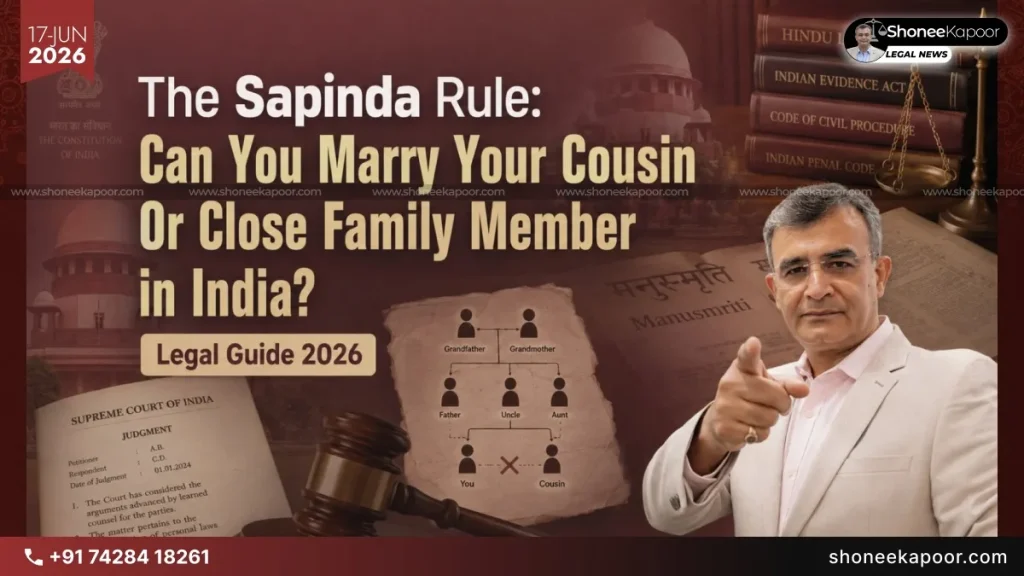
Can Hindus marry cousins or close relatives in India? Read the 2026 legal guide on Sapinda relationship, prohibited marriage, custom exception, void marriage and Delhi High Court rulings.
NEW DELHI: Under Hindu law, you cannot marry a cousin or close family member if both of you fall within the sapinda relationship, unless a legally valid custom or usage governing both parties permits such marriage.
This is not gossip. This is not family pressure. This is law.
In India, marriage is not valid merely because two adults agreed, families attended, rituals happened, photos were taken, or society accepted it. If the marriage violates Section 5(v) of the Hindu Marriage Act, 1955, the court can declare it null and void.
That means the marriage is treated as legally invalid from the beginning.
WHAT IS SAPINDA RELATIONSHIP?
The word “sapinda” is used in Hindu marriage law to identify close blood relationships where marriage is legally restricted.
Section 3(f) of the Hindu Marriage Act, 1955 defines sapinda relationship.
For any person, sapinda relationship extends:
- On the mother’s side: up to the third generation, inclusive.
- On the father’s side: up to the fifth generation, inclusive.
- The person concerned is counted as the first generation.
Two people are sapindas of each other if:
- One is a lineal ascendant of the other within the sapinda limits; or
- Both have a common lineal ascendant who is within the sapinda limits for both of them.
This includes relationships by full blood, half blood, uterine blood, illegitimate blood relationship, legitimate blood relationship, adoption, and blood.
So, people cannot escape the rule by saying “only half relation”, “not same mother”, “not legitimate”, or “adopted relation”. The Act covers these categories.
WHAT DOES SECTION 5(V) SAY?
Section 5 of the Hindu Marriage Act lays down conditions for a valid Hindu marriage.
Section 5(v) says that the parties must not be sapindas of each other, unless the custom or usage governing each of them permits a marriage between them.
This is the key.
- The law does not say every cousin marriage is automatically valid.
- The law does not say every cousin marriage is automatically invalid.
- The law says: check the sapinda relationship first, then check whether a valid custom exists.
CAN YOU MARRY YOUR COUSIN IN INDIA?
For Hindus, Buddhists, Jains and Sikhs governed by the Hindu Marriage Act, the answer depends on the degree of relationship and custom.
You cannot marry a cousin if the cousin falls within the prohibited sapinda range and there is no valid custom permitting such marriage.
Some communities, especially in parts of South India, may have customs permitting certain cousin marriages. But the custom has to be proved. It cannot be casually claimed after the dispute starts.
Court does not accept WhatsApp logic.
Court asks for proof.
FIRST COUSIN MARRIAGE UNDER HINDU LAW
A first cousin marriage will usually fall within prohibited/sapinda relationship under Hindu law, unless a valid custom permits it.
Example:
- Father’s brother’s daughter.
- Mother’s brother’s daughter.
- Father’s sister’s daughter.
- Mother’s sister’s daughter.
These relationships have to be examined under Section 3(f) and Section 5(v). In many cases, such marriages may be hit by sapinda restrictions or prohibited relationship restrictions.
Do not marry first and search Google later.
Take legal opinion before marriage, not after litigation begins.
WHAT IF FAMILIES AGREE?
Family consent does not override the Hindu Marriage Act.
Religious ceremonies do not override the Hindu Marriage Act.
Registration does not cure an invalid marriage.
Living together for years does not automatically validate a void marriage.
Having a child does not convert a void marriage into a valid marriage.
The law is very clear: if the marriage violates Section 5(v) and there is no custom, Section 11 can be used to declare the marriage null and void.
WHAT HAPPENS IF SAPINDA MARRIAGE IS PERFORMED?
If a Hindu marriage violates Section 5(v), then Section 11 of the Hindu Marriage Act becomes important.
Section 11 says that any marriage solemnised after commencement of the Act shall be null and void and may be declared so by a decree of nullity if it violates Section 5(i), Section 5(iv), or Section 5(v).
So, a sapinda marriage without custom is not merely “irregular”.
It is void.
A void marriage means the marriage is treated as if it never had legal existence between the parties.
IS THERE ANY PUNISHMENT?
Yes.
Section 18(b) of the Hindu Marriage Act says that if a person gets a marriage solemnised in violation of Section 5(iv) or Section 5(v), punishment may extend to simple imprisonment up to one month, or fine up to ₹1,000, or both.
The bigger practical consequence is not the fine.
The bigger consequence is this: one party may later walk into court and say the marriage itself was void.
That is where lives get destroyed.
WHAT ABOUT CHILDREN BORN FROM SUCH MARRIAGE?
Section 16 of the Hindu Marriage Act protects the legitimacy of children of void and voidable marriages.
This is important.
Even if the marriage is declared null and void, children are protected as legitimate under Section 16. But rights in property and other consequences have to be examined according to the statute and facts.
The child should not be punished for the legal mistake of adults.
DELHI HIGH COURT: NEETU GROVER V. GAGAN GROVER
The Delhi High Court dealt with this issue in Neetu Grover v. Gagan Grover.
The marriage between Neetu Grover and Gagan Grover was declared null and void because the parties were found to be within sapinda relationship and the wife could not prove a valid custom permitting such marriage.
The marriage was solemnised in 1998.
The husband filed a petition seeking nullity.
The Family Court declared the marriage null and void.
The wife challenged the order.
The Delhi High Court dismissed the appeal in 2023.
The important point is this: the court looked at law, relationship, pleadings and evidence. Emotional arguments did not replace legal proof.
DELHI HIGH COURT 2024: CHALLENGE TO SECTION 5(V) FAILED
In 2024, Neetu Grover challenged the constitutional validity of Section 5(v) of the Hindu Marriage Act.
She argued that her marriage was consensual, families had agreed, and such marriages exist in society. She also argued that the provision was discriminatory because it allows exceptions based on custom.
The Delhi High Court rejected the challenge.
The Court noted that competent courts had already found the parties to be sapindas and had held that no valid custom was proved.
The Court did not strike down Section 5(v).
This is a very important message for 2026.
Adult choice is protected in India, but personal choice still operates within statutory restrictions like age, bigamy, prohibited relationship and sapinda relationship.
Freedom to marry does not mean freedom to bypass every legal condition of marriage.
WHAT IS A VALID CUSTOM?
Section 3(a) of the Hindu Marriage Act defines custom and usage.
A custom must be:
- Continuously observed.
- Uniformly observed.
- Observed for a long time.
- Certain.
- Not unreasonable.
- Not opposed to public policy.
- Applicable to the local area, tribe, community, group or family.
- If it is a family custom, it must not have been discontinued.
- This is not easy to prove.
- You need pleadings, evidence, community material, previous examples, witnesses, and consistency.
- One or two examples do not automatically prove custom.
A casual statement like “hamare yahan hota hai” is not enough.
CAN SPECIAL MARRIAGE ACT SAVE COUSIN MARRIAGE?
This is where people make mistakes.
Changing the route of registration does not automatically erase prohibited relationship issues.
The Special Marriage Act, 1954 has its own rules on prohibited degrees. It also recognises exceptions where a custom governing at least one party permits the marriage, depending on the statutory framework.
So, do not assume that court marriage means any cousin marriage becomes valid.
Court marriage is not a magic stamp.
WHAT ABOUT MUSLIMS, CHRISTIANS, PARSIS AND OTHERS?
Sapinda is a Hindu law concept under the Hindu Marriage Act.
Muslim personal law, Christian marriage law, Parsi marriage law and Special Marriage Act rules have their own restrictions.
So, the answer depends on religion, governing law, relationship chart, custom, and the form of marriage.
This blog is mainly about Hindus, Buddhists, Jains and Sikhs governed by the Hindu Marriage Act.
PRACTICAL RELATIONSHIP CHECKLIST BEFORE MARRIAGE
Before marrying a cousin or close relative, check these points:
- Are both parties governed by the Hindu Marriage Act?
- Are they within sapinda relationship?
- Are they within prohibited relationship under Section 5(iv)?
- Is there a valid custom permitting the marriage?
- Can that custom be proved in court?
- Is the custom governing both parties?
- Are both families relying on actual custom or only convenience?
- Was any legal opinion taken before marriage?
- Is there any chance one party may later use this issue to escape legal responsibility?
These questions are uncomfortable.
But litigation is more uncomfortable.
WHY MEN MUST BE EXTRA CAREFUL
As a men’s rights activist and legal consultant, I will say this bluntly.
Many men enter marriage emotionally and understand law only after notices, FIRs, maintenance claims and court summons begin.
In a sapinda marriage dispute, a man may either be trapped in litigation or may use nullity proceedings if the marriage itself was legally void.
But the real lesson is bigger.
- Do not enter a legally risky marriage without understanding consequences.
- Do not depend only on family elders.
- Do not depend only on rituals.
- Do not depend only on registration.
- Do not depend only on “everyone knows this custom”.
In court, feelings do not win.
Evidence wins.
CAN A WIFE CLAIM MAINTENANCE IF MARRIAGE IS VOID?
This depends on the statute invoked, facts of the case, conduct of parties, and judicial interpretation.
Under the Hindu Marriage Act, rights flowing from a valid marriage may be affected if the marriage is declared void.
However, claims under other laws, including maintenance and domestic violence-related provisions, may require separate legal analysis.
Never assume that nullity automatically ends every financial claim.
Also never assume that a void marriage creates the same rights as a valid marriage.
Each case must be handled strategically.
CAN A HUSBAND CHALLENGE A SAPINDA MARRIAGE LATER?
Yes, a party can seek declaration of nullity under Section 11 if the marriage violates Section 5(v).
But delay, conduct, evidence, children, parallel cases, and pleadings may affect litigation strategy.
The central issue remains: whether the relationship falls within sapinda limits and whether a valid custom exists.
If custom is claimed, the burden lies on the party relying on it.
COMMON MYTHS ABOUT COUSIN MARRIAGE IN INDIA
- Myth 1: If both are adults, marriage is always valid.
Wrong. Adults must still satisfy legal conditions. - Myth 2: If parents agree, law cannot interfere.
Wrong. Parents cannot override statute. - Myth 3: If marriage is registered, it becomes valid.
Wrong. Registration is proof of ceremony and record, not a cure for void marriage. - Myth 4: If community accepts it, court will accept it.
Wrong. Custom must be legally proved. - Myth 5: If there is a child, marriage becomes valid.
Wrong. Child legitimacy is protected, but void marriage does not automatically become valid.
CASE LAW SUMMARY
Neetu Grover v. Gagan Grover, Delhi High Court, 2023
The Delhi High Court upheld the decree declaring the marriage null and void. The parties were found to be within sapinda relationship, and the alleged custom permitting such marriage was not proved.
Neetu Grover v. Union of India & Ors., Delhi High Court, 2024
The petitioner challenged Section 5(v) of the Hindu Marriage Act. The Delhi High Court dismissed the challenge and did not strike down the sapinda restriction.
These judgments are crucial because they show that consent, ceremonies and social acceptance cannot defeat statutory restrictions without legally recognised custom.
FINAL LEGAL POSITION IN 2026
Under Hindu Marriage Act, 1955:
- Sapinda marriage is prohibited under Section 5(v).
- The exception is valid custom or usage.
- If there is no valid custom, the marriage can be declared void under Section 11.
- Children of void marriages are protected under Section 16.
- Contravention may attract punishment under Section 18(b).
- Delhi High Court has upheld the validity of Section 5(v).
So, can you marry your cousin in India?
Only if your marriage does not fall within sapinda/prohibited relationship, or if a legally valid and provable custom permits it.
Otherwise, the marriage may collapse in court even after rituals, family consent, social approval and years of living together.
Marriage is not only emotion.
Marriage is law.
Ignore the law, and the law may later ignore your marriage.
FAQs
Only if the cousin does not fall within sapinda/prohibited relationship, or a valid custom permits such marriage.
Yes, if it violates Section 5(v) of the Hindu Marriage Act and no valid custom is proved.
No. Family consent cannot override the Hindu Marriage Act.
No. Registration does not cure a void marriage.
Neetu Grover’s Delhi High Court cases in 2023 and 2024 are key rulings on sapinda marriage and Section 5(v).