
Facing CAW Cell, Mahila Thana or police mediation after wife’s complaint? Learn husband’s rights under BNS 85/86, BNSS 35/173, Arnesh Kumar and Indian court safeguards.
NEW DELHI: Police mediation is where many husbands make their first fatal mistake.
They think it is only counselling.
They go alone. They speak emotionally. They try to look “adjusting.” They sign papers they have not read properly. They accept words like “mistake,” “sorry,” “misunderstanding,” “settlement,” and “return of articles” without understanding the legal meaning.
Then one day they realise that the police mediation room was not a family drawing room.
It was the first legal record against them.
In family disputes, especially complaints involving cruelty, dowry allegations, domestic violence, stridhan, maintenance pressure, child access, or threats of BNS Section 85, a husband must understand one simple rule:
Police mediation is not the final battle. It is the first record.
Handle it like a legal proceeding.
WHAT IS POLICE MEDIATION IN FAMILY DISPUTES?
Police mediation usually happens when a wife or her family files a complaint before a Women Cell, CAW Cell, Mahila Thana, Family Counselling Centre, local police station, SP office, ACP/DCP office, or other police-linked complaint forum.
The complaint may allege cruelty, dowry demand, harassment, domestic violence, non-maintenance, forceful retention of stridhan, threats, beating, extra-marital allegations, child-related issues, or refusal to take the wife back.
The police may call the husband and his family for counselling, reply, clarification, or settlement attempt.
But a husband must know what police mediation is and what it is not.
- Police mediation is not a court trial.
- Police mediation is not a divorce proceeding.
- Police mediation is not a maintenance court.
- Police mediation is not a custody court.
- Police mediation is not a recovery court.
Police mediation is not a place where a husband should be threatened into signing a settlement just because a complaint has been filed.
A police officer can receive a complaint, examine whether a cognizable offence is disclosed, conduct preliminary enquiry where law permits, record statements, call parties as per law, advise settlement if both sides are willing, and proceed further if an offence is made out.
But the police cannot legally force a husband to admit guilt, pay money, accept false allegations, take back a marriage against his will, return articles without inventory, or sign blank papers.
LAW AFTER 1 JULY 2024: WHY HUSBANDS MUST BE MORE CAREFUL IN 2026
India’s criminal laws changed from 1 July 2024.
The old IPC, CrPC and Indian Evidence Act have been replaced by the Bharatiya Nyaya Sanhita, 2023, Bharatiya Nagarik Suraksha Sanhita, 2023, and Bharatiya Sakshya Adhiniyam, 2023.
For matrimonial cruelty cases, the old IPC Section 498A framework is now reflected through BNS Sections 85 and 86.
BNS Section 85 punishes the husband or his relative if they subject a woman to cruelty.
BNS Section 86 explains cruelty. It includes wilful conduct likely to drive a woman to suicide or cause grave injury or danger to life, limb or health, whether mental or physical. It also includes harassment connected with unlawful demand for property or valuable security.
This means not every marital fight is cruelty.
- Every quarrel is not cruelty.
- Every incompatibility is not cruelty.
- Every demand in marriage is not dowry demand.
- Every allegation is not evidence.
But if the complaint contains serious and specific allegations, it cannot be ignored either.
That is why the husband’s approach must be legally sharp, fact-based, and documented from the first police call itself.
THE FIRST RULE: DO NOT TREAT A POLICE CALL CASUALLY
Many husbands receive a call saying:
“Madam ne complaint di hai. Aap kal aa jaiye.”
This is where panic begins.
Some husbands immediately rush to the police station with parents, relatives, neighbours and emotional explanations.
This is wrong.
Before attending, ask politely:
- What is the complaint number?
- Is there any written notice?
- Has an FIR been registered?
- Is this pre-FIR enquiry or post-FIR investigation?
- Under which sections is the complaint being examined?
- Can a copy of the complaint be supplied?
- Who is the Investigating Officer or complaint officer?
This is not arrogance.
This is legal hygiene.
A husband who does not even know whether he is being called for counselling, preliminary enquiry, witness statement, accused notice, or FIR investigation is already walking blind.
IF IT IS PRE-FIR MEDIATION
In many matrimonial complaints, police first conduct counselling or preliminary enquiry before registering FIR.
The Supreme Court in Lalita Kumari recognised that preliminary enquiry may be made in matrimonial and family disputes to see whether a cognizable offence is disclosed.
Under BNSS Section 173, there is also a statutory framework for preliminary enquiry in certain cognizable offences punishable with three years or more but less than seven years, subject to the required permission and timelines.
This is important.
If it is only preliminary enquiry, the husband should cooperate, file a written reply, produce evidence, and avoid emotional oral statements.
The husband should say:
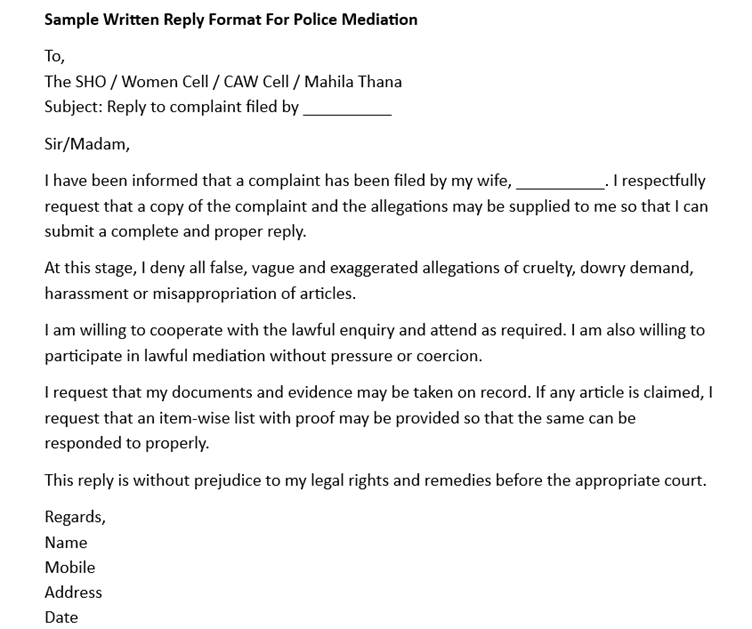
“I am ready to cooperate with the enquiry. Kindly provide me a copy of the complaint. I deny the false allegations. I will submit my written reply along with relevant documents. I am ready for lawful mediation, but I do not admit any allegation.”
This one line can save a man from years of damage.
IF FIR IS ALREADY REGISTERED
If FIR is already registered, the situation is different.
Now it is not merely mediation.
It is criminal investigation.
The husband must immediately consult a criminal lawyer and examine anticipatory bail under BNSS Section 482, compliance with BNSS Section 35 notice, quashing possibilities, evidence preservation, and reply strategy.
If police issue a notice of appearance, comply with it.
- Do not abscond.
- Do not ignore notice.
- Do not argue on WhatsApp with the complainant.
- Do not threaten the wife or her family.
- Do not send angry voice notes.
- Do not make social media posts that can be used against you.
Silence is sometimes better than a foolish defence.
ARNESH KUMAR: NO AUTOMATIC ARREST IN 498A-TYPE CASES
One of the most important judgments for husbands facing matrimonial criminal complaints is Arnesh Kumar v. State of Bihar.
The Supreme Court made it clear that arrest should not be automatic merely because an offence is registered.
The police must apply their mind.
They must examine whether arrest is necessary.
For offences punishable up to seven years, arrest cannot be treated as a routine weapon of pressure.
This is why BNSS Section 35 notice is very important.
If the police issue a notice, attend as directed. Take receiving. Keep proof. Give your reply. Cooperate.
A husband who cooperates lawfully is in a stronger position than a husband who disappears out of fear.
But cooperation does not mean surrender.
Cooperation does not mean confession.
Cooperation does not mean signing whatever is placed before you.
WHAT SHOULD A HUSBAND CARRY TO POLICE MEDIATION?
Do not go empty-handed.
Carry a prepared file.
Your file should have:
- Copy of marriage certificate, if available.
- Copy of wife’s complaint, if received.
- Your written reply.
- Chronology of marriage and disputes.
- Proof of residence.
- Proof of income and liabilities.
- Bank statements showing payments to wife or her family, if relevant.
- Medical records, if false injury allegations are made.
- Travel records, office attendance, hotel bills, CCTV details, FASTag records, call records or location-related material, if relevant.
- WhatsApp chats, emails, SMS, call recordings, photographs, videos and social media screenshots, if legally obtained.
- List of articles received and returned.
- Proof of wife’s employment or income, if relevant.
- Proof of threats, extortion demands, settlement pressure, or contradictory statements.
- Child-related records, if child custody or access is involved.
Do not dump 500 pages before the police.
Make a clean index.
Give only what is relevant.
Keep one copy for police, one copy for yourself, and one copy for your lawyer.
Take receiving on your reply wherever possible.
ELECTRONIC EVIDENCE: PRESERVE IT PROPERLY
In 2026, many family disputes are decided by digital evidence.
WhatsApp chats, call recordings, UPI transfers, emails, photographs, CCTV footage, social media posts, Google location history, bank alerts and voice notes can become crucial.
But electronic evidence must be preserved properly.
Under the Bharatiya Sakshya Adhiniyam, electronic records have to satisfy legal requirements for admissibility. The certificate requirement under Section 63 is now central for electronic records.
This means a husband should not merely take screenshots and relax.
- Export chats.
- Preserve original devices.
- Keep backups.
- Do not edit files.
- Do not crop messages selectively.
- Do not fabricate evidence.
- Do not delete conversations in anger.
- Maintain date, time, phone number and context.
If you are relying on electronic evidence, get proper legal guidance for Section 63 compliance.
Evidence saves innocent men.
Stories do not.
WHAT SHOULD A HUSBAND SAY IN POLICE MEDIATION?
A husband should be calm, precise and legally disciplined.
He can say:
“I deny the allegations.”
“I am ready to cooperate with the police.”
“I request a copy of the complaint.”
“I will file a detailed written reply.”
“I am willing to participate in lawful mediation without pressure.”
“I do not admit cruelty, dowry demand or harassment.”
“If any article is claimed, kindly ask for a proper list with proof, and I am ready to respond item-wise.”
“If settlement is discussed, it must be reduced into a proper written settlement and placed before the competent court wherever required.”
This is enough.
- You do not need to narrate your entire married life like a film script.
- You do not need to cry.
- You do not need to beg.
- You do not need to abuse the wife.
- You do not need to prove your innocence in one sitting.
You need to create a clean legal record.
WHAT SHOULD A HUSBAND NEVER SAY?
Never say:
“Yes, some mistakes happened,” if you do not know what mistake is being recorded.
“I am sorry for everything,” if false allegations are being made.
“I will pay whatever she wants,” under pressure.
“I will take her back,” if the marriage has completely broken and you are saying it only out of fear.
“My parents may have said something,” without clarity.
“We will return all dowry,” if you deny dowry.
“Write anything, I just want peace.”
These lines look harmless in the police station.
Later they can become admissions.
In matrimonial litigation, loose words become sharp weapons.
NEVER SIGN THESE DOCUMENTS BLINDLY
A husband should never sign:
- Blank paper.
- Undated settlement.
- One-sided apology.
- Statement written in language he does not understand.
- Document saying “all allegations are correct.”
- Document saying “dowry articles are pending” without item-wise list.
- Document promising payment without full and final terms.
- Document saying wife will withdraw cases without mentioning specific case numbers.
- Document dealing with divorce, maintenance, custody or criminal quashing without legal drafting.
A bad settlement is not peace.
It is future litigation in writing.
STRIDHAN AND ARTICLES: HANDLE WITH INVENTORY, NOT EMOTION
Stridhan disputes are common in police mediation.
The wife’s side may give a long list of jewellery, cash, furniture, electronics, clothes, gifts and alleged dowry articles.
The husband’s side often panics and says:
“Jo chahiye le lo, bas case mat karo.”
This is dangerous.
If articles are to be returned, insist on:
- Written list.
- Bills, photographs or proof wherever possible.
- Item-wise verification.
- Condition of articles.
- Date and place of return.
- Presence of witnesses.
- Video recording, if legally safe and permitted.
- Police or mediator acknowledgment.
- Receiving from wife or authorised person.
No husband should return articles casually without proof.
Tomorrow the allegation may be that nothing was returned.
Or that more articles are pending.
Or that jewellery was replaced.
Or that cash was never returned.
In stridhan matters, inventory is protection.
CAN POLICE FORCE A HUSBAND TO PAY MONEY?
No.
Police mediation cannot become a recovery counter.
If both parties voluntarily settle, financial terms may be discussed.
But police cannot force a husband to pay lakhs or crores merely because a complaint is pending.
Maintenance is decided by the competent court. Permanent alimony is decided through proper matrimonial proceedings or settlement. Criminal case quashing is done by the High Court in appropriate cases. Divorce is granted by a competent court. Custody and visitation are decided by courts.
A police station cannot replace all courts.
If you are ready to settle, settle properly.
- Mention all cases.
- Mention all parties.
- Mention payment schedule.
- Mention mode of payment.
- Mention withdrawal/quashing obligations.
- Mention divorce terms.
- Mention child custody and visitation.
- Mention stridhan.
- Mention no future claims.
- Mention consequences of breach.
A settlement without legal completeness is an invitation to the next case.
IF THE OFFICER SAYS “COMPROMISE TODAY OR FIR”
Stay calm.
Do not fight.
Do not insult the officer.
Say politely:
“Sir/Madam, I am willing to cooperate and participate in lawful mediation. I request that the complaint copy and allegations be supplied to me so that I can give a proper written reply. I do not want to sign anything under pressure.”
If pressure continues, your lawyer may send a representation to the SHO, ACP/DCP, SP or higher authority, depending on the state and facts.
If there is a real threat of arrest, move anticipatory bail.
If FIR is false and legally unsustainable, examine quashing.
If relatives are being dragged with vague allegations, rely on specific Supreme Court judgments against omnibus implication of family members.
VAGUE ALLEGATIONS AGAINST WHOLE FAMILY
A common pattern in matrimonial complaints is this:
Husband, father-in-law, mother-in-law, brother-in-law, sister-in-law, married sister, distant relative, everyone is named.
The allegation is often general:
“They all harassed me.”
“They all demanded dowry.”
“They all tortured me.”
“They all supported the husband.”
Courts have repeatedly cautioned against vague and omnibus allegations, especially against relatives who do not have a specific role.
In Kahkashan Kausar, the Supreme Court warned against proceeding against relatives on general allegations without specific material.
In Dara Lakshmi Narayana, the Supreme Court again noticed the misuse of cruelty provisions as a tool for personal vendetta and pressure in matrimonial disputes.
This does not mean every wife is false.
It means every accused person deserves specific allegations, specific role, specific date, specific act and specific evidence.
Criminal law cannot run on family-wide blame.
COURTROOM REALITY: ALLEGATION IS NOT EVIDENCE
In court, the question is never:
“Who cried more?”
The question is:
- What is the allegation?
- When did it happen?
- Where did it happen?
- Who was present?
- What is the proof?
- Was any complaint made earlier?
- Is there medical evidence?
- Is there digital evidence?
- Are there contradictions?
- Is the allegation specific or general?
- Was the entire family named mechanically?
- Was settlement money demanded?
- Was the criminal case used after matrimonial negotiations failed?
This is why a husband must build a defence file from the first police mediation.
POLICE MEDIATION AND DOMESTIC VIOLENCE COMPLAINT
Many husbands confuse Domestic Violence Act proceedings with police mediation.
The Protection of Women from Domestic Violence Act provides civil and protective remedies such as protection order, residence order, monetary relief, custody order and compensation.
The police may assist the aggrieved woman and guide her to appropriate remedies.
But a husband must understand that allegations in a DV complaint also require reply, evidence and legal contest.
Do not ignore DV proceedings thinking “it is only mediation.”
Do not admit domestic violence casually.
Do not agree to residence or maintenance terms without understanding long-term consequences.
Do not make statements that can damage your defence in divorce, custody, maintenance, 85 BNS, dowry or stridhan proceedings.
Family litigation is connected.
One bad sentence in one forum can travel to another forum.
FAMILY WELFARE COMMITTEE AND COOLING PERIOD: USE CAREFULLY
In some jurisdictions, Family Welfare Committee or cooling-period safeguards have been discussed in 498A-type matrimonial disputes.
The Allahabad High Court in Mukesh Bansal gave directions for a cooling period and Family Welfare Committee scrutiny in certain cases.
The Supreme Court in Shivangi Bansal referred to those safeguards.
But husbands must not blindly assume that the same mechanism automatically applies everywhere in India.
Local High Court directions, state circulars, police practice and facts matter.
The correct approach is:
Ask your lawyer whether any Family Welfare Committee, CAW Cell rule, Mahila Thana procedure, mediation rule, or local High Court direction applies in your state.
Do not argue internet law inside the police station.
Use law with precision.
POLICE MEDIATION AFTER SETTLEMENT: DOES IT CLOSE THE CASE?
Not always.
This is one of the biggest misunderstandings.
If no FIR is registered and parties settle, the complaint may be closed as per procedure.
But if FIR is already registered under non-compoundable offences like cruelty, police compromise alone does not automatically erase the FIR.
For criminal proceedings arising out of matrimonial disputes, the High Court may quash proceedings under its inherent powers if the settlement is genuine and the case fits legal parameters.
The Supreme Court in B.S. Joshi recognised that genuine matrimonial settlements can be considered for quashing criminal proceedings to secure the ends of justice.
Therefore, if settlement is reached, make sure the final legal step is also completed.
Settlement on paper is not enough.
Closure must be legally complete.
HUSBAND’S 2026 CHECKLIST BEFORE POLICE MEDIATION
- Confirm whether FIR is registered or not.
- Ask for copy of complaint.
- Ask for written notice, if possible.
- Do not attend blindly with the entire family.
- Prepare written reply.
- Carry indexed evidence.
- Preserve electronic records properly.
- Do not sign blank or vague papers.
- Do not admit cruelty, dowry or harassment casually.
- Do not make emotional payments.
- Handle stridhan only through item-wise inventory.
- Keep proof of attendance.
- Comply with lawful notice.
- Consult lawyer before settlement.
- Seek anticipatory bail if there is genuine arrest threat.
- Examine quashing if FIR is false and legally weak.
- Keep communication polite and written.
- Do not threaten, abuse or retaliate.
- Do not post case details publicly.
- Remember that every statement can become evidence.
ADVICE TO HUSBANDS
Do not be arrogant.
Do not be scared.
Be prepared.
A false complaint is not defeated by shouting.
It is defeated by documents, timelines, evidence, contradictions, lawful conduct and legal strategy.
The system often expects men to compromise first and defend later.
Do the opposite.
Defend first. Mediate only if it is lawful, voluntary and properly recorded.
If the marriage can be saved with dignity, save it.
If settlement is possible without blackmail, settle it properly.
If the allegations are false, fight them with evidence.
But never walk into police mediation as an emotional husband.
Walk in as a legally prepared citizen.
Because in matrimonial disputes, the man who signs casually today may spend the next ten years explaining that signature in court.
FAQs
No. Police can facilitate lawful mediation, but they cannot force confession, payment, apology, reunion, divorce or settlement.
No. Attend only after understanding the complaint, preparing a written reply and preserving evidence.
Not automatically. Arrest must follow BNSS safeguards and Supreme Court guidelines. Cooperate with lawful notice and seek anticipatory bail if there is real threat.
No, not by itself. If FIR is registered, proper court proceedings or High Court quashing may be required after genuine settlement.
Signing vague apologies, payment promises or admissions under pressure. One careless signature can damage the entire defence.