
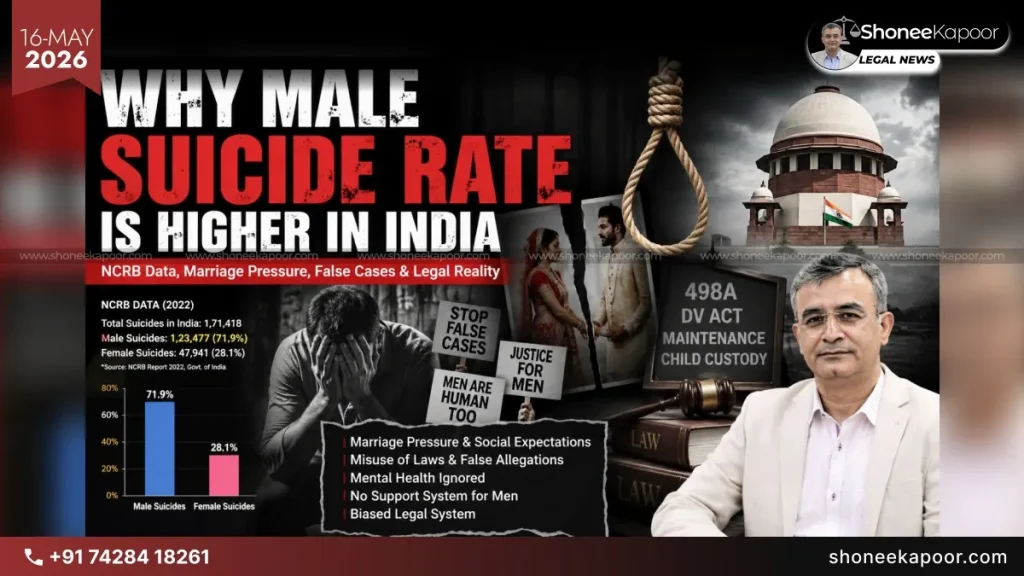
NCRB data shows men form nearly three-fourths of suicide deaths in India. Here is the legal, social and family-court reality behind India’s male suicide crisis.
NEW DELHI: India’s suicide crisis has a gender which is rarely discussed honestly. NCRB data shows that men, especially married and working-age men, are dying by suicide in alarming numbers while law, society and policy continue to ignore male distress.
WHY IS MALE SUICIDE RATE HIGHER IN INDIA?
India does not have a “gender-neutral” suicide crisis. It has a very visible male suicide crisis which is repeatedly softened, ignored or diverted in public debate.
According to the NCRB’s Accidental Deaths and Suicides in India 2023 data, India reported 1,71,418 suicides in 2023, slightly higher than 1,70,924 suicides in 2022. The national suicide rate marginally declined from 12.4 in 2022 to 12.3 in 2023, but the absolute loss of life remained frightening.
The gender split is even more disturbing. NCRB 2023 data shows the male-female suicide ratio at about 72.8 : 27.2, meaning nearly three out of every four persons dying by suicide in India are men.
This is not a small statistical variation. This is a pattern.
Men are dying in silence because Indian society still teaches men to earn, provide, tolerate, absorb humiliation, fight cases, pay maintenance, lose access to children, and remain emotionally unavailable even to themselves.
THE BIGGEST CAUSE: FAMILY PROBLEMS AND ILLNESS
NCRB data repeatedly shows that family problems and illness together account for nearly half of suicides in India.
This is important because male suicide is often wrongly reduced to only “mental health”. Mental health matters, but men are not breaking in isolation. They are breaking inside families, marriages, financial pressure, litigation, unemployment, debt, social shame and the fear of criminal prosecution.
For many Indian men, the crisis is not one event.
It is a chain:
- A failed marriage.
- A false or exaggerated complaint.
- Loss of reputation.
- Police pressure.
- Maintenance proceedings.
- Child access denial.
- Job instability.
- Social isolation.
- No emotional support.
- No institutional support.
When all this comes together, the man is not merely “depressed”. He is legally, socially and financially cornered.
MARRIED MEN ARE NOT BEING SEEN AS VICTIMS
Public sympathy is easily available for women in matrimonial disputes. A woman in distress is quickly seen as a victim. A man in distress is first tested, mocked, doubted or blamed.
That is one reason married men often suffer quietly.
Many men trapped in matrimonial litigation are not only fighting one case. They are fighting a complete legal package: cruelty allegations, dowry harassment, domestic violence proceedings, maintenance, child custody, property pressure, police complaints and social stigma.
Even before conviction, a man can lose his dignity, job prospects, family peace, mental balance and access to his own child.
The law may say “innocent until proven guilty”, but society often treats the husband as guilty from the first allegation.
THE 498A REALITY: PROTECTION LAW, BUT ALSO A PRESSURE WEAPON
Section 498A IPC was enacted to protect married women from cruelty. After the Bharatiya Nyaya Sanhita, 2023 came into force, the corresponding offence is now placed under Sections 85 and 86 BNS, dealing with cruelty by husband or relatives of husband.
Genuine cruelty must be punished. No serious legal discussion should deny that.
But it is equally true that the Supreme Court has repeatedly recognised misuse of Section 498A-type litigation.
In Sushil Kumar Sharma v. Union of India, the Supreme Court upheld the validity of Section 498A but warned that complaints filed with an oblique motive can create “legal terrorism”.
In Social Action Forum for Manav Adhikar v. Union of India, the Supreme Court again noted that while the provision is constitutional and meant to prevent dowry harassment, many instances had come to light where complaints were not bona fide and were filed with oblique motives.
In Rajesh Sharma v. State of U.P., the Supreme Court specifically dealt with the issue of misuse of Section 498A and the need to prevent unnecessary harassment of husband’s relatives.
In Arnesh Kumar v. State of Bihar, the Supreme Court had to remind police officers that arrest is not automatic merely because Section 498A is invoked. This itself shows the ground reality: arrest and criminal process were being used as punishment before trial.
VAGUE ALLEGATIONS DESTROY MEN AND THEIR FAMILIES
One of the most common patterns in matrimonial criminal litigation is the use of vague and omnibus allegations.
The complaint does not say who did what, when, where, how and why. It simply names the husband, parents, sisters, brothers, sometimes even distant relatives.
Courts have repeatedly warned against this practice. Recent Supreme Court and High Court rulings continue to hold that vague allegations without specific overt acts cannot be allowed to become a criminal trial against the entire family.
But by the time the case is quashed, the damage is often already done.
- The father has retired but is running to court.
- The mother is old but standing in criminal proceedings.
- The sister is married elsewhere but named in the FIR.
- The husband is fighting criminal law, family court, maintenance and custody together.
This is not justice. This is process becoming punishment.
WHY MEN DO NOT SPEAK BEFORE IT IS TOO LATE
The Indian man is trained to remain silent.
- If he cries, he is weak.
- If he complains, he is irresponsible.
- If he speaks against false cases, he is anti-woman.
- If he asks for child custody, he is told children belong with the mother.
- If he asks for help, he is told to “adjust”.
- If he breaks, everyone asks why he did not speak earlier.
This hypocrisy kills men.
Male suicide is higher because men have fewer socially acceptable exit points from humiliation, financial collapse, litigation and emotional abuse.
Women are encouraged to share. Men are expected to survive.
ECONOMIC PRESSURE IS A MAJOR FACTOR
NCRB 2023 data shows that daily wage earners accounted for 47,170 suicide deaths, about 28% of all suicides, making them the largest occupational group affected. It also shows that the lowest income group, earning ₹1 lakh or less annually, constituted 66% of total suicides.
This shows that suicide prevention cannot be reduced to counselling alone.
A man without income is not only unemployed. In Indian society, he is often treated as useless.
- A husband without income is still expected to pay.
- A father without income is still expected to provide.
- A litigant without income is still expected to fight.
- A son without income is still expected to support parents.
The economic burden on men is real, measurable and deadly.
FALSE CASES, MAINTENANCE PRESSURE AND CHILD ALIENATION
In matrimonial disputes, many men face three simultaneous wounds.
- First, criminal allegations destroy reputation.
- Second, maintenance litigation creates continuous financial pressure.
- Third, denial of child access creates emotional devastation.
A man may survive one of these. Many do not survive all three together.
Child alienation is especially brutal. A father who was present in the child’s life is suddenly reduced to a visitor, an ATM, or a litigant begging for visitation. The emotional collapse caused by separation from children is rarely acknowledged in courts or society with the seriousness it deserves.
THE LAW MUST PROTECT WOMEN WITHOUT DESTROYING INNOCENT MEN
This debate is not about removing protection for genuine victims. It is about stopping misuse and building balance.
- A genuine victim deserves protection.
- A falsely accused man deserves protection too.
- A child deserves both parents unless one is unfit.
- Old parents should not be dragged into criminal trials without specific material.
- Arrest should not be used as negotiation pressure.
- Maintenance should not become extortion.
- Mediation should not become coercion.
Justice cannot be gender-selective.
WHAT INDIA NEEDS IMMEDIATELY
India needs a serious male suicide prevention framework.
There must be proper study of male suicide linked to matrimonial litigation, false criminal cases, unemployment, child access denial and maintenance pressure.
India also needs gender-neutral mental health outreach, gender-neutral domestic violence recognition, faster quashing of false cases, penalties for malicious prosecution, better father-child access enforcement and legal aid for falsely accused men.
Most importantly, India needs to stop treating male pain as comedy.
A man dying by suicide is not a statistic. He is someone’s son, father, brother, friend or husband.
And many times, he did not want to die. He wanted the torture to stop.
FINAL WORD
The male suicide rate is higher in India because men are expected to carry unbearable pressure without complaint.
- They carry family pressure.
- They carry financial pressure.
- They carry false case pressure.
- They carry social shame.
- They carry the burden of being presumed strong even when they are collapsing.
The law must remain strong against genuine cruelty. But the same law must also be strong against false implication, legal harassment and misuse.
A society that ignores male suicide cannot call itself just.
If India wants to prevent suicides, it must first accept one uncomfortable truth: men are also victims, and many of them are dying because nobody listened in time.
If any person is in immediate distress, call emergency services or contact Tele- MANAS at 14416 / 1800-89-14416 for free mental health support in India.
Tele-MANAS is a Government of India mental health helpline under the Ministry of Health and Family Welfare.
Or the Sahodar 24/7 Helpline at +91-9811850498 for immediate support.
FAQs
Because men face heavy financial, family, marital, legal and social pressure but are rarely encouraged to seek help or speak openly.
NCRB 2023 data shows that nearly three-fourths of suicide deaths in India are by men, with a male-female ratio of about 72.8 : 27.2.
Married men can be highly vulnerable due to family pressure, marital disputes, litigation, maintenance, child custody issues and social shame.
Yes. Section 498A IPC has been replaced in substance by Sections 85 and 86 of the Bharatiya Nyaya Sanhita, 2023.
Yes. False or exaggerated criminal cases can create severe mental, financial and social pressure, especially when combined with arrest fear, court cases, job loss and child access denial.