
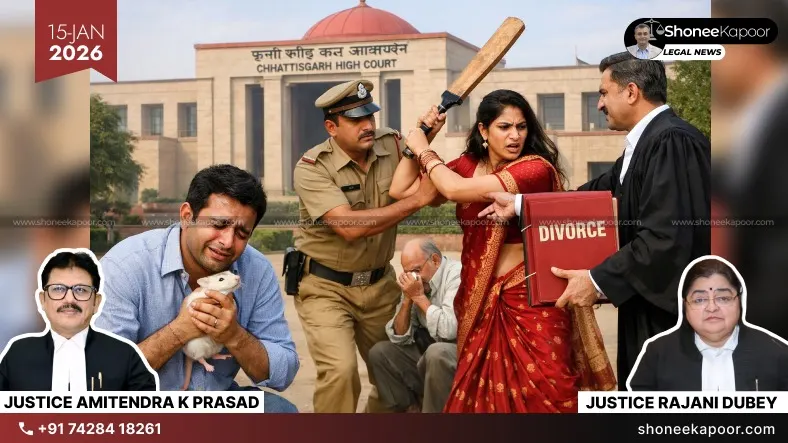
The Chhattisgarh High Court confirmed divorce after finding that forcing a husband to leave his parents and humiliating him amounted to mental cruelty. Despite the wife being a salaried government teacher, the husband was directed to pay ₹5 lakh as permanent alimony.
BILASPUR: The Chhattisgarh High Court has upheld a 2019 Family Court order granting divorce to a 39-year-old bank employee, holding that his wife’s repeated demand that he separates from his parents amounted to mental cruelty under matrimonial law.
While confirming the divorce, Justice Rajani Dubey and Justice Amitendra Kishore Prasad also directed the husband to pay ₹5 lakh as permanent alimony to his wife, a 34-year-old government school teacher earning ₹46,941 per month.
The parties were married on June 28, 2009, and a son was born on June 5, 2010. The child is presently living with the mother in Bilaspur. The husband approached the court stating that soon after marriage, his wife began provoking him against his parents and continuously pressured him to live separately. According to him, this pressure was not occasional but persistent, creating constant mental stress and conflict within the household.
In his testimony, the husband stated that his wife insulted him by calling him a “Paaltoo Chooha” for listening to and respecting his parents. He further alleged that she became aggressive on several occasions, physically assaulted him in front of his mother, and even tried to harm herself during pregnancy. These incidents, he claimed, caused him deep mental trauma and fear, not only as a husband but also as a son responsible for his aging parents.
The husband also told the court that after the birth of their child, he was deliberately excluded from important family ceremonies. He stated that in August 2010, his wife went to her parental home in Bilaspur for the Teej festival and never returned. During the trial, a text message sent by the wife was placed on record, in which she told him that if he wanted her to come back, he must first leave his parents’ house. During cross-examination, the wife admitted that she had sent this message.
On the other hand, the wife denied all allegations of cruelty. She argued that she was never accepted by her in-laws and accused her husband of neglecting her, using abusive language, and consuming alcohol. She claimed that she had made efforts to resume matrimonial life by seeking restoration of conjugal rights, but according to her, the husband refused to take her back.
After examining the evidence, the High Court found that the husband’s version remained consistent and was supported by documentary proof and admissions made by the wife herself. The Court observed that demanding a husband to sever ties with his parents and making the marital relationship conditional upon such separation strikes at the mental peace of the spouse and amounts to mental cruelty. The Court also noted that the wife’s prolonged absence from the matrimonial home clearly established desertion for more than two years before the divorce petition was filed.
The bench concluded that both cruelty and desertion were proved. While affirming the divorce decree, the Court considered the financial status of both parties, including the wife’s regular government income and the husband’s obligation toward their minor child. Taking these factors into account, the Court fixed permanent alimony at ₹5 lakh.
The judgment once again highlights how repeated humiliation, forced isolation from parents, and sustained mental pressure within a marriage can legally amount to cruelty. At the same time, it reflects the complex balance courts attempt to maintain, where even a working husband facing proven cruelty continues to shoulder long-term financial responsibility after the marriage ends.
Explanatory Table: Laws and Legal Principles Applied
| Law / Provision | Explanation in Simple Terms | How It Applied in This Case |
| Hindu Marriage Act, 1955 – Section 13(1)(ia) | Divorce can be granted if one spouse treats the other with mental or physical cruelty | The court held that forcing the husband to leave his parents, humiliating him, and aggressive behavior amounted to mental cruelty |
| Hindu Marriage Act, 1955 – Section 13(1)(ib) | Divorce can be granted if one spouse deserts the other for more than two years | The wife left the matrimonial home in August 2010 and did not return, proving desertion |
| Principles of Mental Cruelty (Judicial Interpretation) | Mental cruelty includes conduct that causes mental pain, fear, or emotional distress | Insults, pressure to separate from parents, and conditional return to marriage were treated as cruelty |
| Permanent Alimony (Judicial Discretion) | Courts may award a lump sum amount after divorce considering income and responsibilities | Despite the wife’s government job, the court fixed ₹5 lakh alimony after considering the child’s welfare |
Case Details
- Case Title: FA(MAT) No. 10 of 2019 | Smt. Monika Tamrakar W/o Prashant Kumar Tamrakar Vs. Prashant Kumar Tamrakar
- Court: High Court Of Chhattisgarh At Bilaspur (Division Bench)
- Bench: Hon’ble Smt. Justice Rajani Dubey & Hon’ble Shri Justice Amitendra Kishore Prasad
- Neutral Citation: 2025:CGHC:44905-DB
- Date of Order: 03.09.2025
- Reserved For Orders On: 21.08.2025
- Counsels
- For Appellant (Wife): Ms. Shrijita Kesharwani, Advocate (appearing on behalf of Mr. R. K. Kesharwani, Advocate)
- For Respondent (Husband): Mr. J. A. Lohani, Advocate & Mr. B. M. Roy, Advocate
Key Takeaways
- Forcing a husband to abandon his parents is legally recognised as mental cruelty, not a normal marital demand.
- Verbal abuse, humiliation, and physical aggression against men inside marriage are valid grounds for divorce.
- Desertion by a wife, even after childbirth, attracts serious legal consequences under matrimonial law.
- Courts may acknowledge cruelty against men, yet financial liability on the husband often continues regardless of the wife’s independent income.
- This case exposes how men are expected to balance parental duty, child responsibility, and post-divorce payments even after proving abuse.
This Could Change Your Case-Get FREE Legal Advice-Click Here!
Disclaimer: The views and opinions expressed in this article are those of the Indian courts and do not necessarily reflect the official policy or position of “ShoneeKapoor.com” or its affiliates. This article is intended for informational and educational purposes only. The content provided is not legal advice, and viewers should not act upon this information without seeking professional counsel. Viewer discretion is advised.