
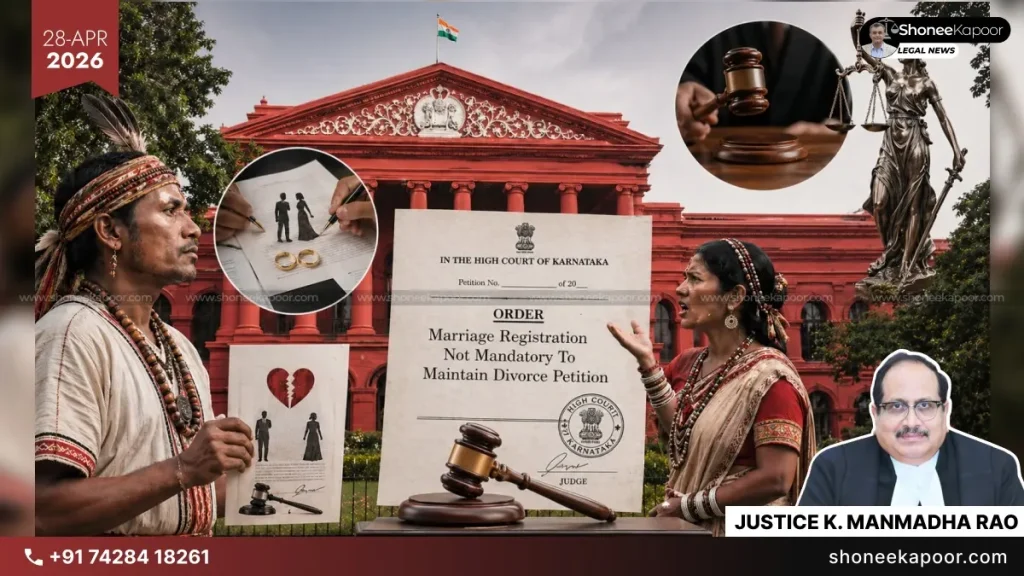
Does an unregistered marriage mean no remedy under the Special Marriage Act?
Karnataka High Court said no, holding that non-registration does not take away divorce rights and a petition under the Special Marriage Act can continue if the marital relationship otherwise existed.
BENGALURU: Justice Dr. K. Manmadha Rao of the Karnataka High Court delivered an important judgment that can help many couples facing legal disputes. The Court clarified that a divorce petition under the Special Marriage Act can be filed even if the marriage was never registered under that law.
The matter arose from a matrimonial dispute where the marriage was performed on 30 April 2006 at Kanakapura according to community customs and traditions. A daughter was born from the marriage. However, due to disputes between the spouses, they started living separately from 2009.
The wife later approached the Karnataka High Court challenging an order passed by the Family Court. She argued that both parties belong to the “Meda” Scheduled Tribe community and therefore, under Section 2(2) of the Hindu Marriage Act, that law does not apply to them. She further claimed that since their marriage was neither solemnized nor registered under the Special Marriage Act, the husband could not file a divorce case under that law.
Earlier, the husband had filed a divorce petition under the Hindu Marriage Act, but the same was dismissed for lack of jurisdiction. After that, he filed a fresh divorce petition under the Special Marriage Act seeking dissolution of marriage.
The wife objected to this and requested the Family Court to reject the case at the initial stage. However, the Family Court refused to do so. Aggrieved by that order, she moved the High Court through a writ petition.
While deciding the matter, Justice Dr. K. Manmadha Rao examined Section 15 and Section 27 of the Special Marriage Act. The Court noted that Section 15 only deals with registration of marriages celebrated in other forms and lays down conditions for such registration.
The High Court clearly held that:
“Section 27 of the Special Marriage Act do not contemplate requirement of registration of the marriage under the Act to maintain an application to seek the decree of divorce.”
The Court further clarified that registration under the Special Marriage Act is optional and not compulsory. It observed:
“Under the provisions of the Special Marriage Act, 1954, registration of marriage is not mandatory.”
Rejecting the wife’s objection, the Court found that there is no legal provision stating that a divorce petition cannot be maintained merely because the marriage was not registered.
The judgment also made it clear that Section 15 only prescribes conditions for registration and does not make registration mandatory for availing divorce remedies under the law.
After considering the facts and legal provisions, the High Court found no error in the Family Court’s decision and declined to interfere.
Finally, the Court ordered:
“The Writ Petition is dismissed.”
The High Court also confirmed that the earlier Family Court order rejecting the wife’s objection application would remain in force.
Explanatory Table: Laws And Sections Involved
| Law / Section | Purpose | How Applied in This Case |
| Article 227, Constitution of India | High Court power to supervise lower courts | Wife filed writ petition challenging Family Court order |
| Hindu Marriage Act, 1955 | Governs Hindu marriages/divorce | Husband’s earlier divorce case filed under this Act |
| Section 2(2), Hindu Marriage Act | HMA does not apply to Scheduled Tribes unless notified by Central Govt | Since parties were Scheduled Tribe members, HMA held inapplicable |
| Section 13, Hindu Marriage Act | Divorce provision under HMA | Earlier divorce case filed under this section |
| Special Marriage Act, 1954 | Law for civil marriages and divorce | Husband later filed case under this Act |
| Section 15, Special Marriage Act | Registration of marriages celebrated in other forms | Wife argued registration was necessary |
| Section 18, Special Marriage Act | Effect/benefits after registration | Court said registration gives benefits but is not compulsory |
| Section 24(2), Special Marriage Act | Void marriages in certain circumstances | Discussed in cited Calcutta HC case |
| Section 27, Special Marriage Act | Divorce grounds under SMA | Main issue before Court |
| Section 27A, Special Marriage Act | Alternative relief of judicial separation | Mentioned in extracted section |
| Indian Penal Code | Criminal law statute | Mentioned inside Section 27(c) SMA |
Case Details
- Case Title: Smt. Rathna P vs Sri. Chikkamanchaiah S.M.
- Case Number: Writ Petition No. 33261 of 2025 (GM-FC)
- Court: High Court of Karnataka at Bengaluru
- Bench: Hon’ble Dr. Justice K. Manmadha Rao
- Date of Judgment: 17 April 2026
- Counsels:
- For Petitioner: Sri. Nataraj Baba K., Advocate
- For Respondent: Sri. Ravisha M.G., Advocate
Key Takeaways
- Marriage registration is not mandatory for seeking divorce, so technical gaps cannot be used to block legal remedies against men.
- Women cannot misuse procedural objections like “non-registration” to delay or frustrate divorce proceedings.
- If one law does not apply (like Hindu Marriage Act for certain communities), alternative legal remedies remain open and valid.
- Courts are recognising that legal process should not become a tool of harassment through repeated objections and litigation tactics.
- Substance of the relationship matters more than paperwork, ensuring men are not trapped due to technical or procedural loopholes.
This Could Change Your Case-Get FREE Legal Advice-Click Here!
Disclaimer: The views and opinions expressed in this article are those of the Indian courts and do not necessarily reflect the official policy or position of “ShoneeKapoor.com” or its affiliates. This article is intended for informational and educational purposes only. The content provided is not legal advice, and viewers should not act upon this information without seeking professional counsel. Viewer discretion is advised.