
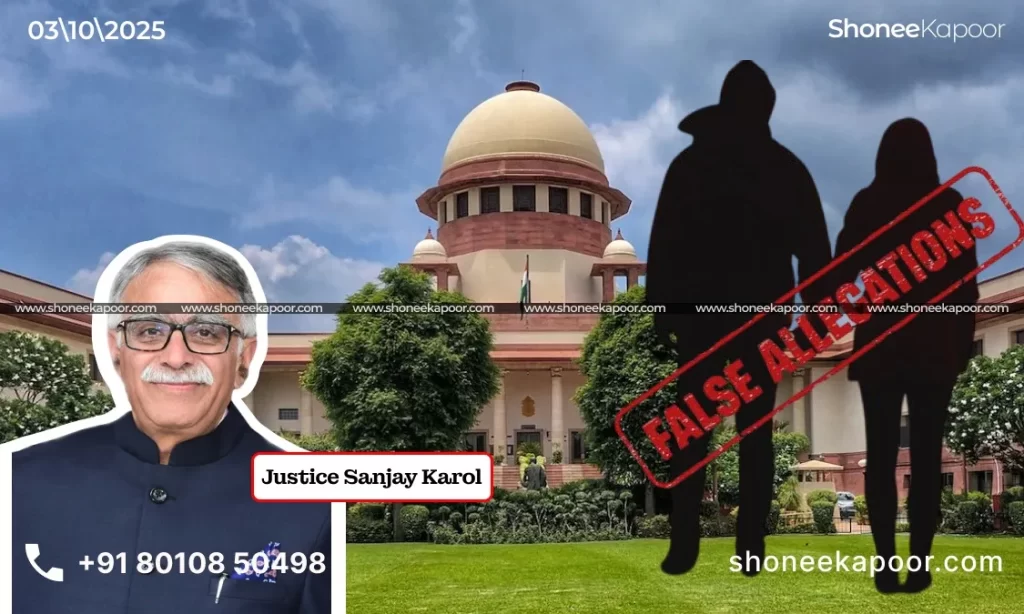
The Supreme Court of India has given major relief to Madhya Pradesh officer Surendra Khawse by cancelling a false rape case filed against him. The court said the Rape FIR was “malicious, vexatious and filed with ulterior motives.”
NEW DELHI: The Supreme Court of India has delivered a very important judgment in the case of Surendra Khawse, an Assistant Revenue Inspector from Madhya Pradesh, who was earlier facing serious charges under Sections 376 and 376(2)(n) of the Indian Penal Code. He was accused of sexual misconduct on the pretext of marriage.
The complaint against him alleged that he had convinced a colleague to enter into physical relations by giving assurance of marriage, but later refused to marry her. This led to an FIR being registered against him. However, after carefully looking into the facts, the apex court has now said that the FIR and chargesheet were not genuine but were “malicious, vexatious and filed with ulterior motives.”
The judges highlighted some very important details in the case. It was pointed out that both the accused and the complainant had been working as colleagues for almost five years. Their personal relationship had later turned bitter. Even before the FIR, Mr. Khawse had already filed several complaints against the complainant regarding harassment, threats of self-harm, abusive language, and acts of intimidation.
The court also noted that the FIR was filed four months after the alleged incident, which created a strong doubt about the genuineness of the complaint. It appeared more like an act of retaliation. In addition, Mr. Khawse had already approached higher authorities, sent show-cause notices, and filed official complaints against the complainant, pointing out continuous harassment.
The Supreme Court bench relied on the powers given under Section 482 of CrPC (now Section 528 of BNSS 2023). This section allows courts to quash false or frivolous criminal cases that are filed only to harass someone. While giving its ruling, the court also referred to previous landmark judgments including Bhajan Lal v. State of Haryana and Mohd. Wajid v. State of U.P.
The court made an important observation:
“In frivolous or vexatious proceedings, the Court owes a duty to look into many other attending circumstances emerging from the record, and with due care and circumspection try to read in between the lines.”
The judges further explained that since the FIR was lodged only after Mr. Khawse had filed his complaints against the complainant, there was a clear possibility that it was motivated by personal vengeance. In very strong words, the bench also added:
“The Court reinforced that justice must protect innocence as fiercely as it protects victims, and legal processes cannot be weaponized for personal vendetta.”
Explanatory Table of All Laws and Sections in This Case
| Law / Section | Provision / Meaning | Relevance in the Case |
| Section 376 IPC | Deals with the offence of rape. Punishment: rigorous imprisonment of not less than 10 years (extendable to life) and fine. | The complainant alleged that Surendra Khawse forced physical relations on promise of marriage. |
| Section 376(2)(n) IPC | Covers repeated commission of rape by the same person. Punishment: rigorous imprisonment of not less than 10 years (extendable to life) and fine. | FIR included this charge, claiming repeated sexual relations under false assurance of marriage. |
| Section 482 CrPC | Inherent powers of High Court to quash criminal proceedings if they are frivolous, vexatious, or filed with mala fide intention. | Supreme Court relied on this to cancel the FIR, noting the malicious intent. |
| Section 528 BNSS 2023 | New Bharatiya Nagarik Suraksha Sanhita (BNSS) provision corresponding to Section 482 CrPC. Gives courts power to quash false or baseless proceedings. | Mentioned as updated law replacing old CrPC section. |
| Bhajan Lal v. State of Haryana (1992) | Landmark case laying down principles for quashing FIRs. It stated that FIRs filed with mala fide intention or without legal grounds can be quashed. | Cited by the Supreme Court to justify quashing of FIR in this case. |
| Mohd. Wajid v. State of U.P. | Another precedent reinforcing courts’ power to quash proceedings that are frivolous or malicious. | Referred to by the bench for legal backing. |
Case Title: Surendra Khawse vs. State of Madhya Pradesh & Anr. (Criminal Appeal No…./2025 @ SLP (Crl) No. 3361/2025)
Counsels
For Appellant (Surendra Khawse):
- Mr. Mrigendra Singh, Senior Counsel
- Assisted by Ms. Niti Richhariya, Advocate-on-Record
For Respondents (State of Madhya Pradesh & Anr.):
- Mr. Bhupendra Pratap Singh, Deputy Advocate General
- Assisted by Ms. Mrinal Gopal Elker, Advocate-on-Record
Bench
- Hon’ble Mr. Justice Sanjay Karol
- Hon’ble Mr. Justice Nongmeikapam Kotiswar Singh
Details
Court: Supreme Court of India
Jurisdiction: Criminal Appellate Jurisdiction
Date of Judgment: 22nd September 2025
Impugned Order: High Court of Madhya Pradesh, Jabalpur (27th January 2025) in Misc. Criminal Case No. 48079/2023
Statutory References:
- Section 528 of BNSS, 2023 (inherent powers of High Court)
- Section 482 CrPC (corresponding provision)
- Sections 376 & 376(2)(n) IPC (alleged offences in FIR)
Supreme Court’s Holding:
- FIR and chargesheet against the appellant quashed.
- Court held the complaint was likely motivated by vengeance and an “afterthought” after administrative actions against the complainant.
- Relied on principles from State of Haryana v. Bhajan Lal (1992), M. Srikanth v. State of Telangana (2019), Balaji Traders v. State of U.P. (2025), and Mohd. Wajid v. State of U.P. (2023).

Disclaimer: The views and opinions expressed in this article are those of the Indian courts and do not necessarily reflect the official policy or position of “ShoneeKapoor.com” or its affiliates. This article is intended for informational and educational purposes only. The content provided is not legal advice, and viewers should not act upon this information without seeking professional counsel. Viewer discretion is advised.