
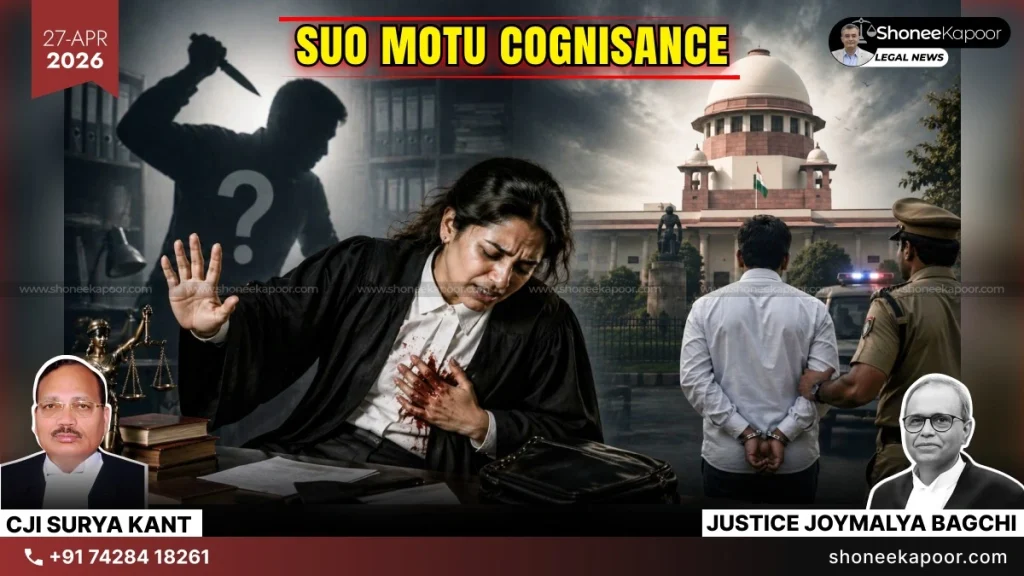
The Supreme Court of India directed that the investigation be handled by a senior police officer to ensure seriousness and transparency.
Will such monitored investigations also guarantee that accused persons are not presumed guilty before trial, especially in emotionally charged matrimonial disputes?
NEW DELHI: The Supreme Court of India took urgent suo motu action after a Delhi woman lawyer was allegedly stabbed by her husband. The Court also raised serious questions on hospitals refusing emergency treatment and protection of the children.
Chief Justice of India Surya Kant, along with Justice Joymalya Bagchi, on Sunday took immediate notice of a shocking case where Delhi advocate Madhu Rajput was brutally attacked and allegedly stabbed by her husband. Treating the matter with urgency, the Supreme Court registered a suo motu case and started hearing it without waiting for any formal petition. The incident has once again raised concerns about growing family disputes turning violent and the failure of authorities to act in time.
During the hearing, the Court was informed that the woman lawyer was attacked inside her husband’s office and suffered serious injuries. Advocate Sneha Kalita told the Bench,
“A lady lawyer was attacked. She was brutally stabbed in the office of her husband. She went somehow made PCR calls and the hospitals refused to take her in,”.
The Court was told that after the incident, the injured woman was first taken to GTB, RK and Kailash hospitals, but she was allegedly denied admission. She was later treated at AIIMS Trauma Centre. Taking serious note of this, the Supreme Court said:
“Let this aspect of non-admission by hospitals be probed into,”.
This direction is important because under Indian law, hospitals cannot refuse emergency treatment to an injured person. If the allegations are true, strict action may follow. At the same time, false or exaggerated claims must also be properly verified through fair investigation. Every side deserves due process.
The Supreme Court also considered the financial condition of the victim and her children. The Bench ordered immediate support and said:
“Since the victim is in need of financial assistance for treatment and to take care of her children, we direct judicial member secretary National Legal Services Authority (NALSA) to grant (financial aid) to the victim. Let the amount be deposited by tomorrow,”.
Additional Solicitor General Aishwarya Bhati informed the Court that the husband had already been arrested and a criminal case was registered. She told the Bench:
“The accused was arrested. The FIR is under section 109(1) BNSS. AIIMS has been treating her. She has been discharged and now in private hospital.”
Even after hearing this, the Court remained concerned about the conduct of the hospitals and asked:
“Why did the hospital deny emergency treatment?”
The interim order also recorded that photographs showed the brutal nature of the injuries and that some injuries affected vital organs. The Court further noted that while the husband had been arrested, the in-laws against whom allegations were made were absconding.
The Bench was also informed that the couple has three minor daughters aged 12 years, 4 years and 1 year. The Court noted:
“The girl children were abandoned by the father. Now they are under care of maternal grandparents,”.
Since the welfare of children is the highest priority in law, the Supreme Court directed police to trace their whereabouts and ensure stability in custody. The Court ordered:
“Let the whereabouts of minor children be found out who were stated to be taken away by the grandparents. If the grandmother is taking care then let the arrangements continue. Let the custody of eldest child be with the maternal grandparents,”
This case is now bigger than one criminal allegation. It concerns domestic conflict, safety inside marriage, medical negligence, child welfare, and fair criminal investigation. In a lawful society, violence by any spouse must be punished, but investigations must remain neutral, evidence-based and free from gender bias. Justice must protect victims, while also protecting due process.
Explanatory Table: Laws And Provisions Involved
| Law / Provision | Purpose | How Applied in This Case |
| Suo Motu Cognisance | Allows Court to start proceedings on its own without waiting for petition | Supreme Court directly registered and heard the matter after receiving information |
| Section 109(1) BNSS | Criminal procedural provision under Bharatiya Nagarik Suraksha Sanhita for FIR/investigation process | State informed Court FIR was registered under this section |
| FIR (First Information Report) | Official start of police criminal investigation | Police registered case against accused husband |
| Power of Constitutional Courts to Monitor Investigation | Ensures fair and effective probe in serious matters | Court ordered senior police officer to investigate |
| Right to Emergency Medical Treatment (Article 21 principles) | Protects life and requires urgent treatment to injured persons | Court questioned hospitals for alleged refusal and ordered inquiry |
| NALSA Victim Assistance Mechanism | Provides legal and financial support to needy victims | Court directed immediate monetary aid to victim |
| Child Welfare Principle | Best interest of child is highest priority in custody matters | Court allowed children to remain with maternal grandparents |
| Due Process of Law | Protects fairness for complainant and accused both | Investigation to proceed lawfully based on evidence |
Case Details
- Case Title: Re: Brutal Assault on a Member of the Legal Fraternity and need For Judicial Intervention
- Court: Supreme Court of India
- Case Number: SMW(c) 4/2026.
- Date of Hearing: 27 April 2026
- Nature of Matter: Suo Motu Cognisance taken by the Supreme Court.
- Bench: CJI Surya Kant & Justice Joymalya Bagchi
- Counsels Appearing:
- For Victim: Adv. Sneha Kalita
- For State: Adv. Aishwarya Bhati
Key Takeaways
- Violence inside marriage is unacceptable, whether committed by husband or wife, and must be punished strictly on evidence.
- Serious allegations should lead to fair investigation, not instant media conviction; due process is essential.
- Hospitals refusing emergency treatment is a grave failure and endangers every citizen, including men falsely ignored in crisis.
- Child welfare must come first in family disputes; children should never become collateral damage of marital conflict.
- Law must remain gender-neutral—protect genuine victims, but also safeguard against false implication and biased investigation.
This Could Change Your Case-Get FREE Legal Advice-Click Here!
Disclaimer: The views and opinions expressed in this article are those of the Indian courts and do not necessarily reflect the official policy or position of “ShoneeKapoor.com” or its affiliates. This article is intended for informational and educational purposes only. The content provided is not legal advice, and viewers should not act upon this information without seeking professional counsel. Viewer discretion is advised