
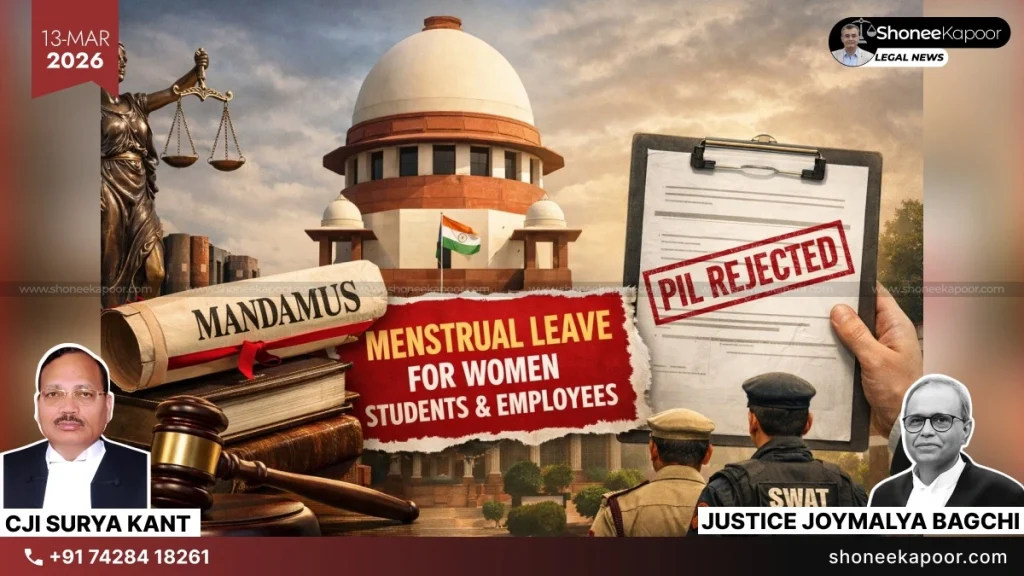
The Supreme Court declined to entertain a PIL seeking mandatory menstrual leave across India, observing that forcing employers to provide such leave could discourage hiring women. The court said the issue lies in the policy domain of the government, leaving the final decision to lawmakers and ministries.
Menstrual Leave Policy PIL: The Supreme Court of India on Friday refused to entertain a Public Interest Litigation seeking a nationwide policy granting menstrual leave to women students and employees across the country. A bench led by Chief Justice Surya Kant and Justice Joymalya Bagchi observed that while the issue may appear beneficial at first glance, making menstrual leave compulsory through legislation could have unintended consequences in employment and social perception.
The petition was filed by Shailendra Mani Tripathi, who sought a uniform national policy that would grant menstrual leave to women in workplaces and educational institutions. During the hearing, the Supreme Court carefully examined whether such a direction should be issued through a judicial order.
The bench expressed concern that mandating menstrual leave through law could lead employers to avoid hiring women altogether. The court noted that legal provisions, if poorly designed, may end up reinforcing gender stereotypes rather than promoting equality.
During the hearing, the bench observed:
“These pleas are made to create fear, to call women inferior, that menstruation is something bad happening to them..this is an affirmative right…but think about the employer who needs to give paid leave,”
Senior advocate M R Shamshad, appearing for the petitioner, argued that certain states and institutions have already introduced menstrual leave or similar relaxations. He referred to the example of Kerala, where some relaxation has been given in schools, and also pointed out that several private companies have voluntarily adopted menstrual leave policies for their employees.
Responding to this submission, the Chief Justice acknowledged that voluntary policies are acceptable but warned against making such provisions compulsory through law. The court highlighted that forcing employers to provide mandatory menstrual leave could discourage them from hiring women in the first place.
The Chief Justice further remarked:
“Voluntarily given is excellent. The moment you say it is compulsory in law, nobody will give them jobs. Nobody will take them in the judiciary or government jobs; their career will be over. They will say you should sit at home after informing everyone,”
The bench also noted that the petitioner had already submitted a representation before the relevant authorities seeking a policy decision on menstrual leave. The court observed that repeatedly approaching the judiciary for a mandamus was unnecessary when the matter was already placed before the competent authority.
The court’s concern also indirectly reflects how legally mandated gender-specific benefits can influence employment patterns. If employers are legally required to provide additional paid leave only to women employees, workplaces may begin to view male and female employees differently in terms of cost and productivity. Such legal mandates could unintentionally create a hiring bias, where employers may prefer male candidates to avoid additional compliance burdens, and it may create a situation where men carry a disproportionate share of day-to-day work pressure.
Explanatory Table: Law And Provisions Involved
| Law / Section | Purpose | How Applied in This Case |
| Article 32 of the Constitution of India | Provides the right to approach the Supreme Court directly for enforcement of fundamental rights. | The petitioner filed a PIL under Article 32 seeking a judicial direction to create a nationwide menstrual leave policy. |
| Writ of Mandamus | A constitutional remedy directing authorities to perform a public or statutory duty. | The petitioner requested the Supreme Court to issue a mandamus directing the government to frame a menstrual leave policy. |
| Separation of Powers (Constitutional Principle) | Ensures that the judiciary, legislature, and executive perform distinct functions. | The Supreme Court indicated that policy decisions like employment leave schemes fall under the executive domain rather than judicial intervention. |
| Article 14 of the Constitution (Equality Before Law) | Guarantees equality before law and equal protection of laws. | The debate around mandatory menstrual leave raised concerns about whether gender-specific benefits could indirectly affect equality in employment. |
| Article 16 of the Constitution (Equality in Public Employment) | Ensures equal opportunity in matters of public employment. | The bench noted that compulsory menstrual leave policies could influence hiring decisions and potentially affect employment opportunities. |
| Labour and Employment Policy Framework | Regulates workplace conditions, leave structures, and employment benefits. | The court observed that such policies should ideally be framed through government consultation and labour policy mechanisms rather than through court directions. |
Case Details
- Case Title: Shailendra Mani Tripathi v. Secretary, Ministry of Women and Child Development, Union of India & Ors.
- Court: Supreme Court of India
- Case Type: Public Interest Litigation (PIL)
- Bench:
- Chief Justice Surya Kant
- Justice Joymalya Bagchi
- Counsel for Petitioner: Senior Advocate M. R. Shamshad
Key Takeaways
- The Supreme Court has acknowledged that mandatory gender-specific leave policies can influence hiring decisions and workplace dynamics.
- If additional legally mandated leave is granted only to one gender, the practical workload in offices often shifts to male employees who remain present at work.
- Policies framed without considering operational realities can unintentionally create workplace imbalance and increased pressure on men.
- Employment benefits must be designed carefully so that they do not indirectly create hiring bias or unequal expectations within teams.
- True workplace equality requires policies that support women without placing disproportionate responsibility or productivity burdens on male colleagues.
This Could Change Your Case-Get FREE Legal Advice-Click Here!
Disclaimer: The views and opinions expressed in this article are those of the Indian courts and do not necessarily reflect the official policy or position of “ShoneeKapoor.com” or its affiliates. This article is intended for informational and educational purposes only. The content provided is not legal advice, and viewers should not act upon this information without seeking professional counsel. Viewer discretion is advised.