
Can Personal Liberty Override Marriage Laws Fixed By Parliament?
The Allahabad High Court held that Article 21 cannot be invoked to defeat statutory restrictions governing marriageable age under Indian law.
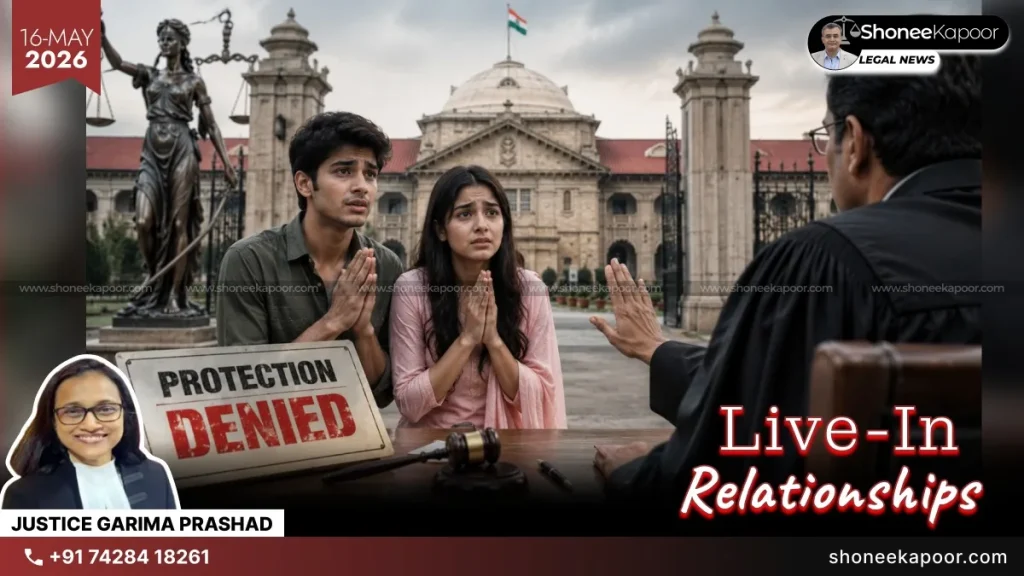
PRAYAGRAJ: The Allahabad High Court refused to grant protection to a live-in couple after observing that the male partner was only 19 years old and therefore still legally treated as a “child” for marriage purposes under Indian law.
The couple had approached the Court seeking police protection and directions restraining their family members from interfering in their relationship. During the hearing, they admitted that they could not legally marry under the Special Marriage Act because the male partner had not yet attained the legally prescribed marriageable age of 21 years.
While examining the Prohibition of Child Marriage Act, Hindu Marriage Act and Special Marriage Act, the Court observed that Parliament has intentionally fixed a higher age threshold for marriage and courts cannot bypass that restriction through live-in relationship protection orders.
The Court stated:
“A male may be an adult under the law of majority upon completing eighteen years of age, but the Parliament has still chosen to treat him as a “child” for marriage until the age of twenty-one.”
The High Court explained that child marriage laws are welfare legislation enacted to prevent immature unions and their long-term emotional, financial and social consequences. According to the Court, the live-in arrangement in the present case was effectively being used as a substitute for marriage because the law itself did not presently permit the couple to marry.
Rejecting the plea, the Court observed:
“The doctrine that what cannot be done directly cannot be permitted to be done indirectly applies with full force here.”
The Court further clarified that consent alone cannot override statutory age restrictions and a relationship cannot be legally protected merely because both parties claim it to be consensual when one party lacks legal capacity under marriage laws.
At the same time, the High Court made it clear that parents and authorities cannot use illegal methods such as threats, violence or confinement against adults. However, lawful action under child marriage laws cannot be restrained by courts.
The Court finally held:
“This Court, in exercise of its writ jurisdiction, cannot grant protection to a live-in relationship in a manner that confers legitimacy upon, or facilitates the continuation of, a relationship which, in substance, operates as a substitute for a marriage that is presently impermissible under the statutory framework governing capacity to marry.”
However, the Court also clarified that even such individuals remain entitled to protection against illegal violence, detention or coercion under Article 21 of the Constitution.
The High Court held that no ground was made out for granting a blanket protection order and accordingly dismissed the writ petition.
Explanatory Table: Laws And Sections Mentioned
| Law / Section | Purpose | Court’s View |
| Article 21 of Constitution | Protects right to life, liberty and personal choice | Personal liberty cannot be used to bypass statutory marriage restrictions |
| Prohibition of Child Marriage Act, 2006– Section 2(a) | Defines a “child” as male below 21 and female below 18 | Male petitioner was still legally treated as a child for marriage purposes |
| PCM Act, 2006, Section 2(b) | Defines what constitutes a child marriage | Relationship involving underage marriage falls within statutory restriction |
| PCM Act, 2006, Section 3 | Makes child marriage voidable at option of child party | Law protects future rights and legal security of child party |
| PCM Act, 2006, Sections 4–7 | Deals with maintenance, custody and legitimacy issues | Shows welfare-oriented framework created by Parliament |
| PCM Act, 2006, Section 11 | Punishes persons promoting or permitting child marriage | Parents and guardians have legal duty to prevent such marriages |
| PCM Act, 2006, Section 13 | Gives Magistrate power to stop child marriage through injunction | Authorities can lawfully intervene before marriage takes place |
| PCM Act, 2006, Section 15 | Declares offences under Act as cognizable and non-bailable | Reflects seriousness attached to child marriage violations |
| PCM Act, 2006, Section 16 | Provides appointment of Child Marriage Prohibition Officers | State machinery has statutory duty to prevent child marriages |
| Hindu Marriage Act, Section 5(iii) | Prescribes minimum marriageable age under Hindu law | Legal age condition is a mandatory requirement for marriage |
| HMA Section 18 | Provides punishment for violating marriage conditions | Violation of age requirement can attract penal consequences |
| SMA Section 4(c) | Fixes marriageable age under secular marriage law | Couple could not legally marry under present statutory framework |
| Special Marriage Act, Section 24 | Declares marriage void if statutory conditions violated | Marriage becomes invalid if mandatory conditions are not fulfilled |
| POCSO Act, 2012 | Protects minors from sexual offences and exploitation | Consent alone cannot override statutory protection principles |
Case Details
- Case Title: Shajiya Parveen and Another vs State of U.P. and 3 Others
- Court: High Court of Judicature at Allahabad
- Case Number: Writ – C No. 469 of 2026
- Bench: Hon’ble Justice Garima Prashad
- Neutral Citation: 2026:AHC:100410
- Date of Judgment: 4 May 2026
- Counsels:
- For Petitioners: Sri Mahipal Singh
- For Respondents: Sri Ashwani Kumar Tripathi, Additional Chief Standing Counsel
Key Takeaways
- Courts cannot use Article 21 to bypass clear statutory marriage laws fixed by Parliament.
- A male below 21 is still legally treated as a “child” for marriage purposes, even if he is a major otherwise.
- Consent alone does not make every relationship legally protected when statutory age restrictions exist.
- Parents cannot use threats or violence, but they still have legal authority to prevent prohibited marriages.
- Live-in relationships cannot become a backdoor method to indirectly legalise what law presently prohibits directly.
This Could Change Your Case-Get FREE Legal Advice-Click Here!
Disclaimer: The views and opinions expressed in this article are those of the Indian courts and do not necessarily reflect the official policy or position of “ShoneeKapoor.com” or its affiliates. This article is intended for informational and educational purposes only. The content provided is not legal advice, and viewers should not act upon this information without seeking professional counsel. Viewer discretion is advised.