
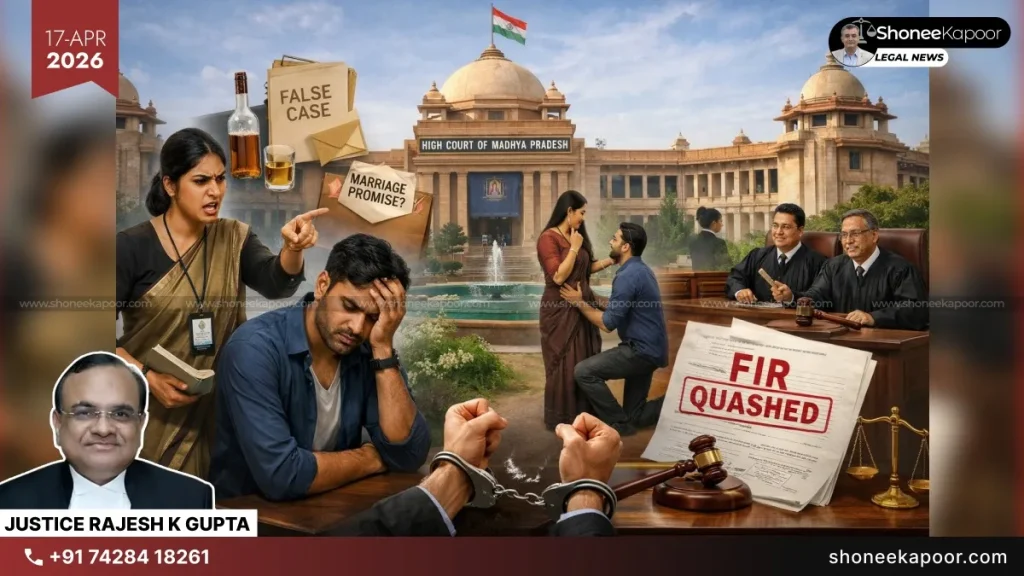
Can a long consensual relationship suddenly become a rape case after marriage talks fail? Madhya Pradesh High Court’s sharp ruling exposes how delayed FIRs can collapse in court.
MADHYA PRADESH: The Madhya Pradesh High Court at Gwalior, led by Justice Rajesh Kumar Gupta, has quashed an FIR in a case involving allegations of rape on false promise of marriage, criminal intimidation, cheating, extortion and Section 67 of the Information Technology Act.
The Court found that the man and woman knew each other for years and remained in a voluntary relationship for a long time.
According to the complaint, the woman said she met the accused in 2018 while travelling to Chhatarpur. She alleged that he offered to drop her in his vehicle, took her to his house saying he had to collect documents, and then served tea and biscuits mixed with an intoxicating substance, due to which she became unconscious, and during that condition the accused committed rape and took obscene photographs of her.
She further alleged that thereafter, on the false promise of marriage, he continued to maintain physical relations with her.
According to the complainant, the accused used those photographs to threaten her, warned of making them viral, and on that basis continued to have sexual relations without her consent and also demanded money from her, which forced her to remain in contact and continue the relationship out of fear and coercion.
The defence argued that both parties were adults, had known each other since 2018 and had continued in a relationship for years. It was also argued that the complainant was an educated woman serving as an Assistant District Prosecution Officer and the FIR was filed much later. The petitioner said this was not a rape case but a failed personal relationship later converted into criminal litigation.
The High Court relied on important Supreme Court judgments such as Pramod Suryabhan Pawar and Uday v State of Karnataka while examining the law on consent and false promise to marry. After considering the facts, the Court observed that the complainant continued the relationship for a long time, and therefore:
“It is inconceivable that the complainant would continue to meet the appellant or maintain a prolonged association or physical relationship with him in the absence of voluntary consent on her part.”
The Court further noted that where parties remain in a consensual relationship for a substantial period, and marriage discussions later fail, criminal prosecution cannot automatically continue.
It held that if a man is accused of sexual relations on false promise of marriage, then the relationship must be clearly connected to a false promise made from the beginning. If the relationship continued knowingly and willingly for years, it cannot automatically be called rape later merely because the relationship ended.
Referring to settled legal principles, the Court observed:
“There is a clear distinction between rape and consensual sex.”
It also held that there must be proper material to show that from the very start the accused never intended to marry. Mere later refusal to marry is not enough to make out an offence of rape.
The High Court found that both parties were major adults and remained in a consensual relationship for around two to three years. It also noted that when the relationship began, the complainant was already married and was fully aware of the surrounding circumstances. Therefore, later refusal to marry could not automatically convert an old consensual relationship into rape.
On the allegation of extortion, the Court noted that material on record showed a cheque of Rs. 3,00,000 issued by the petitioner to the complainant, which made the allegation doubtful at the prima facie stage.
Finally, the Court held:
“Continuation of the criminal proceedings would, therefore, amount to an abuse of the process of law.”
It accordingly quashed the FIR along with all consequential proceedings.
Explanatory Table: Laws And Sections Involved
| Law / Section | Purpose | How Applied in This Case |
| Section 482 Cr.P.C. | Gives High Court power to stop misuse of criminal proceedings | Used to seek quashing of FIR and case |
| Section 376 IPC | Punishes rape | FIR alleged rape based on intoxication and false promise to marry |
| Section 506 IPC | Punishes criminal intimidation | Allegation that complainant was threatened using photographs |
| Section 420 IPC | Punishes cheating and dishonest inducement | Allegation that marriage promise was false |
| Section 384 IPC | Punishes extortion through fear | Allegation that money was demanded through threats |
| Section 67 IT Act | Punishes electronic transmission/publication of obscene material | Allegation that obscene photos would be made viral |
| Section 164 Cr.P.C. | Records statement before Magistrate | Prosecutrix statement considered by Court |
| Section 90 IPC | Says consent under fear or misconception may be invalid | Relevant to false promise to marry argument |
| Section 375 IPC | Defines rape and valid consent | Discussed through Supreme Court precedents |
Case Details
- Case Title: Girraj Sharma Versus The State of Madhya Pradesh
- Case Number: Misc. Criminal Case No. 26644 of 2023
- Court: High Court of Madhya Pradesh at Gwalior
- Bench: Hon’ble Shri Justice Rajesh Kumar Gupta
- Date of Judgment: 11 November 2025
- Neutral Citation: 2025:MPHC-GWL:28659
- Counsels:
- For Petitioner: Mr. Amit Lahoti, Advocate
- For State: Mr. Purshottam Tanwar, Panel Lawyer
- For Complainant: Mr. Sanjay Kumar Sharma, Advocate
Key Takeaways
- Even serious allegations like intoxication and rape will not sustain if the overall facts show a long, voluntary relationship between adults.
- Claims of blackmail, threats, and extortion must be backed by strong evidence, not just allegations.
- Delay in filing complaints and contradictory conduct can weaken allegations and expose misuse of criminal law.
- False promise to marry allegations require proof that deception existed from the very beginning, not just later refusal.
- Courts must intervene where criminal proceedings appear vindictive, retaliatory, or an abuse of legal process.
This Could Change Your Case-Get FREE Legal Advice-Click Here!
Disclaimer: The views and opinions expressed in this article are those of the Indian courts and do not necessarily reflect the official policy or position of “ShoneeKapoor.com” or its affiliates. This article is intended for informational and educational purposes only. The content provided is not legal advice, and viewers should not act upon this information without seeking professional counsel. Viewer discretion is advised.