
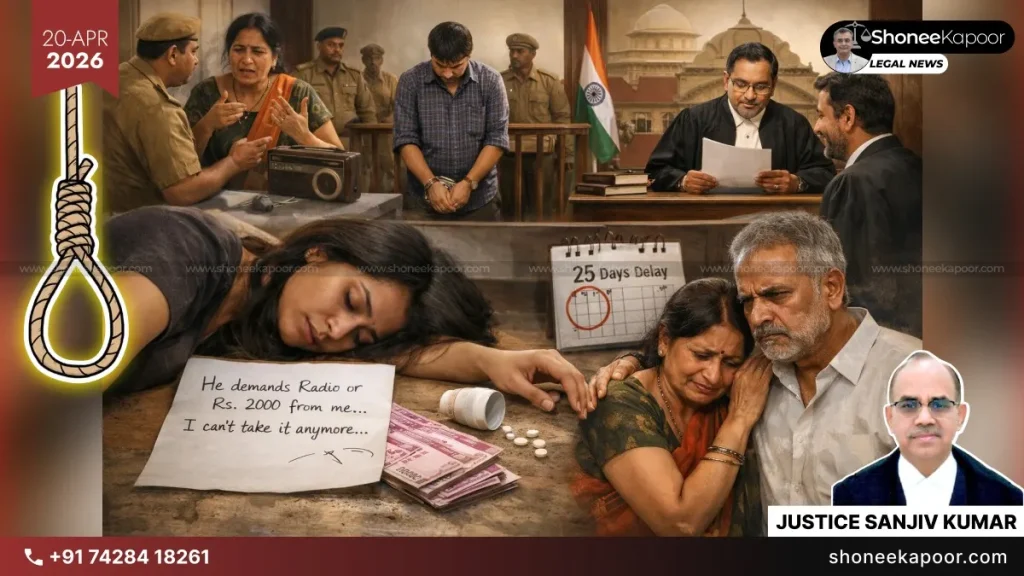
Innocent husband convictedfor more than 4 decades, acquitted later when the Allahabad High Court found no proof of dowry harassment or abetment to suicide.
Is an accusation alone enough to destroy a man’s life? Does justice delayed by the system remain justice at all?
PRAYAGRAJ: The Allahabad High Court, presided over by Justice Sanjiv Kumar, acquitted a husband who had earlier been convicted for abetment of suicide under Section 306 IPC. The Court found that the trial court had relied on weak and incomplete evidence, leading to an unsustainable conviction.
The case arose from allegations registered in 1982, where the husband and his family were accused of harassing the deceased woman over a demand for a radio or Rs.2000. However, the High Court carefully examined the evidence and found serious gaps in the prosecution story. One of the most important issues was a delay of 25 days in filing the FIR.
The Court noted that such delay, without proper explanation, raises strong doubt about the truth of the allegations and creates the possibility of an afterthought.
The Court relied on Meharaj Singh (L/NK.) v. State of U.P., and said:
“FIR in a criminal case and particularly in a murder case is a vital and valuable piece of evidence… Delay in lodging the FIR often results in embellishment… the FIR not only gets bereft of the advantage of spontaneity, danger also creeps in of the introduction of a coloured version or exaggerated story.”
Further, the Court found that the letter written by the deceased asking for a radio or money did not indicate any harassment or pressure from the husband. It was a simple request without any mention of cruelty or coercion. This weakened the prosecution’s claim of dowry harassment.
While explaining the law on abetment of suicide, the Court reiterated principles quoted from S.S. Chheena v. Vijay Kumar Mahajan:
“Abetment involves a mental process of instigating a person or intentionally aiding a person in doing of a thing. Without a positive act on the part of the accused to instigate or aid in committing suicide, conviction cannot be sustained.”
The High Court also referred to Jaydeepsingh Pravinsingh Chavda v. State of Gujarat and made it clear that:
“Mere harassment is not sufficient to constitute an offence under Section 306 IPC, unless it is accompanied by deliberate acts of incitement or facilitation.”
The Court observed that no clear act of instigation or conduct close to the time of death was proved against the husband. There was no evidence showing that he pushed the deceased into a situation where she had no option but to take her life.
The defence version also gained strength as the woman was taken to the hospital by her in-laws, and efforts were made to record her dying declaration. Medical evidence did not clearly support the prosecution’s claim of forced burning, and accidental burn during cooking could not be ruled out.
The Court held that the prosecution failed to prove guilt beyond reasonable doubt and that the conviction was based on assumptions rather than solid evidence. The husband was therefore acquitted, reinforcing the principle that serious criminal charges cannot stand on weak, delayed, and unproven allegations.
Explanatory Table: Laws And Sections Involved
| Law / Section | Purpose | How Applied in This Case |
| Section 306 IPC | Punishes abetment of suicide | Husband was convicted by trial court, but acquitted by High Court due to lack of proof |
| Section 107 IPC | Defines abetment through instigation, conspiracy, or intentional aid | Court examined whether husband instigated or aided suicide |
| Section 374(2) CrPC | Allows appeal against conviction by Sessions Court | Husband filed criminal appeal under this provision |
| Section 207 CrPC | Requires supply of prosecution papers to accused | Mentioned as part of trial procedure before framing charge |
| Section 174 CrPC | Governs inquest proceedings in suspicious death cases | Referred while discussing FIR and inquest timing |
| Section 437-A CrPC | Requires bond after acquittal for future appearance | Mentioned through corresponding BNSS provision |
| Section 481 BNSS, 2023 | New law corresponding to Section 437-A CrPC | Court directed appellant to furnish personal bond of Rs.25,000 |
Case Details
- Case Title: Rameshwar Prasad Gupta v. State of U.P.
- Court: Allahabad High Court
- Case Number: Criminal Appeal No. 205 of 1985
- Bench: Justice Sanjiv Kumar
- Neutral Citation: 2026:AHC:70198
- Date of Judgment: 13.02.2026
- Counsels:
- For Appellant: G.P. Dixit, Kameshwar Singh
- For Respondent: A.G.A.
Key Takeaways
- Men are often made to face criminal prosecution on weak or delayed allegations, but evidence must always meet strict legal standards.
- Mere claims of harassment in matrimonial disputes cannot automatically amount to abetment of suicide without clear proof of instigation.
- Unexplained delay in filing an FIR is a serious warning sign and may indicate afterthought, exaggeration, or fabrication.
- Courts require specific and proximate acts showing intent to drive a person to suicide, not vague accusations or emotional narratives.
- Criminal law cannot be allowed to become a weapon against men in the absence of solid, credible, and legally admissible evidence.
This Could Change Your Case-Get FREE Legal Advice-Click Here!
Disclaimer: The views and opinions expressed in this article are those of the Indian courts and do not necessarily reflect the official policy or position of “ShoneeKapoor.com” or its affiliates. This article is intended for informational and educational purposes only. The content provided is not legal advice, and viewers should not act upon this information without seeking professional counsel. Viewer discretion is advised.