
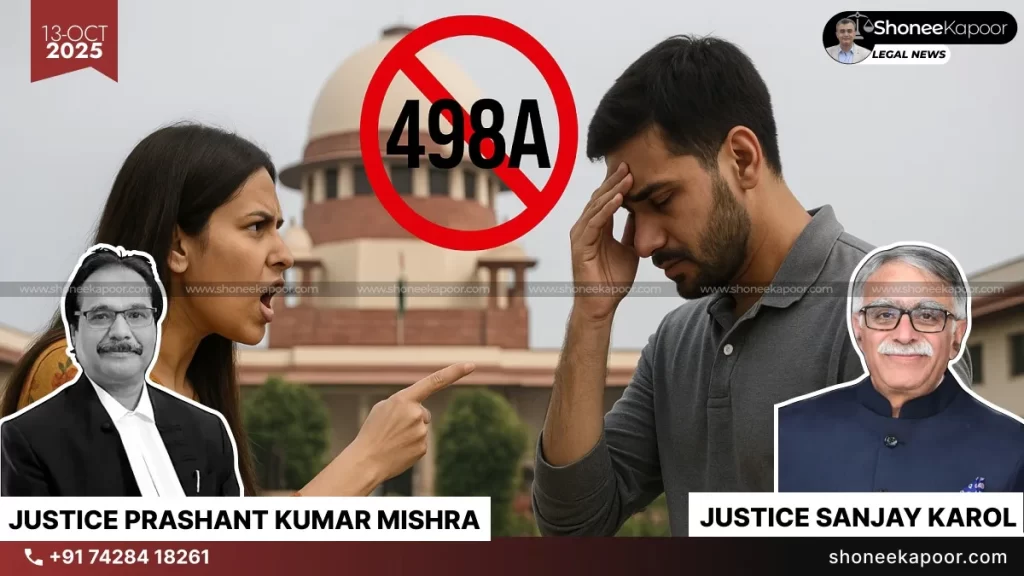
The Supreme Court of India cancelled a 498A dowry harassment FIR filed three years after a couple’s separation abroad. The court said it was a misuse of law since foreign courts had already settled their divorce and custody issues.
NEW DELHI: In a major judgment on September 18, 2025, the Supreme Court of India quashes 498A harassment FIR filed in 2016 by a woman against her ex-husband, observing that the couple’s marital and custody disputes had already been decided by courts in Australia and Austria.
A bench of Justices Sanjay Karol and Prashant Kumar Mishra allowed the appeal of Nitin Ahluwalia, an Australian citizen of Indian origin, who challenged the Punjab and Haryana High Court’s 2017 decision refusing to cancel the FIR. The complaint had been filed on December 7, 2016, by his former wife Tina Khanna Ahluwalia, an Austrian citizen.
Earlier, the High Court had said that the case was still at the “initial stage of investigation” and the husband’s petition was “premature.” But the Supreme Court disagreed, saying that such issues are not always “straight cut cases.”
The bench observed,
“While it is true that elaborate defences and evidence brought on record is not to be considered at this stage, it is equally true that a mechanical approach cannot be countenanced. What renders a judicial mind distinct is its application to the given facts in accordance with law. Therefore, the court ought to have appreciated, at least to some extent, the background in which the respondent filed the subject FIR.”
The judges also expressed sadness over how long the couple’s conflict had continued, affecting their young daughter. The court said,
“We are disappointed in the lack of foresight shown by both parties, particularly when it comes to the well-acknowledged ill effects of continued, strained and hostile relationship between the parents, on a young child. In this case, the child was born in September 2012, and the parents have been in litigation from the time when she was not even a year old to the day this judgment is delivered.”
The husband’s lawyer argued that the FIR did not show any real offence and was only meant to harass him. He said that even after the Austrian court ordered the wife to return the child to Australia, she ignored it, came to India, and then filed the dowry case.
He also pointed out that no such accusations were ever made in Austria or Australia, and the complaint was filed just to take unfair advantage of Indian law.
The wife denied this claim and said she went to the police only after mediation efforts failed. She also said that India is not a signatory to the Hague Convention, so foreign court decrees do not apply here. She argued that custody is a civil matter, while cruelty is a criminal matter, and both are separate issues.
While reviewing the appeal, the Supreme Court noted that if the complaint was seen alone, the High Court’s decision could have made sense. But since the FIR was filed after divorce orders abroad, the timing looked suspicious. The court questioned why she chose to file a criminal complaint almost three years after separation.
The bench said,
“Though this is not expressly prohibited by law, it certainly begs the question as to why despite having been separated from the appellant for almost three years to the date, did the respondent consider filing an application with the police at that relevant time.”
The court added,
“To entertain the possibility that the same is nothing but a counterblast to the fact that the appellant has two orders in his favour, one by the courts in Austria ordering the respondent to bring the child back to Australia and the other, by the courts in Australia, accepting the appellant’s prayer for grant of divorce, does not appear far-fetched.”
The bench remarked,
“On our own analysis, we find the conduct of the respondent to be questionable.”
The judges further pointed out that one of the wife’s allegations hinted at possible child abduction by the husband, but it never became a formal charge.
The order said,
“Even though in the eventual FIR such allegation does not translate into a charge, the mere presence of the statement makes us believe that a picture far from the truth has been painted.”
The court also noted that the wife had taken the child away unilaterally from joint custody, and the timeline of alleged cruelty extended even beyond the period of marriage.
The bench commented,
“We may only wonder how that can be.”
Although India is not a signatory to the Hague Convention, the court clarified that foreign decrees cannot simply be ignored. It stated,
“It cannot be disputed that the courts in Austria had jurisdiction. They decided a dispute as per the applicable law. No occasion whatsoever arises for India to apply its standard.”
Referring to the landmark case State of Haryana v. Bhajan Lal (1992), the Supreme Court held that allowing the FIR to continue would amount to an abuse of legal process.
The couple had married in Panchkula in 2010 and later moved to Australia, where their daughter was born in 2012. In 2013, the wife left for Austria with the child without informing the husband.
He then started custody proceedings in Vienna and divorce proceedings in Australia. After both courts passed orders in his favour in 2016, the wife returned to India and filed a dowry harassment FIR in May 2016.

Finally, the Supreme Court quashed the FIR, giving a clear message that criminal law should not be used as a weapon in personal disputes, especially when foreign courts have already decided the matter.
Explanatory Table – Laws & Sections Mentioned
| Law / Case | Section / Citation | Explanation in Simple Terms (Indian English) |
|---|---|---|
| Indian Penal Code (IPC) | Section 498A | This section punishes a husband or his relatives for cruelty, physical or mental harassment, or dowry-related torture against a wife. Punishment: Up to 3 years in jail and fine. |
| Code of Criminal Procedure (CrPC) | Section 482 | Gives the High Court power to stop misuse of criminal law and quash cases if continuing them would be unfair or unnecessary. |
| Hague Convention (1980) | The Hague Convention on the Civil Aspects of International Child Abduction | An international treaty that helps parents get back children who are taken across countries illegally by one parent. India is not a signatory to this convention. |
| State of Haryana v. Bhajan Lal (1992) | 1992 Supp (1) SCC 335 | Landmark case that listed seven conditions under which FIRs can be quashed to prevent abuse of process or harassment. |
| CBI v. Aryan Singh (2023) | (2023) 18 SCC 399 | Clarified that courts should look only at basic facts in an FIR and not conduct a detailed trial during quashing. |
| Rajeev Kourav v. Baisahab (2020) | (2020) 3 SCC 317 | Reaffirmed that quashing should happen only if no offence is made out, not if allegations are weak. |
| Digambar v. State of Maharashtra (2024) | 2024 SCC OnLine SC 3836 | FIR filed after divorce notice was quashed; Court said it was a “retaliatory measure” against the husband. |
| Jayedeepsinh Pravinsinh Chavda v. State of Gujarat | (2023) — cited in judgment | Clarified that not every act of cruelty counts under Section 498A — it must be intended to cause serious injury or force illegal demands. |
| Family Law Act, 1975 (Australia) | – | Law under which the Australian court granted divorce to the appellant on the ground of irretrievable breakdown of marriage. |
Case Summary
- Case Title: Nitin Ahluwalia vs. State of Punjab & Anr.
- Citation: 2025 INSC 1128
- Court: Supreme Court of India
- Jurisdiction: Criminal Appellate Jurisdiction
- Case Number: Criminal Appeal No. 187 of 2020
- Date of Judgment: September 18, 2025
- Bench (Judges): Justice Sanjay Karol and Justice Prashant Kumar Mishra
- Appellant: Nitin Ahluwalia — Australian citizen of Indian origin
- Respondents: 1. State of Punjab 2. Tina Khanna Ahluwalia (former wife, Austrian citizen)
- Counsel for Appellant: [Not specified in file, usually mentioned in the order sheet]
- Counsel for Respondent: [Not specified in file]
- FIR Details: FIR No. 65 of 2016, filed on 7 December 2016 at Women Police Station, SAS Nagar, Punjab
- High Court Order Appealed Against: Punjab & Haryana High Court judgment dated 23 March 2017 in Criminal Misc. No. M-850 of 2017 (O&M)
- Supreme Court Verdict: FIR and High Court judgment quashed; appeal allowed
- Date of Marriage: 29 November 2010, Panchkula, Haryana
- Child Birth: Daughter born on 29 September 2012, Melbourne
- Separation: Wife left for Austria on 30 June 2013 with the child
- Foreign Court Orders: Vienna District Court and Austrian Supreme Court ordered child’s return to Australia; Australian Federal Circuit Court granted divorce on 1 April 2016
- Complaint Filed in India: May 2016, alleging dowry and cruelty under Section 498A IPC
- Mediation Attempts in India: 4 January 2019 and 27 February 2025 – both failed
- Judgment Delivered by: Justice Sanjay Karol (Authored judgment)

Disclaimer: The views and opinions expressed in this article are those of the Indian courts and do not necessarily reflect the official policy or position of “ShoneeKapoor.com” or its affiliates. This article is intended for informational and educational purposes only. The content provided is not legal advice, and viewers should not act upon this information without seeking professional counsel. Viewer discretion is advised.