
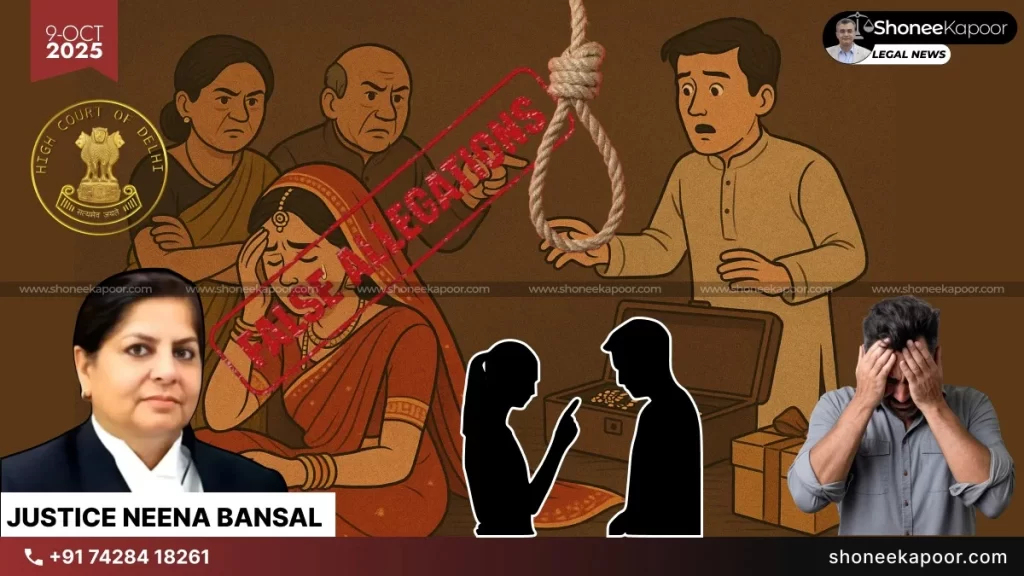
The Delhi High Court quashed a dowry harassment FIR filed after a husband’s suicide within 40 days of marriage, calling the allegations vague and the case a clear abuse of process. Justice Neena Bansal Krishna observed that the complaint lacked credible evidence and was filed to harass the in-laws.
NEW DELHI: The Delhi High Court has quashed a dowry case and cruelty FIR lodged by a woman against her in-laws after her husband took his own life just 40 days after their marriage.
Justice Neena Bansal Krishna observed that the complaint contained only vague allegations and represented an abuse of legal process, stating that “it will not be in the interest of justice to let the criminal proceedings continue.”
The petition was filed by the sister-in-law, father-in-law, and mother-in-law seeking quashing of the charge-sheet in an FIR registered in 2016 under Sections 498A, 406, and 34 of the Indian Penal Code (IPC). The couple had married in March 2016, but soon after, differences arose between the husband and wife.
According to the in-laws, the husband became depressed, disturbed, and frustrated, allegedly because the woman’s family was pressuring and threatening him to live with her “under all circumstances.”
The in-laws further claimed that they were terrorised by the woman’s parents, who threatened to implicate the entire family in a false and frivolous case of dowry and domestic violence.
They maintained that the husband, being mentally and physically harassed by the unwarranted acts and persistent threats extended by the wife and her parents, ultimately committed suicide on April 13, 2016, merely 40 days after the marriage.
After the husband’s death, the woman left the matrimonial home immediately after the cremation, allegedly at the instance of her parents. The deceased’s father filed a complaint seeking a fair investigation to uncover the truth behind the suicide.
However, two months later, the woman filed a counter-complaint before the Crime Against Women (CAW) Cell, accusing her in-laws of dowry harassment, conspiracy, and abetment of suicide.
Justice Krishna noted:
“It was an unfortunate case where the marriage did not survive even for 40 days and the husband committed suicide, resulting in sour relations followed by ugly litigation.”
The court found that the allegations against the sister-in-law were “clearly vague and omnibus, which did not inspire any truth.”
The judge said:
“Rather, it is an unsuccessful attempt to somehow rope in the sister-in-law, without any basis.”
Regarding the father-in-law, the court observed that the woman made only bald allegations of demanding cash, a four-wheeler, and expensive ornaments, seemingly just to make out a complaint under Section 498A IPC.
The bench remarked:
“…the allegations made in the Complaint of dowry harassment, are vague which are not borne out from the record and essentially not supported by any cogent evidence. The present Complaint was filed under Section 498A IPC is clearly, a case of the abuse of process of law and merits quashing in the interest of justice.”
In conclusion, the Delhi High Court held that the dowry harassment case was based on baseless and unsubstantiated claims, and continuing the proceedings would only harass the petitioners further. The FIR and chargesheet were therefore quashed in the interest of justice.
Explanatory Table: Laws and Sections Mentioned in the Dowry Case
| Law / Section | Full Name | Main Objective / Meaning | Punishment / Legal Consequence | Relevance in This Case |
|---|---|---|---|---|
| Section 498A IPC | Cruelty by Husband or Relatives of Husband | Protects married women from cruelty, harassment, or violence by husband or his relatives, especially for dowry. | Imprisonment up to 3 years and fine. | The wife accused her in-laws of cruelty and dowry harassment under this section, but the Court found her allegations vague and baseless, calling it an “abuse of process of law.” |
| Section 406 IPC | Criminal Breach of Trust | Punishes a person who dishonestly misuses or keeps property or articles entrusted to them. | Imprisonment up to 3 years, or fine, or both. | The wife alleged her stridhan and belongings were misused, but no evidence supported this claim. |
| Section 34 IPC | Acts done by several persons in furtherance of common intention | Makes every person involved in a joint act equally responsible for a criminal act done with shared intent. | Punishment same as the main offence committed jointly. | The wife invoked Section 34 to implicate all family members (father-in-law, mother-in-law, sister-in-law), but the Court noted the allegations were general and unsupported. |
| Section 306 IPC (Indirectly Relevant) | Abetment of Suicide | Punishes anyone who instigates or helps another person to commit suicide. | Imprisonment up to 10 years and fine. | Though not directly charged, the wife alleged that her in-laws abetted her husband’s suicide. The Court found no evidence of instigation or cruelty leading to suicide. |
| Section 10(1)(x) Divorce Act, 1869 (Referenced for context) | Grounds of Divorce – Cruelty | Allows divorce if one spouse treats the other with cruelty or causes fear of harm. | Civil remedy (divorce decree). | This is a comparative context — similar “mental cruelty” claims are often misused under 498A; not directly applied here. |
| Crime Against Women (CAW) Cell | Delhi Police Women’s Complaint Cell | Investigates complaints of dowry harassment, domestic violence, and related offences before formal FIR registration. | Not a penal section — a preliminary inquiry body. | The wife filed her complaint before the CAW Cell two months after the husband’s suicide, which the Court termed a counterblast to the father’s complaint. |
- Case Title: Smt. Sarita & Ors. v. State (NCT of Delhi) & Anr. (Crl. M.C. 1593/2018 & Crl. M.A. 1932/2019)
- Court: High Court of Delhi at New Delhi
- Date of Judgment: October 8, 2025
- Coram / Bench: Hon’ble Ms. Justice Neena Bansal Krishna
- Case Number: Crl.M.C. 1593/2018 with Crl.M.A. 1932/2019
Counsels Appearing:
| Party | Advocates |
|---|---|
| For the Petitioners (Sister-in-law, Father-in-law, Mother-in-law) | Mr. Aditya Vikram, Advocate with Ms. Anjali Khanna, Advocate |
| For the Respondent No.1 / State (NCT of Delhi) | Mr. Rakesh Kumar, APP for the State with SI Saroj, P.S. Hari Nagar |
| For the Respondent No.2 / Complainant (Wife) | Mr. Ranjit Sharma, Advocate |
Acts / Sections Involved:
- Section 498A IPC – Cruelty by husband or relatives of husband
- Section 406 IPC – Criminal breach of trust
- Section 34 IPC – Common intention
- (Contextually referenced: Section 306 IPC – Abetment of suicide)
Facts in Brief:
- Marriage took place in March 2016.
- Within 40 days, the husband committed suicide (April 13, 2016).
- The wife (Respondent No.2) filed an FIR in 2016 under Sections 498A, 406, and 34 IPC against her in-laws, alleging dowry harassment and mental cruelty.
- The in-laws (Petitioners) contended that the wife and her parents had threatened to implicate them in false cases and that the husband was mentally harassed by the wife’s family, leading to suicide.
- The wife’s complaint to the CAW Cell was filed two months after the husband’s death, allegedly as a counterblast to the father’s prior complaint seeking a fair investigation.
Final Decision:
- The FIR and chargesheet were quashed.
- The Court held that continuing proceedings would amount to harassment and abuse of legal process.
- The petitioners (in-laws) were thereby relieved from all criminal proceedings.

Disclaimer: The views and opinions expressed in this article are those of the Indian courts and do not necessarily reflect the official policy or position of “ShoneeKapoor.com” or its affiliates. This article is intended for informational and educational purposes only. The content provided is not legal advice, and viewers should not act upon this information without seeking professional counsel. Viewer discretion is advised