
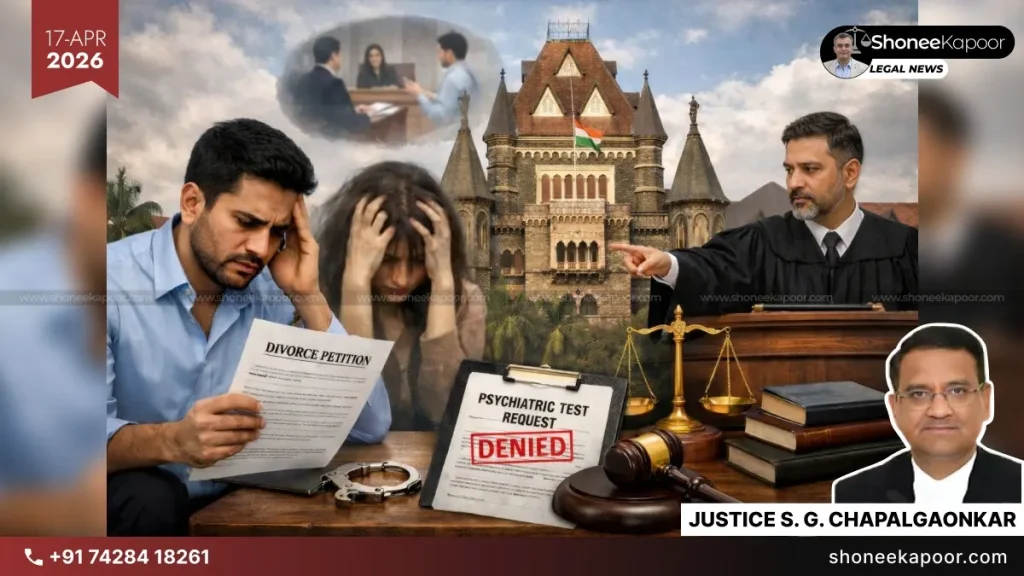
Bombay High Court set aside the trial court’s order for medical examination for want of strong evidence.
How can a husband establish truth in court when his primary request for psychiatric evaluation is rejected as “no prima facie case”?
MUMBAI: Justice S. G. Chapalgaonkar of the Bombay High Court at Aurangabad passed an important order in a matrimonial dispute and explained when a husband can seek psychiatric examination of his wife in divorce proceedings.
The case came before the High Court after a trial court had allowed the husband’s request for medical examination of the wife through an expert psychiatrist.
The husband had filed a divorce case under Section 13 of the Hindu Marriage Act on the grounds of cruelty, desertion, and mental disorder. He claimed that after marriage, the wife’s behaviour was abnormal, she was not willing for marital relations, she was secretly taking medicines, and her parents had hidden her mental condition before marriage.
The wife denied all allegations and told the court that she was mentally fit and not suffering from any illness. During the divorce case, the husband requested that she be sent for a psychiatric examination so that the truth could come on record.
The trial court accepted this request and directed her to appear before an expert psychiatrist at Civil Hospital, Dhule, and also asked for a confidential report.
The wife challenged that order before the Bombay High Court. Her side argued that the lower court passed the order mechanically and there was no material to show any mental illness. It was argued that only on the basis of allegations, such an order should not be passed.
After hearing both sides, Justice S. G. Chapalgaonkar examined the law and referred to the Supreme Court judgment in Sharda vs Dharmpal. The High Court repeated the legal position that matrimonial courts do have power to order medical tests when required. The Court quoted the Supreme Court and stated that:
“Matrimonial Court has power to order person to undergo medical test and passing of such order by Court would not be in violation of right to personal liberty under Article 21 of Constitution of India.”
The Court further repeated another important principle that:
“Court should exercise such power, if applicant has strong prima facie case and there is sufficient material before Court. If despite order of Court, respondent refuses to submit himself or herself for medical examination, Court will be entitled to draw adverse inference against him/her.”
However, the High Court found that in the present matter, the trial court had not properly examined whether enough material existed before passing such an order. The order did not show proper reasoning or application of mind.
Justice Chapalgaonkar clearly observed that courts should not casually direct medical examination merely because one side makes allegations.
The High Court said that in such matters, the husband must first place evidence on record to show that examination is necessary to determine whether the spouse suffers from the required degree of unsoundness of mind or whether the condition is incurable. Only then should such power be exercised.
The High Court cancelled the order directing psychiatric examination. At the same time, the Court protected the husband’s rights and gave him liberty to file a fresh application after leading evidence and establishing a prima facie case. The trial court was told that if fresh material is produced, it may reconsider the request and pass a proper reasoned order.
Explanatory Table: Laws And Sections Involved
| Law / Section | Purpose | How Applied in This Case |
| Section 13(1)(ia), Hindu Marriage Act | Provides divorce on ground of cruelty | Husband relied on this while seeking divorce. |
| Section 13(1)(ib), Hindu Marriage Act | Provides divorce on ground of desertion | Husband invoked this ground in petition. |
| Section 13(1)(iii)(a) & (b), Hindu Marriage Act | Divorce where spouse is incurably of unsound mind or has serious mental disorder | Main legal ground connected to request for psychiatric examination. |
| Order XXXII Rule 15, CPC | Deals with persons of unsound mind in civil proceedings | Trial court referred to this while allowing medical examination. |
| Article 21, Constitution of India | Protects life and personal liberty | Court noted medical examination order in matrimonial matters is not automatically violation of Article 21. |
| Writ Jurisdiction (Articles 226/227) | High Court power to review lower court orders | Wife challenged trial court order through writ petition. |
Case Details
- Case Title: DNS vs NNS
- Court: Bombay High Court, Bench at Aurangabad
- Case Number: Writ Petition No. 12217 of 2025
- Bench: Justice S. G. Chapalgaonkar
- Neutral Citation: 2026:BHC-AUG:15923
- Date of Judgment: 15 April 2026
- Counsels:
- For Petitioner: Ms. Rutuja L. Jakhande, Advocate
- For Respondent: Mr. H. V. Tungar, Advocate
Key Takeaways
- Husband raised serious allegations of mental illness and concealment, yet the court denied immediate verification, leaving him to continue litigation without access to crucial medical truth.
- Even when law permits psychiatric examination, burden is heavily placed on husband to first prove suspicion, making it difficult to expose hidden facts after marriage.
- System protects personal liberty of wife at initial stage, but husband’s right to defend himself against alleged fraud or suppression gets delayed.
- Trial court’s attempt to uncover truth was overturned, showing how procedural barriers can block early fact-finding in favour of men.
- Although fresh application is allowed, it forces husband into prolonged litigation, increasing financial and mental pressure before he can even prove his core allegation.
This Could Change Your Case-Get FREE Legal Advice-Click Here!
Disclaimer: The views and opinions expressed in this article are those of the Indian courts and do not necessarily reflect the official policy or position of “ShoneeKapoor.com” or its affiliates. This article is intended for informational and educational purposes only. The content provided is not legal advice, and viewers should not act upon this information without seeking professional counsel. Viewer discretion is advised.