
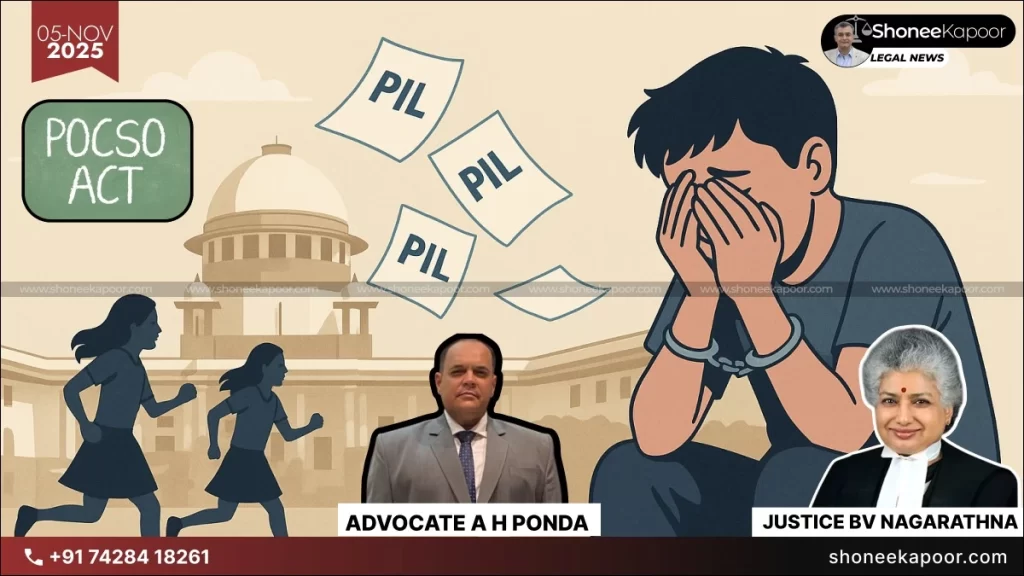
Supreme Court highlights the growing misuse of the POCSO Act in marital disputes and consensual adolescent relationships (Teen Relationships), emphasized by Senior Advocate Aabad Harshad Ponda, stressing the urgent need for legal awareness, education, and protections to safeguard boys and men from wrongful harassment.
Teen Relationships: In an eye-opening observation that underscores concerns over the misuse of child protection laws, the Supreme Court, through Justices B.V. Nagarathna and R. Mahadevan, noted that the Protection of Children from Sexual Offences (POCSO) Act is increasingly being invoked in cases arising from marital disputes and consensual adolescent relationships.
Senior Advocate Aabad Harshad Ponda, appearing in the PIL, urged the Court to promote public sensitization and legal awareness to prevent wrongful harassment of boys and men. The Bench stressed that while the law is intended to protect minors, ignorance among boys and men about legal provisions can lead to misuse, unnecessary arrests, and legal trauma, highlighting the urgent need for preventive education and awareness programs.
Facts of the Case
Background:
Senior Advocate Aabad Harshad Ponda filed a PIL highlighting the growing misuse of the POCSO Act in cases arising from marital discord and consensual adolescent relationships. The petition emphasized that, while the law is meant to protect minors, it is sometimes invoked in ways that wrongfully target boys and men, causing harassment, legal trauma, and undue detention.
Petitioner’s Arguments:
- The purpose of the PIL is to promote public awareness about sexual offence laws, including amendments made post-Nirbhaya case.
- Advocates preventive measures, stressing that punitive action after the crime is insufficient; awareness and legal literacy are crucial.
- Recommended moral education and citizenship classes in all government and private schools to instill values and prevent misuse.
- Highlighted disconnect between legislative intent and public awareness, warning that boys and men often face harassment due to ignorance of the law.
- Raised constitutional concerns regarding reactionary legislative measures in states that introduce mandatory death penalties for certain sexual offences, citing Mithu v. State of Punjab (1983).
Key Issues Highlighted in the Petition:
- POCSO provisions are sometimes misapplied in cases influenced by marital disputes or consensual teen relationships.
- False or strategically timed complaints can weaponize the law against men, violating principles of fairness and due process.
- Public education and preventive legal literacy are essential tools to curb misuse and protect men’s rights without undermining child protection objectives.
Court’s Findings
Observations by the Bench:
Justices B.V. Nagarathna and R. Mahadevan observed that the POCSO Act is being misused in cases arising out of marital discord and consensual adolescent relationships. The Court emphasized that boys and men need legal awareness to prevent wrongful harassment, as ignorance can result in arrests, prosecutions, and long-term trauma.

Senior Advocate Aabad Harshad Ponda highlighted that preventive measures such as moral education, citizenship classes, and gender sensitivity training in schools can reduce misuse and promote respect for women’s rights.
The Bench also cautioned against reactionary legislation, noting that harsher punishments alone do not prevent crime and may increase the risk of misuse against innocent men.
Key Directions / Remarks:
“One thing we would like to remark: the POCSO Act is being misused in cases of marital discords and matters pertaining to consensual relationships between adolescents. We should spread awareness in boys and men about the legal provisions.” – Supreme Court
Justice Nagarathna suggested two weekly classes in all schools, government and private, on moral education and citizenship values to empower children to educate themselves and influence their families positively.
Analysis Table: Misuse, Awareness, and Legal Perspective
| Observation / Direction | Details / Relevance |
| Misuse of POCSO | Court noted misuse in marital disputes and consensual teen relationships, causing undue harassment of boys and men. |
| Awareness for Boys & Men | Judges emphasized spreading legal literacy to prevent wrongful implication and protect men’s rights. |
| Preventive Approach | Court highlighted the importance of education, moral guidance, and gender sensitivity over purely punitive measures. |
| Legislative Caution | Bench warned against reactionary laws (e.g., mandatory death penalties), citing Mithu v. State of Punjab (1983). |
| Further Proceedings | Matter adjourned to 2 December 2025 for States/UTs to file responses regarding awareness programs and preventive steps. |
Case Details
| Case Title | Aabad Harshad Ponda v. Union of India & Ors. |
| Court | Supreme Court of India |
| Bench / Judges | Justices B.V. Nagarathna and R. Mahadevan |
| Advocate / Petitioner | Senior Advocate Aabad Harshad Ponda |
| Case Type | Public Interest Litigation / Writ Petition (Criminal) |
| Case Number | W.P. (Crl.) No. 382/2024 |
| Filing Year | 2024 |
| Hearing Date | 4 November 2025 |
| Matter Status | Adjourned to 2 December 2025 for States/UTs to file responses |
| Relief Sought | Directions for public sensitization, preventive education, moral and gender sensitization in schools |
| Key Legal Principle | Misuse of POCSO Act can lead to wrongful harassment of boys and men; preventive education and legal literacy are essential to protect rights while safeguarding children |
Disclaimer: The views and opinions expressed in this article are those of the Indian courts and do not necessarily reflect the official policy or position of “ShoneeKapoor.com” or its affiliates. This article is intended for informational and educational purposes only. The content provided is not legal advice, and viewers should not act upon this information without seeking professional counsel. Viewer discretion is advised.