
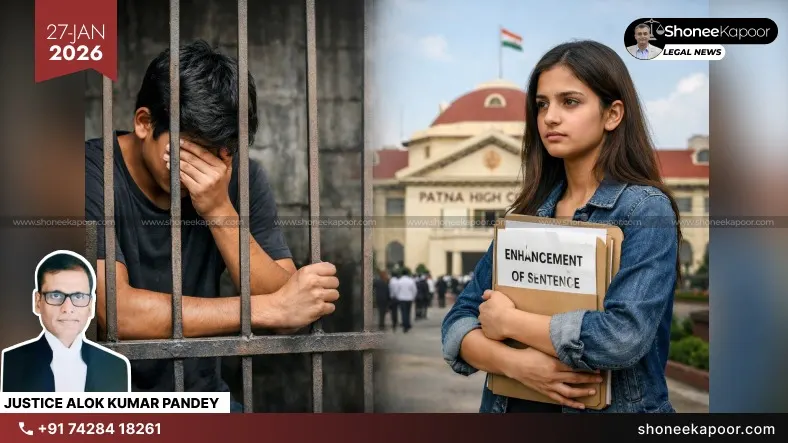
The Patna High Court upheld the conviction of a man for kidnapping a minor girl under Section 363 IPC but refused to apply POCSO charges due to lack of consistent evidence and medical support. The Court also rejected the plea to enhance the sentence, clarifying that law does not permit a victim to seek sentence enhancement and that punishment must rest strictly on proven facts.
Patna: A criminal appeal was decided by the Patna High Court in a matter arising from Digha Police Station, Patna. The appeal was filed by the victim challenging the adequacy of the sentence and seeking addition of charges under the POCSO Act against the accused, who had already been convicted by the trial court under Section 363 of the Indian Penal Code for kidnapping a minor girl.
The case related to an incident dated 19 January 2022, when a 15-year-old girl left her house in the morning for coaching classes and did not return home. Her mother later lodged a police complaint stating that the accused had taken her daughter away without permission.
During the trial, the prosecution examined the victim, her parents, relatives, the investigating officer, and the doctor. The trial court convicted the accused under Section 363 IPC and sentenced him to four years’ rigorous imprisonment but acquitted him of charges under the POCSO Act.
The victim challenged this decision, arguing that the punishment was too lenient and that POCSO Section 12 should also apply.
While examining the appeal, the High Court framed the key issue as:
“Whether the sentence awarded under Section-363 of IPC requires to be enhanced and whether offence under Section 12 of POCSO Act is made out against respondent No.2 in the light of given facts and circumstances of the case or not ?”
The Court carefully examined the statements of the victim given under Section 164 CrPC and her testimony during trial. It noted serious contradictions between the two.
In her earlier statement, the victim herself stated that “respondent no. 2 has not committed any wrong with her.”
However, during trial, new allegations of intoxication, confinement, threats, and misconduct were added.
The High Court relied heavily on the evidence of the Investigating Officer, who repeatedly stated that these serious allegations were never made during investigation. The Court observed that “these omissions are not minor but strike at the root of credibility.”
Medical evidence also showed no signs of sexual assault, and the doctor concluded that “it is difficult to say whether rape has occurred or not.”
On the issue of age, the Court found that the school certificate clearly proved the girl was a minor on the date of the incident. Referring to the Juvenile Justice Act, the Court accepted the trial court’s finding that the victim was below 18 years.
The Court clearly held that “there is no reason to differ from the finding given by the concerned court” on the question of age.
The High Court then explained the law on kidnapping and stated that “in order to attract the offence committed under Section 363 of IPC,” it must be shown that a minor was taken away from lawful guardianship without consent.
On this core issue, the Court found the evidence consistent and reliable. It held that “respondent no. 2 being major without consent of lawful guardian took away the appellant/victim and appellant/victim is minor.”
However, on the demand to add POCSO charges, the Court was categorical. It noted that the victim herself denied any sexual offence in her earliest statement and that later improvements could not be relied upon. The Court held that:
“There was no material for proving the accusation under Section 12 of the POCSO Act.”
The Court also rejected the plea for enhancement of sentence. Referring to criminal procedure law, it clarified that victims cannot seek enhancement of sentence and that such power lies only with the State.
The Court observed that “there is no provision for appeal by the victim for questioning the order of sentence as inadequate.”
Finally, after reviewing the entire record, the High Court concluded that:
“I find no reason to differ with the findings given by the learned trial court.”
The conviction under Section 363 IPC and the sentence of four years’ imprisonment were upheld, and the appeal was dismissed.
This judgment reinforces that taking a minor without parental consent is a serious offence, but at the same time, courts will not allow exaggerated or improved allegations to convert a kidnapping case into a sexual offence case without clear, consistent, and medical evidence.
Explanatory Table: Laws And Sections Involved
| Law / Section | What It Deals With | Court’s Finding |
| IPC Section 363 | Kidnapping of a minor from lawful guardianship | Proved and conviction upheld |
| IPC Section 366 | Abduction for marriage or illicit purpose | Not proved |
| IPC Section 366A | Procuration of minor girl | Not proved |
| POCSO Act Section 12 | Sexual harassment of a child | Not attracted |
| CrPC Section 164 | Magistrate-recorded statement | Relied upon as earliest version |
| CrPC Section 161 | Police-recorded statements | Used to test contradictions |
| CrPC Section 313 | Accused’s statement | Denial of allegations |
| CrPC Section 372 | Victim’s right to appeal | No right to seek sentence enhancement |
| CrPC Section 377 | Appeal for enhancement of sentence | Power lies with State only |
| JJ Act Section 94 | Determination of age | School certificate accepted |
Case Details
- Case Title: XXXX vs State of Bihar & Anr.
- Court: High Court of Judicature at Patna
- Case Number: Criminal Appeal (SJ) No. 1724 of 2025, Arising out of Digha P.S. Case No. 39 of 2022, District Patna
- Bench: Hon’ble Mr. Justice Alok Kumar Pandey
- Date of Judgment: 20 January 2026
- Counsels:
- For Appellant: Mr. Ajay Kumar, Advocate; Mr. Awadhesh Kumar, Advocate
- For State: Mr. Ramchandra Singh, A.P.P.
- For Respondent No. 2: Mr. Ramji Kumar, Advocate
Key Takeaways
- Courts must rely on the earliest and most consistent statements, not later improvements that change the story and create exaggerated allegations against a man.
- Medical evidence matters. When there is no injury, no proof of assault, and no scientific support, sexual allegations cannot be forced into a criminal case.
- Kidnapping law applies strictly when a minor is taken without guardian consent, but it should not be stretched to falsely label a man as a sexual offender.
- Victims cannot demand sentence enhancement under law; only the State has that power, preventing emotional or revenge-driven punishment demands.
- This case exposes how contradictions and afterthought allegations damage genuine justice and highlights the urgent need for fair, evidence-based trials to protect innocent men.
This Could Change Your Case-Get FREE Legal Advice-Click Here!
Disclaimer: The views and opinions expressed in this article are those of the Indian courts and do not necessarily reflect the official policy or position of “ShoneeKapoor.com” or its affiliates. This article is intended for informational and educational purposes only. The content provided is not legal advice, and viewers should not act upon this information without seeking professional counsel. Viewer discretion is advised.