
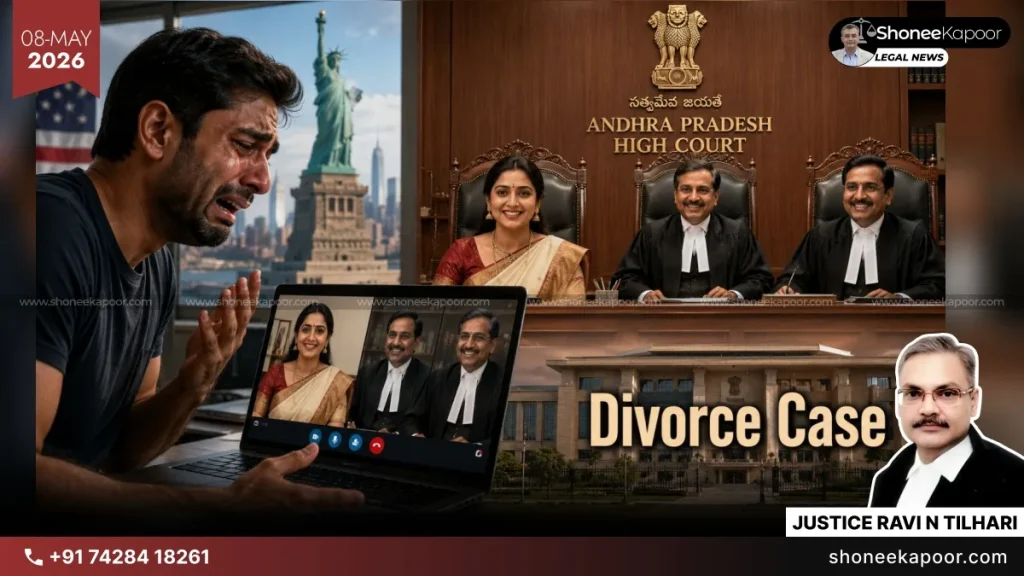
Can a NRI husband avoid personal appearance in reconciliation proceedings during divorce through video call? The Andhra Pradesh High Court has now given a clear answer.
AMARAVATI: The Andhra Pradesh High Court has ruled that video conferencing cannot be allowed at the reconciliation stage in matrimonial disputes like divorce, even if one spouse is living abroad.
Justice Ravi Nath Tilhari held that reconciliation proceedings require personal interaction between husband and wife in a confidential atmosphere, and virtual hearings may defeat the very purpose of settlement efforts.
The case involved a husband residing in Texas, USA, who approached the High Court after the trial court refused to allow him to attend reconciliation proceedings through Zoom, WhatsApp or Skype. The husband argued that his employer had denied him leave and therefore he could not travel to India.
The husband relied on the Andhra Pradesh High Court Rules for Video Conferencing for Courts, 2023, arguing that the Rules permit video conferencing “at all stages of judicial proceedings.” However, the wife opposed the plea and argued that reconciliation requires direct personal interaction and confidentiality, which cannot be effectively achieved through virtual mode.
The High Court referred to the Supreme Court judgment in Santhini Vs. Vijaya Venkatesh and clarified that video conferencing can be permitted only after reconciliation efforts fail and both parties consent. The Court emphasized that the law laid down by the Supreme Court remains binding across India, including Andhra Pradesh.
Justice Ravi Nath Tilhari observed:
“This Court do not say that the Rules, 2023 are ultra vires Article 227(2)(b) read with the proviso to Clause (3), as this Court is of the considered view that the said Rules, 2023 have been framed generally to regulate video conferencing. The said Rules are procedural in nature and are to be understood as regulating the procedure for video conferencing where such conferencing is otherwise permissible. However, in cases where video conferencing is not permissible, or is not permissible up to or at a particular stage of judicial proceedings, the said Rules shall have no application.
This Court is further unable to construe the Rules, 2023 in the manner urged by the learned counsel for the petitioner. The submissions are misconceived and proceed on misunderstanding of the settled legal principles and that too the very basic principles.
This Court cannot read the Rules, 2023 as mandating video conferencing in matters such as the present case, whether before the Family Court or a Civil Court dealing with matrimonial disputes, so as to permit video conferencing even at the stage of reconciliation, contrary to the law laid down by the Hon’ble Apex Court in Santhini (supra). The Rules, 2023 cannot be construed as being in conflict with, or inconsistent with, the provisions of the statutory enactments or the judge-made law laid down by the High Court or the Supreme Court”.
The Court further noted that matrimonial disputes involve emotional, personal and sensitive issues where the judge must directly interact with both parties. It held that reconciliation cannot become a mechanical online exercise, especially when law requires in-camera and confidential proceedings.
The High Court finally held:
“ In view of the aforesaid discussion, this Court holds, on points of determination ‘A’ and ‘B’, that video conferencing is permissible in matrimonial proceedings, whether before the Family Court or the Civil Court, after reconciliation fails. In other words, at the stage of reconciliation, until it fails, video conferencing is not permissible for such purpose. The judgment in Santhini (supra) applies with full force in the State of Andhra Pradesh as well and is not inapplicable, as contended by the petitioner’s counsel, on account of the Andhra Pradesh High Court ‘Rules for Video Conferencing for Courts, 2023’.”
While courts continue encouraging technology in litigation, this judgment also reflects the practical reality that matrimonial disputes are deeply personal matters where absence, distance and prolonged separation often become part of the conflict itself.
The Court made it clear that convenience alone cannot override the statutory process of reconciliation in family disputes.
Explanatory Table Of Laws & Sections Mentioned
| LAW / SECTION | EXPLANATION | HOW COURT USED IT |
| Article 227 of Constitution of India | Gives High Courts supervisory powers over subordinate courts and power to frame procedural rules | Court held VC Rules framed under Article 227 are procedural only and cannot override Supreme Court law |
| Article 141 of Constitution of India | Supreme Court judgments are binding on all courts in India | Court held Santhini judgment is binding across Andhra Pradesh also |
| Family Courts Act, 1984 | Governs matrimonial and family disputes | Court emphasized reconciliation and confidentiality are core objectives under this Act |
| Section 11, Family Courts Act | Proceedings can be held in-camera and confidentiality must be maintained | Court said reconciliation through VC may dilute privacy and settlement atmosphere |
| Hindu Marriage Act, 1955 | Main law governing matrimonial disputes among Hindus | Court relied on reconciliation mandate under matrimonial law framework |
| Section 23(2), Hindu Marriage Act | Court must attempt reconciliation before granting matrimonial relief | Court said physical interaction is important for meaningful reconciliation |
| Section 22, Hindu Marriage Act | Matrimonial proceedings to be conducted in-camera | Used to stress confidentiality and sensitivity of matrimonial disputes |
| Rules for Video Conferencing for Courts, 2023 | Andhra Pradesh procedural rules for VC hearings | Court held these rules cannot override Supreme Court precedent or statutory mandate |
| Rule 3(i), VC Rules 2023 | Says VC may be used at all stages of judicial proceedings | Husband relied on this rule to seek virtual reconciliation appearance |
| Rule 3(iii), VC Rules 2023 | Makes CPC, CrPC, Evidence Act etc. applicable to VC proceedings | Petitioner argued matrimonial proceedings are also judicial proceedings under this Rule |
| CPC (Code of Civil Procedure) | Governs civil court procedure | Mentioned through Rule 3(iii) applicability to VC proceedings |
| CrPC (Code of Criminal Procedure) | Governs criminal procedure | Mentioned under VC Rules applicability |
| Indian Evidence Act, 1872 | Governs admissibility and appreciation of evidence | Mentioned as applicable in VC proceedings |
| Information Technology Act, 2000 | Governs digital and electronic systems | Mentioned regarding legal framework for VC proceedings |
| Contempt of Courts Act, 1971 | Governs contempt proceedings | Mentioned under VC Rules applicability |
| Santhini vs Vijaya Venkatesh (2018) 1 SCC 1 | Landmark Supreme Court judgment on VC in matrimonial matters | Court relied heavily on this case to hold VC not permissible during reconciliation stage |
| Krishna Veni Nagam vs Harish Nagam | Earlier Supreme Court view allowing broader VC use | Overruled partly in Santhini judgment |
| Anjali Brahmawar Chauhan vs Navin Chauhan | Supreme Court allowed VC during Covid circumstances | Court clarified it was only because of pandemic situation |
Case Details
| PARTICULARS | DETAILS |
| Case Title | ABC vs XYZ |
| Case Number | Civil Revision Petition No. 311 of 2026 |
| Court | Andhra Pradesh High Court |
| Bench | Justice Ravi Nath Tilhari |
| Date of Judgment | 30.04.2026 |
| Counsel for Petitioner | Sri B. Abhay Siddanth Mootha |
| Originating Case | I.A. No.457 of 2024 in H.M.O.P. No.35 of 2023 |
| Trial Court | Civil Judge (Senior Division), Yellamanchili |
| Final Result | Civil Revision Petition Dismissed |
Key Takeaways
- The Court has made it clear that video conferencing is not allowed during the reconciliation stage in matrimonial disputes, even for NRIs living abroad.
- A husband’s employment pressure, visa issues, leave problems, or international distance may still not be enough to avoid personal appearance before Indian courts.
- The judgment reinforces that matrimonial litigation continues to place disproportionate logistical and financial burdens on men, especially NRI husbands facing prolonged family disputes.
- The Andhra Pradesh High Court held that the 2023 Video Conferencing Rules cannot override the Supreme Court judgment in Santhini Vs. Vijaya Venkatesh.
- The Court clarified that video conferencing can only be considered after reconciliation fails and generally with consent of both parties.
This Could Change Your Case-Get FREE Legal Advice-Click Here!
Disclaimer: The views and opinions expressed in this article are those of the Indian courts and do not necessarily reflect the official policy or position of “ShoneeKapoor.com” or its affiliates. This article is intended for informational and educational purposes only. The content provided is not legal advice, and viewers should not act upon this information without seeking professional counsel. Viewer discretion is advised.