
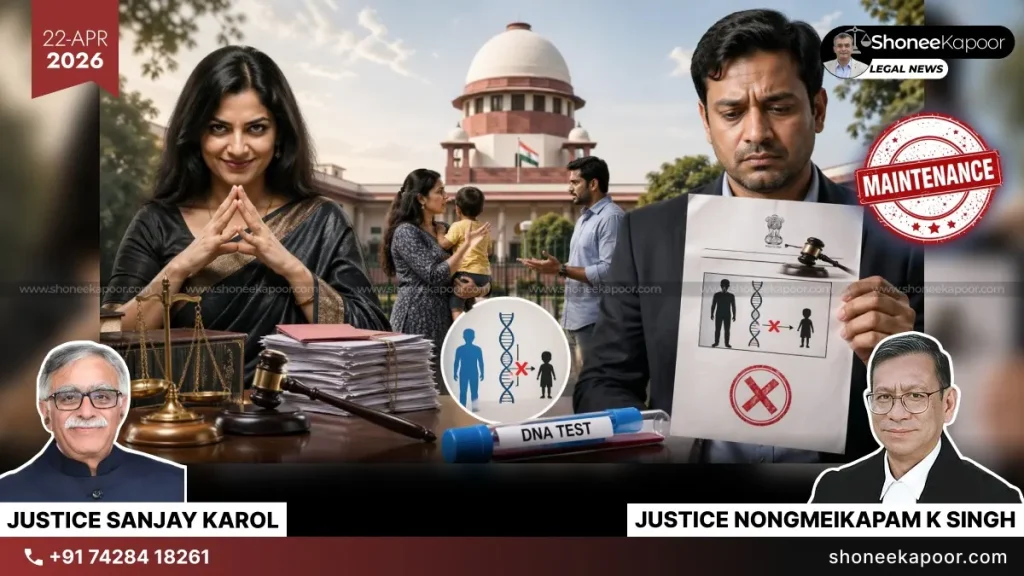
A landmark Supreme Court ruling has shaken family law debates by holding that no man can be compelled to pay maintenance once DNA proves he is not the biological father.
The verdict raises serious questions on how long men can be dragged through false claims before truth prevails.
NEW DELHI: In a maintenance judgment dated 21 April 2026, Justice Sanjay Karol and Justice Nongmeikapam Kotiswar Singh of the Supreme Court held that a man cannot be forced to pay maintenance for a child when a court-ordered DNA test clearly proves that he is not the biological father.
The Court held that while the law gives certain presumptions to protect children born during marriage, accepted scientific evidence cannot be ignored.
The case began with a woman seeking maintenance under the Domestic Violence Act for herself and her child. The man denied paternity and requested a DNA test. The test report confirmed that he was not the biological father. Based on this, lower courts denied maintenance for the child, and the Supreme Court agreed with that conclusion.
The Court explained the legal position around presumption of legitimacy under law and how courts must be cautious before disturbing it. It referred to earlier rulings and warned that:
“The court must carefully examine as to what would be the consequence of ordering the blood test; whether it will have the effect of branding a child as a bastard and the mother as an unchaste woman.”
At the same time, the Court also acknowledged the importance of scientific truth and observed:
“Where there is evidence to the contrary, the presumption is rebuttable and must yield to proof. The interest of justice is best served by ascertaining the trut.”
This became the key principle applied in the present matter.
The Court further noted that DNA testing should not be used casually and must be balanced against privacy, dignity, and social consequences. It emphasised:
“DNA testing is the most legitimate and scientifically perfect means.”
After reviewing the law and facts, the Court concluded that since the DNA report was already conducted with consent and remained undisputed, it had attained finality.
Therefore, forcing the man to pay maintenance for a child who is not biologically his would be unjust. The appeal was dismissed, confirming that no maintenance is payable by him for the child.
However, the Court did not ignore the situation of the woman and clarified that her own maintenance claim must still be reconsidered properly by the trial court. At the same time, keeping the welfare of the child in mind, directions were issued to government authorities to assess and ensure the child’s well-being.
The Court ultimately dismissed the appeal and upheld the denial of maintenance for the child, holding that once a court-ordered DNA test conclusively establishes that the man is not the biological father, he cannot be made liable to pay maintenance for the child.
Explanatory Table: Laws And Sections Involved
| Law / Section | Purpose | How Applied in This Case |
| Section 12, Protection of Women from Domestic Violence Act, 2005 | Allows aggrieved woman to seek maintenance, protection and other reliefs | Wife filed complaint seeking maintenance for herself and child |
| Protection of Women from Domestic Violence Act, 2005 | Gives civil remedies in domestic violence disputes | Original proceedings for interim maintenance were under this Act |
| Section 112, Indian Evidence Act, 1872 | Creates presumption that child born during marriage is legitimate | Main legal issue before Supreme Court regarding paternity presumption |
| Section 116, Bharatiya Sakshya Adhiniyam, 2023 | New equivalent provision replacing Section 112 | Court compared it and noted same legislative intent |
| Section 13, Hindu Marriage Act | Provides grounds for divorce such as adultery | Mentioned while discussing earlier precedent on DNA testing |
| Special Leave Petition (Article 136 route) | Enables appeal to Supreme Court | Present matter came to Supreme Court through SLP |
| Criminal Appellate Jurisdiction | Allows Supreme Court to hear criminal appeals | Appeal was decided under this jurisdiction |
Case Details
- Case Title: Nikhat Parveen @ Khusboo Khatoon v. Rafique @ Shillu
- Court: Supreme Court of India
- Case: Criminal Appeal arising out of SLP (Crl.) No. 15256 of 2023
- Neutral Citation: 2026 INSC 399
- Date of Judgment: 21 April 2026
- Bench: Justice Sanjay Karol & Justice Nongmeikapam Kotiswar Singh
Key Takeaways
- A man cannot be forced to take responsibility for a child when science clearly proves he is not the father.
- Legal presumptions cannot be misused to impose financial liability where truth is already established through DNA evidence.
- Maintenance laws should not become tools to burden innocent men without proper verification of facts.
- Courts must balance protection of children with fairness towards men who are wrongly implicated.
- Truth backed by scientific evidence must prevail over assumptions, especially when a man’s rights and finances are at stake.
This Could Change Your Case-Get FREE Legal Advice-Click Here!
Disclaimer: The views and opinions expressed in this article are those of the Indian courts and do not necessarily reflect the official policy or position of “ShoneeKapoor.com” or its affiliates. This article is intended for informational and educational purposes only. The content provided is not legal advice, and viewers should not act upon this information without seeking professional counsel. Viewer discretion is advised.