
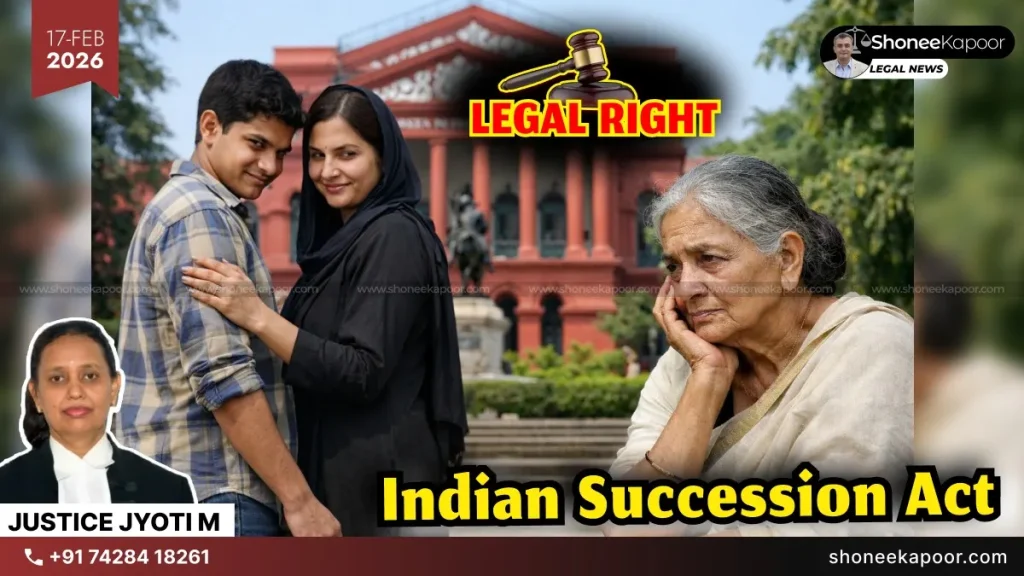
The Karnataka High Court held that under Sections 32 and 33 of the Indian Succession Act, a mother does not inherit when the deceased is survived by his widow and children. Setting aside the Trial Court’s order, the Court directed that the succession certificate be granted to the widow and two sons in accordance with law.
Mother Gets No Share If Son Dies Intestate: In a judgment dated 02 February 2026, the Karnataka High Court, led by Hon’ble Ms. Justice Jyoti M, delivered clarity on inheritance rights under Christian personal law. The case involved the family of late Mr. Herold Vaz, who died intestate, meaning without leaving any will.
After his death, his widow and children approached the court seeking a succession certificate to transfer shares he had invested in private companies. However, the Trial Court rejected their request, mainly on the ground that the deceased’s mother was also a legal heir. The appeal was filed before the Karnataka High Court.
The High Court examined whether the Trial Court was correct in refusing the certificate. The central issue was whether the presence of the mother of the deceased could prevent the widow and children from receiving the succession certificate.
Justice Jyoti M clearly pointed out the legal mistake made by the lower court. The Court stated that the Trial Court had “improperly rejected the application, citing the mother’s legal heir status as the exclusive reason to deny the certificate.” The High Court further held that this reasoning “is unsustainable in law.”
The judgment also made it clear that the Trial Court had erred by failing to apply the correct provisions of law. The Court observed that it “erred in law by failing to apply Sections 32 and 33 of the Indian Succession Act, 1925,” which clearly govern the distribution of property in such cases.
Explaining the legal position in simple terms, Justice Jyoti M stated that:
“If the intestate dies leaving a widow and lineal descendants, 1/3rd of the property goes to the widow and 2/3rd to the lineal descendants.”
The Court further clarified that when a Christian man dies, leaving behind his wife and children, the mother does not get a share under the Act.
The Court observed that the Trial Court had misunderstood the legal position and wrongly denied relief. The judgment clarified that inheritance under Christian law is governed strictly by statutory provisions and must be applied correctly.
Finally, the High Court set aside the earlier order and directed that the succession certificate be issued as per law. The judgment also reflects how elderly mothers can become vulnerable in inheritance disputes when legal provisions are misunderstood. It serves as a reminder that courts must carefully apply succession laws to avoid unnecessary hardship and uncertainty for surviving family members.
Explanatory Table: Laws And Sections Involved
| Law / Section | Purpose | How Applied in This Case |
| Indian Succession Act, 1925 – Section 372 | Provides procedure to apply for a Succession Certificate for debts and securities of a deceased person | The widow and children filed a petition under this section seeking certificate to transfer the deceased’s shares. The Trial Court rejected it. |
| Indian Succession Act, 1925 – Section 384 | Provides right to appeal against order refusing or granting a succession certificate | The family filed the present Miscellaneous First Appeal before the High Court under this provision challenging the rejection order. |
| Indian Succession Act, 1925 – Section 32 | Lays down general rules of intestate succession for Christians | The High Court examined this section to determine correct legal heirs when a Christian dies without a will. |
| Indian Succession Act, 1925 – Section 33 | Specifies distribution of property when widow and lineal descendants survive | The Court clarified that 1/3rd goes to the widow and 2/3rd to children, and held that the Trial Court wrongly misunderstood this provision while denying the certificate. |
Case Details
- Case Title: Mrs. Estrida Lucy Janet Vaz & Others v. Nil
- Case Number: Miscellaneous First Appeal No. 3127 of 2024 (ISA)
- Court: High Court of Karnataka at Bengaluru
- Bench: Hon’ble Ms. Justice Jyoti M
- Date of Judgment: 02 February 2026
- Neutral Citation: 2026:KHC:5798
- Counsel for Appellants: Sri Pruthveen Kattimani, Advocate (appeared on behalf of Sri Giridhar H., Advocate)
Key Takeaways
- An elderly parent can be excluded when courts mechanically apply succession law without fully appreciating her emotional and financial dependence on her son.
- The law under Sections 32 and 33 of the Indian Succession Act clearly sidelines the mother if a widow and children are alive, leaving her with no statutory share, regardless of her vulnerability.
- This judgment highlights the harsh reality that biological motherhood does not automatically translate into legal protection under Christian intestate succession.
- It raises an important debate on whether succession laws should be re-examined to protect aged and dependent parents who may otherwise be left without support.
- For parents of married sons, this case is a reminder to ensure financial planning and legal clarity during the son’s lifetime, because after his death, the law may not safeguard the mother’s rights.
This Could Change Your Case-Get FREE Legal Advice-Click Here!
Disclaimer: The views and opinions expressed in this article are those of the Indian courts and do not necessarily reflect the official policy or position of “ShoneeKapoor.com” or its affiliates. This article is intended for informational and educational purposes only. The content provided is not legal advice, and viewers should not act upon this information without seeking professional counsel. Viewer discretion is advised.