
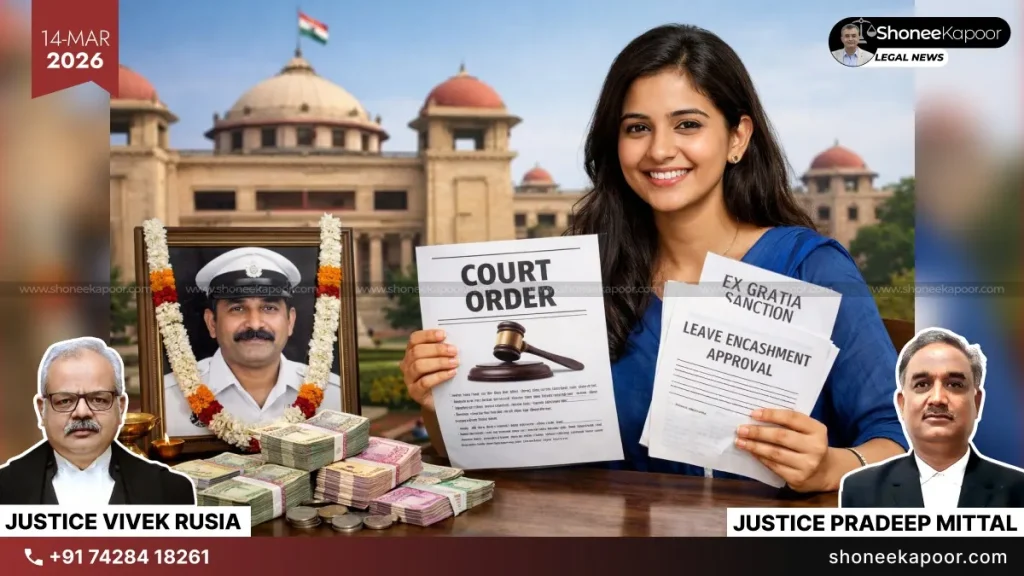
The MP High Court ruled that denying service death benefits to a married daughter only because of her marital status is discriminatory. The Court ordered payment of ex-gratia and leave encashment to the petitioner.
JABALPUR: The Madhya Pradesh High Court, in a judgment delivered by Justice Vivek Rusia and Justice Pradeep Mittal, held that a married daughter cannot be denied service benefits such as ex-gratia payment and leave encashment merely because she is married. The Court emphasized that benefits earned by a government employee during service must reach the lawful heirs and cannot be withheld on arbitrary grounds.
The case arose after the death of Prabhat Kumar Namdev, who was working as a driver at the District Court in Narsinghpur under the administrative control of the High Court. He died in May 2024 while still in service. After his death, his daughter applied for settlement of the service dues including GPF, leave encashment and ex-gratia benefits payable to the family of a deceased employee.
During his lifetime, the employee had nominated his daughter in the service records after the death of his wife. Authorities themselves accepted her as the nominee and released the GPF and group insurance amounts to her. She was also granted compassionate appointment, clearly acknowledging her status as the legal beneficiary.
However, despite recognizing her as the nominee for other benefits, the authorities refused to release ex-gratia and leave encashment only because she was a married daughter. The decision was challenged before the High Court, where it was argued that denying benefits solely on marital status violated constitutional equality.
While examining the matter, the Court observed that marriage does not end a daughter’s relationship with her parental family. Referring to settled legal principles, the bench stated:
“A woman citizen cannot be excluded for any appointment on compassionate basis on the ground of sex alone.”
The Court further clarified:
“The daughter even after marriage remains part of the family and she could not be treated as not belonging to her father’s family.”
The judges also discussed the nature of service benefits and emphasized that such payments cannot be treated as discretionary favours. The Court observed, “The right to leave encashment is a statutory right.” Explaining the purpose of ex-gratia payments, the bench noted:
“Ex gratia payments upon an employee’s death are voluntary, compassionate lump-sum payments made by employers to beneficiaries.”
The Court concluded that denying these benefits solely because the claimant is a married daughter amounts to discrimination. Allowing the petition, the High Court directed the authorities to release the ex-gratia and leave encashment to the petitioner within 60 days.
At the same time, the judgment also brings attention to a broader issue within the justice system. While courts rightly intervene to correct discrimination against women, in many family and criminal disputes, men often face an early presumption of guilt even before the facts are fully examined. The larger concern remains that justice must always stay neutral and evidence-based, ensuring that while women’s rights are protected, men are not automatically treated with suspicion simply because of their gender.
Explanatory Table: Laws And Provisions Involved
| Law / Provision | Explanation | Role in the Case |
| Article 14 of the Constitution of India | Guarantees equality before law and equal protection of laws to all persons | The Court held that denying benefits solely because the claimant is a married daughter violates equality principles |
| Article 16 of the Constitution of India | Ensures equality of opportunity in public employment | Referred while discussing discrimination against married daughters in service-related benefits and compassionate considerations |
| Article 39(a) of the Constitution of India | Directive principle ensuring equal right to livelihood for men and women | Cited in earlier precedent relied upon by the Court to support gender equality in employment benefits |
| Article 300A of the Constitution of India | Protects a person from being deprived of property without authority of law | The Court held that retiral benefits like leave encashment are a form of property and cannot be arbitrarily denied |
| M.P. Civil Services (Pension) Rules, 1976 | Governs pension and related service benefits of government employees in Madhya Pradesh | The Court noted that retiral benefits can only be withheld under specific provisions of these rules |
| Government Notification dated 14 November 1972 | Policy governing ex-gratia payment to the family of deceased government employees | The Court interpreted the notification and clarified that it does not exclude a married daughter if she is the only legal heir |
| Precedent: Meenakshi Dubey v. M.P. PoorvaKshetra Vidyut Vitran Co. Ltd. | Larger Bench decision holding exclusion of married daughters from compassionate benefits unconstitutional | Relied upon to support the principle that marital status cannot be a ground to deny benefits |
| Case: Bhaskar Ramchandra Joshi v. State of M.P. (2013 (4) MPLJ 35) | Recognized retiral dues as property under constitutional protection | Used to reinforce that service benefits cannot be withheld arbitrarily |
Case Details
- Case Title: Prasanna Namdev (Soni) vs The High Court of Madhya Pradesh and Others
- Court: High Court of Madhya Pradesh, Jabalpur Bench
- Case Number: Writ Petition No. 37546 of 2024
- Date of Judgment: 18 February 2026
- Neutral Citation: 2026:MPHC-JBP:14293
- Bench: Justice Vivek Rusia | Justice Pradeep Mittal
- Counsels:
- For Petitioner: Shri Durgesh Kumar Singrore
- For Respondents: Shri Shobhitaditya
Key Takeaways
- Legal rights arising from employment or family relationships cannot be denied on the basis of outdated social assumptions about gender or marital status.
- Equality before law must apply to everyone, and benefits or protections in the legal system should not depend on stereotypes about men and women.
- Administrative authorities often rely on rigid rules that create unfair outcomes, showing why constitutional principles must guide every decision.
- In many disputes, men frequently face early suspicion or presumptions of guilt, which highlights the urgent need for a truly evidence-based justice system.
- A fair legal framework must ensure balance, where neither women are denied legitimate rights nor men are automatically treated as responsible or guilty without proper proof.
This Could Change Your Case-Get FREE Legal Advice-Click Here!
Disclaimer: The views and opinions expressed in this article are those of the Indian courts and do not necessarily reflect the official policy or position of “ShoneeKapoor.com” or its affiliates. This article is intended for informational and educational purposes only. The content provided is not legal advice, and viewers should not act upon this information without seeking professional counsel. Viewer discretion is advised.