
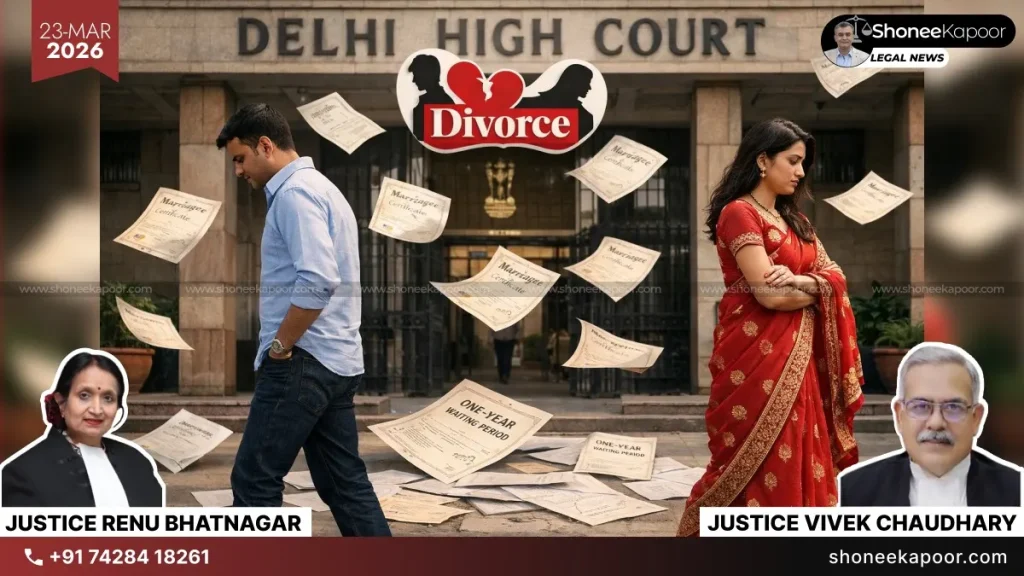
Can a marriage end before 1 year if husband and wife never really lived together? Delhi High Court says YES, but what pushed the court to take this rare step?
NEW DELHI: The Delhi High Court has ruled that when a marriage has no real relationship, no physical intimacy and no proper stay together, then it cannot be treated as a complete marriage. In such cases, forcing the couple to wait for one year before divorce serves no real purpose.
“The absence of cohabitation and consummation, coupled with the immediate separation of the parties soon after the marriage, clearly indicates that the matrimonial relationship between the parties never took shape in any meaningful sense,”
said the division bench of Justices Vivek Chaudhary and Renu Bhatnagar.
Based on this reasoning, the High Court cancelled the Family Court’s earlier order, which had refused to waive the mandatory one-year waiting period under Section 14 of the Hindu Marriage Act.
As per the facts, the couple got married in May 2025 but stayed together for only around seven days. There was no physical relationship, and no children were born. After separating, both parties mutually agreed to end the marriage.
Despite this, the Family Court refused to allow early divorce, stating that the legal requirement of one year had not been completed.
The couple then approached the High Court, arguing that continuing such a marriage would cause serious hardship and had no practical value.
The High Court explained that Section 14 of the Hindu Marriage Act is meant to give couples time to rethink and possibly reconcile. However, it also clearly allows relaxation of this rule in cases of “exceptional hardship.”
After speaking directly with both parties, the court accepted their reasons and found that there was no chance of the marriage continuing.
“Both parties have entered into a mutual settlement and have unequivocally expressed their intention not to continue the matrimonial relationship. The material on record does not indicate any possibility of resumption of matrimonial life. 17. In such circumstances, insisting that the parties wait for completion of the statutory period would serve no meaningful purpose and would only prolong a marriage that exists merely in law and not in substance,” the Court observed.
The High Court then allowed the couple to proceed with mutual divorce and sent the case back to the Family Court for quick disposal.
This judgment highlights an important point: laws are not meant to trap individuals in relationships that exist only on paper. Where a marriage has no real foundation, forcing continuation can lead to unnecessary mental and legal stress, especially when both parties have already decided to separate.
Explanatory Table – Laws & Sections Involved
| Law / Section | Provision | What It Means in Simple Terms | How Court Used It |
| Hindu Marriage Act, 1955 – Section 13B(1) | Mutual Divorce | Husband and wife can jointly file for divorce if they have lived separately for 1 year and cannot live together | Court allowed parties to proceed under this section despite not completing 1 year |
| Hindu Marriage Act, 1955 – Section 13B(2) | Cooling-Off Period (6 months) | After filing, parties usually wait 6 months before final divorce | Court referred to judgments allowing waiver if marriage is beyond repair |
| Hindu Marriage Act, 1955 – Section 14 | Bar on Divorce Within 1 Year | Divorce cannot normally be filed within 1 year of marriage | Central issue in this case; Family Court refused waiver |
| Proviso to Section 14(1) HMA | Exception Clause | Court can allow early divorce in cases of “exceptional hardship” or serious circumstances | High Court used this to grant waiver |
| Case Law: Amardeep Singh v. Harveen Kaur (2017) 8 SCC 746 | Supreme Court Judgment | Cooling-off period is not mandatory, can be waived | Relied upon to support flexibility in divorce timelines |
| Case Law: Shiksha Kumari v. Santosh Kumar (2025) | Delhi HC Full Bench | Both 1-year and 6-month periods can be waived independently in proper cases | Strengthened High Court’s reasoning to allow waiver |
Case Details
- Case Title: PJ & Anr. vs N
- Case Number: MAT.APP.(F.C.) 72/2026
- Court: High Court of Delhi at New Delhi
- Judgment Date: 10.03.2026
Bench
- Hon’ble Mr. Justice Vivek Chaudhary
- Hon’ble Ms. Justice Renu Bhatnagar
Counsels
- For Appellants: Ms. Isha Khanna, Advocate (with appellant in person)
- For Respondent: Respondent in person
Lower Court Details
- Family Court: Family Judge-03, Karkardooma Courts, Delhi
- Impugned Order Date: 08.12.2025
- Case No.: HMA No. 1772/2025
Important Facts
- Marriage Date: 07.05.2025
- Separation Date: 15.05.2025
- Cohabitation: Only ~7 days
- Marriage Status: Never consummated
- Children: None
- Settlement Date: 19.09.2025
Key Takeaways
- Courts are finally acknowledging that forcing continuation of a dead marriage is injustice, especially when there is no real relationship from day one.
- A man should not be legally trapped in a marriage that never even started in substance.
- The system’s rigid timelines often ignore ground reality, causing unnecessary mental and financial burden on men.
- Mutual consent is being respected here, but in most cases men are denied timely exit and dragged into prolonged litigation.
- This judgment exposes how law can become a tool of harassment when procedural delays are blindly enforced.
This Could Change Your Case-Get FREE Legal Advice-Click Here!
Disclaimer: The views and opinions expressed in this article are those of the Indian courts and do not necessarily reflect the official policy or position of “ShoneeKapoor.com” or its affiliates. This article is intended for informational and educational purposes only. The content provided is not legal advice, and viewers should not act upon this information without seeking professional counsel. Viewer discretion is advised.