
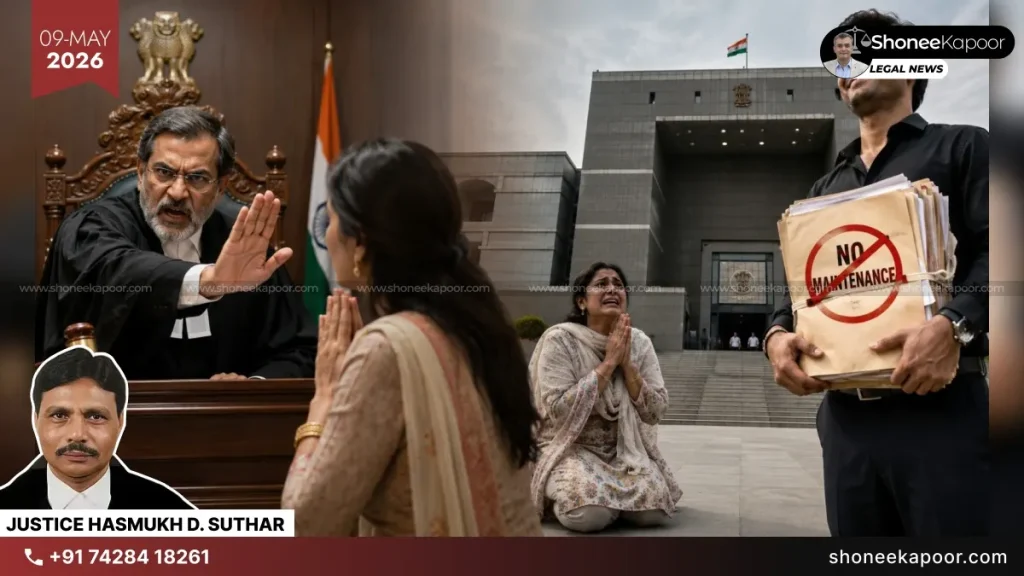
Can a wife claim maintenance after leaving her husband without a strong legal reason? The Gujarat High Court has now given a clear answer in a case that is drawing major attention. The court closely examined the woman’s own statements during the case and found important contradictions that changed the outcome completely.
AHMEDABAD: The Gujarat High Court has upheld a Family Court order refusing maintenance to a woman who started living separately from her husband without proving a valid reason.
Justice Hasmukh D Suthar dismissed the woman’s revision application and clarified that under Section 125(4) of the Code of Criminal Procedure, a wife cannot get maintenance if she refuses to stay with her husband without “reasonable cause”.
The dispute started after the woman filed a maintenance case following her marriage in 2009. She alleged that her husband and in-laws harassed and treated her cruelly, forcing her to leave her matrimonial home.
However, the Rajkot Family Court rejected her maintenance plea in 2013. The woman later challenged that decision before the Gujarat High Court.
During the hearing, the High Court noticed major contradictions in her statements. In cross-examination, she reportedly admitted that her original application did not specifically mention that she had been deserted or thrown out of the matrimonial home.
The court observed that the evidence on record did not support her allegations strongly enough to justify living separately from her husband while still claiming maintenance.
Relying on Section 125(4) CrPC, the High Court ruled that when a wife leaves her husband without sufficient legal justification, she loses the right to claim maintenance.
The judgment is being seen as an important reminder that maintenance laws are meant to protect genuinely aggrieved spouses, but courts will also closely examine evidence, conduct, and consistency in statements before granting relief.
Explanatory Table : Laws And Sections Mentioned In This Case
| LAW / SECTION | PROVISION | WHAT IT MEANS IN SIMPLE LANGUAGE | HOW COURT APPLIED IT |
| Section 125 CrPC | Maintenance to wife, children and parents | A wife who cannot maintain herself can seek monthly maintenance from husband | Wife filed maintenance case under this provision |
| Section 125(4) CrPC | Exception to maintenance rights | Wife is not entitled to maintenance if she refuses to live with husband without sufficient reason | High Court relied on this section to deny maintenance |
| Revision Jurisdiction of High Court | Power to examine lower court order | High Court can check whether Family Court order was legally correct | Woman challenged Family Court order through revision plea |
Case Details
| PARTICULARS | DETAILS |
| Case Title | Wife vs Husband |
| Court | Gujarat High Court |
| Judge | Justice Hasmukh D. Suthar |
| Lower Court | Rajkot Family Court |
| Marriage Year | 2009 |
| Main Issue | Whether wife is entitled to maintenance after leaving husband without valid reason |
| Final Outcome | High Court dismissed wife’s revision application and upheld denial of maintenance |
| Key Observation | Wife failed to prove sufficient reason for living separately |
| Important Contradiction | Wife admitted during cross-examination that original application did not clearly state desertion or expulsion |
Key Takeaways
- Mere allegations of cruelty are not enough; courts now expect clear evidence before granting maintenance.
- A wife who voluntarily leaves the matrimonial home without sufficient legal reason can lose her right to maintenance under Section 125(4) CrPC.
- Contradictions during cross-examination can completely destroy a maintenance claim.
- Family Courts are increasingly examining whether husbands are being unfairly targeted through exaggerated or unsupported accusations.
- This judgment reinforces that maintenance is meant for genuine hardship, not as automatic compensation after separation initiated without justification.
This Could Change Your Case-Get FREE Legal Advice-Click Here!
Disclaimer: The views and opinions expressed in this article are those of the Indian courts and do not necessarily reflect the official policy or position of “ShoneeKapoor.com” or its affiliates. This article is intended for informational and educational purposes only. The content provided is not legal advice, and viewers should not act upon this information without seeking professional counsel. Viewer discretion is advised.