
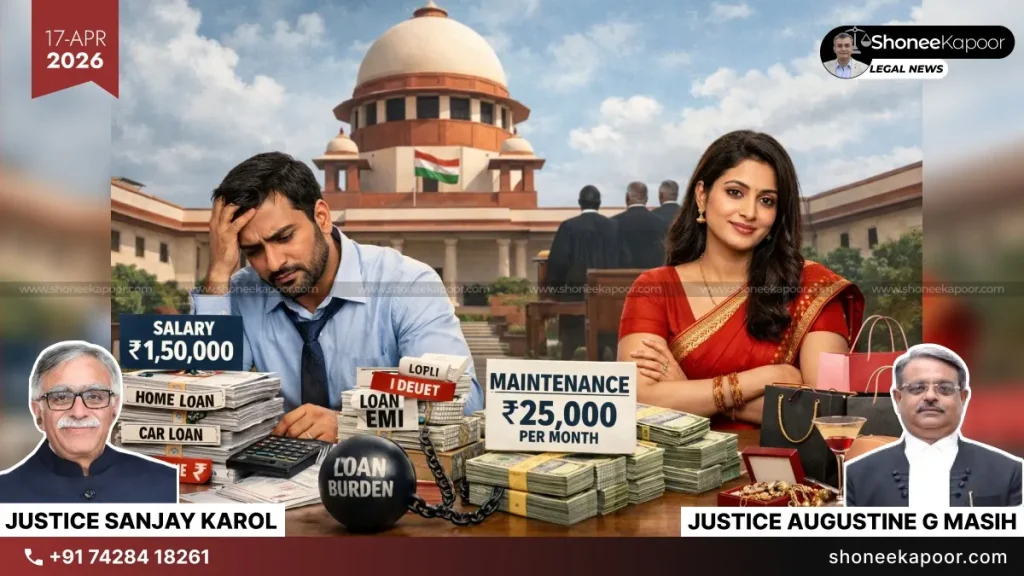
Can a husband reduce maintenance liability by citing loan EMIs? Supreme Court says- No, holding that repayments for loans cannot override the husband’s primary legal duty to maintain his wife.
NEW DELHI: In a judgment dated April 16, 2026, delivered by Justices Sanjay Karol and Augustine George Masih, the Supreme Court of India dealt with a maintenance dispute between a husband and wife.
The couple got married on 07.05.2023 in New Delhi, but within a year, their relationship broke down, and the wife started living separately. The Court recorded that she had no independent source of income.
The wife approached the court seeking ₹50,000 per month as maintenance. Initially, the Family Court granted only ₹8,000 per month, which was later increased to ₹15,000 by the High Court. Still dissatisfied, she moved to the Supreme Court.
The husband argued that his salary had several deductions like loan EMIs and financial liabilities, reducing his actual income. However, the Court did not accept this argument fully and made a strong observation:
“The liability to maintain a spouse is a primary obligation and cannot be subordinated to such financial arrangements.”
The Court further clarified that deductions like loan repayments, especially when they help in creating assets, cannot be treated as essential expenses:
“Such financial commitments, being voluntary in nature, cannot be accorded precedence over the statutory and legally enforceable obligation of maintenance.”
The judgment also highlighted the real purpose of maintenance laws, stating:
“Maintenance must not be illusory and should enable the wife to live with dignity.”
The Court emphasized that a balance must be maintained between the husband’s earning capacity and the wife’s needs.
After examining the husband’s income of around ₹1.15 lakh per month as a bank manager, the Court concluded that the earlier amount was too low and increased the maintenance to ₹25,000 per month. It held that the wife should be able to live with dignity and in a standard similar to what she had during marriage.
Finally, the Court ordered that all arrears must be cleared within three months and monthly maintenance should be paid on time.
This judgment again shows how courts are increasingly placing financial burden on husbands while limiting consideration of their real liabilities, reinforcing that a man’s primary legal duty remains maintenance, regardless of his personal financial planning.
Explanatory Table: Laws And Provisions Involved
| Law / Provision | Purpose | How Applied in This Case |
| Section 144, Bharatiya Nagarik Suraksha Sanhita, 2023 (BNSS) | Provides legal remedy for wife, children, or parents to claim maintenance when neglected and unable to maintain themselves. | The wife filed her maintenance petition under this section seeking ₹50,000 per month. |
| Bharatiya Nagarik Suraksha Sanhita, 2023 | New criminal procedure law replacing CrPC, containing maintenance mechanism under Section 144. | The proceedings were governed under BNSS since the claim was filed after the new law came into force. |
| Chaturbhuj v. Sita Bai (2008) 2 SCC 316 | Held that maintenance law aims to prevent destitution and protect dependent spouse. | The Supreme Court cited it to reaffirm that wife need not prove complete helplessness before claiming maintenance. |
| Shamima Farooqui v. Shahid Khan (2015) 5 SCC 705 | Held that maintenance should be realistic and allow a dignified life. | Used by the Court to stress that maintenance cannot be merely symbolic or too low. |
| Rajnesh v. Neha (2021) 2 SCC 324 | Laid down that maintenance must be fair, reasonable, and based on parties’ status and husband’s capacity. | Relied upon while increasing maintenance to ₹25,000 per month. |
| Principle regarding Loan Repayments / EMIs | Courts distinguish essential expenses from voluntary financial commitments creating assets. | Supreme Court held that loan repayments cannot substantially reduce husband’s maintenance liability. |
| Principle of Primary Duty to Maintain Spouse | Legal obligation to support spouse takes priority over optional financial arrangements. | Court ruled that husband’s duty to maintain wife overrides asset-building deductions from salary. |
Case Details
- Case Title: Deepa Joshi v. Gaurav Joshi
- Court: Supreme Court of India
- Jurisdiction: Criminal Appellate Jurisdiction
- Case Number: Criminal Appeal arising out of SLP (Crl.) No. 15662 of 2025
- Bench: Justice Sanjay Karol and Justice Augustine George Masih
- Neutral Citation: 2026 INSC 370
- Date of Judgment: 16 April 2026
- Arrears Direction: To be cleared within 3 months.
Key Takeaways
- Supreme Court prioritized maintenance over husband’s loan EMIs, increasing burden on salaried men already facing financial commitments.
- Asset-building expenses like home or personal loan repayments were treated as secondary to spouse maintenance obligations.
- Court focused on gross earning capacity, which may ignore real take-home salary pressures such as tax, rent, parents, and debts.
- Judgment strengthens trend where husbands’ financial liabilities receive limited weight in maintenance disputes.
- Need for gender-neutral maintenance laws that equally assess both spouses’ earning ability, liabilities, and actual financial realities.
This Could Change Your Case-Get FREE Legal Advice-Click Here!
Disclaimer: The views and opinions expressed in this article are those of the Indian courts and do not necessarily reflect the official policy or position of “ShoneeKapoor.com” or its affiliates. This article is intended for informational and educational purposes only. The content provided is not legal advice, and viewers should not act upon this information without seeking professional counsel. Viewer discretion is advised.