
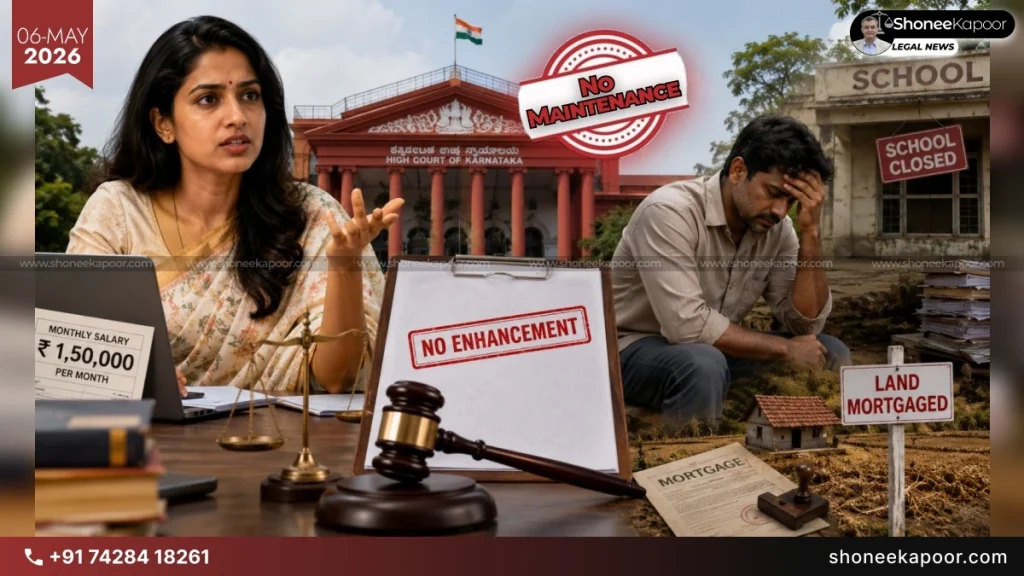
Can speculative claims over ancestral property outweigh the financial independence of the wife and the husband’s unemployment claim?
The Karnataka High Court answered in negative, refused to enhance maintenance, and dismissed the revision petitions.
BENGALURU: The Karnataka High Court refused to enhance the maintenance amount sought by a wife who was already earning nearly ₹1.5 lakh per month.
The Court observed that the husband’s one-acre mortgaged land and possible future share in ancestral property could not automatically become grounds for increasing maintenance, especially when the wife was financially independent and there were no children from the marriage.
The dispute arose from a marriage that took place on April 13, 2009. Soon after the marriage, the wife filed proceedings under Section 12 of the Protection of Women from Domestic Violence Act, alleging that the husband demanded an Omni car and subjected her to physical and mental harassment when the demand was not fulfilled. The husband denied all allegations during the trial.
The husband’s counsel informed the Court that the husband earlier used to run a school, but the school had shut down, leaving him unemployed and financially weak. The lawyer further argued that the wife herself was earning more than ₹1.5 lakh per month and therefore there was no justification for granting higher maintenance.
It was also argued before the Court that the husband owned only one acre of land, which had already been mortgaged to a bank for ₹4.5 lakh. On the other hand, the wife argued that the husband also had a share in ancestral properties and was hiding his true financial position from the Court.
While examining the case, the Karnataka High Court noted that the exact share of the husband in the ancestral property had still not been determined. The Court held that such uncertain future rights could not become the basis for enhancement of maintenance.
The Court also took note of the wife’s own financial records, which showed that she was financially capable and even able to spend substantial amounts on litigation expenses.
At the same time, the Court observed that the husband had failed to fully comply with earlier maintenance directions and had cited lack of funds. However, the Court remarked that the fact that he managed to raise ₹4.5 lakh by mortgaging property showed “a reluctance, rather than inability to pay maintenance.”
The husband’s lawyer also informed the Court that on March 18, 2026, the husband had already paid ₹10,000 and expressed inability to pay the remaining amount because of unemployment. The wife’s side continued to insist that his ancestral property rights proved that he had sufficient means to pay enhanced maintenance.
After considering all circumstances, especially the husband’s claim of unemployment and the wife’s strong monthly income, the Karnataka High Court held that there was no valid reason to interfere with the earlier orders passed by the lower courts.
The Court finally observed:
“Therefore, the grounds urged in the revision petitions are hardly sufficient to interfere with the Orders passed by the learned Trial Magistrate confirmed by the First Appellate Court.”
Accordingly, the Court dismissed the Revision Petition.
Explanatory Table: Laws And Provisions Involved
| Law / Section | Purpose | How Applied In This Case |
| Protection of Women from Domestic Violence Act, 2005 | Law protecting women from domestic violence and allowing maintenance, residence and compensation claims | Wife filed proceedings under this law |
| Section 12 DV Act | Allows an aggrieved woman to file complaint/application before Magistrate | Wife initiated domestic violence proceedings under this section |
| Section 18 DV Act | Gives protection orders restraining domestic violence | Husband restrained from committing acts of domestic violence |
| Maintenance Relief | Financial support ordered by court for spouse | Wife sought enhancement of maintenance amount |
| Compensation Relief | Monetary compensation for alleged suffering or injury | Court awarded ₹40,000 compensation earlier |
| Residence/Rent Relief | Court can direct payment for accommodation or rent | Husband directed to pay ₹5,000 monthly rent |
Case Details
- Case Title: Wife v. Husband
- Court: Karnataka High Court
- Case Type: Revision Petitions
- Final Outcome: The Karnataka High Court dismissed the revision petitions and refused to enhance maintenance.
- Counsel For Respondent: Advocate PradeepMarriage Date: 13 April 2009.
- Children: There were no children born from the marriage.
Key Takeaways
- A financially independent spouse earning a high salary cannot automatically demand higher maintenance by merely pointing towards ancestral property claims.
- Possible future share in family property is not equal to actual available income or immediate financial capacity.
- Maintenance laws are meant for genuine financial support, not for creating endless financial pressure despite substantial personal earnings.
- Financial records, employment status, liabilities, and real earning capacity of both parties matter while deciding maintenance disputes.
- Vague assumptions about hidden wealth or ancestral assets should not become tools for excessive maintenance demands against unemployed or financially struggling men.
This Could Change Your Case-Get FREE Legal Advice-Click Here!
Disclaimer: The views and opinions expressed in this article are those of the Indian courts and do not necessarily reflect the official policy or position of “ShoneeKapoor.com” or its affiliates. This article is intended for informational and educational purposes only. The content provided is not legal advice, and viewers should not act upon this information without seeking professional counsel. Viewer discretion is advised.