
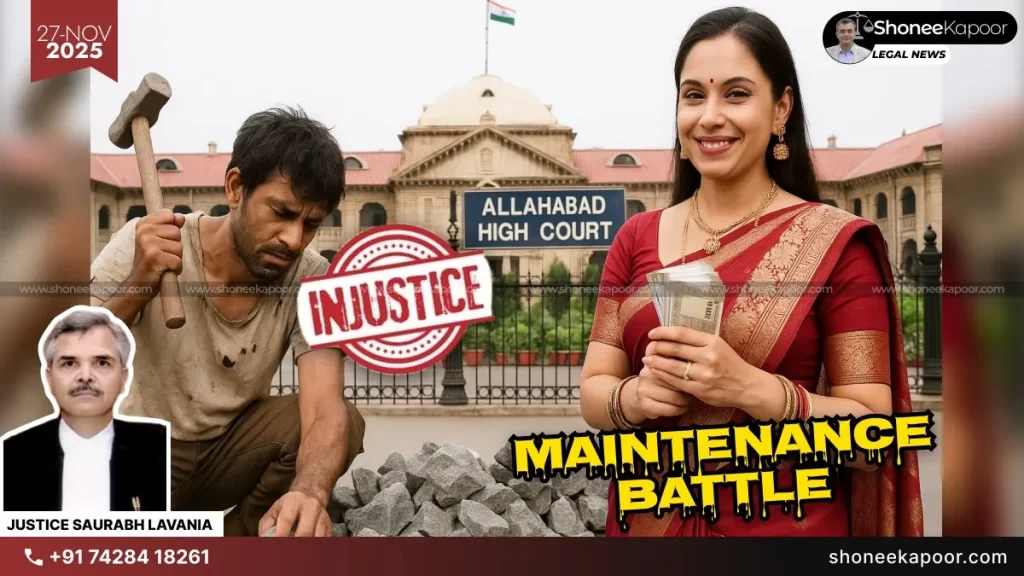
The Allahabad High Court upheld the Family Court’s order directing a husband to pay ₹2,500 monthly maintenance to his wife, saying an able-bodied man cannot escape responsibility by claiming unemployment. The Court noted that even minimum-wage labourers can earn enough to support their spouse.
UTTAR PRADESH: The Allahabad High Court (Lucknow Bench) has refused to interfere with a Family Court order directing a husband to pay ₹2,500 per month as interim maintenance to maintain wife.
The husband had filed a criminal revision petition against this order, but the High Court bench of Justice Saurabh Lavania dismissed it, clearly stating that an able-bodied man cannot avoid his legal duty to support his wife.
The case started after the wife filed a maintenance application under Section 125 Cr.P.C. claiming that she had no income and her husband earned nearly ₹1 lakh per month. She asked for ₹50,000 per month as interim maintenance. She stated that the parties married on 28 November 2013 and that soon after the marriage, she was harassed for dowry by the husband and his family members.
She narrated several incidents of harassment, including a major incident on 2 February 2021 where she was allegedly beaten by her sister-in-law and other relatives. She further said the husband abandoned her in a rented room for 20 days, after which her brother brought her back to Lucknow on 21 February 2021.
The wife claimed that the husband earned ₹60,000 from fruit business and ₹40,000 from rental income, giving him a total income of ₹1 lakh per month. She also said he had a house, bank balance, and other properties. She said she had no income and therefore needed maintenance.
The husband denied all allegations. He said he was unemployed and earlier worked as a driver. According to him, his fruit business had already closed and he had no source of income. He further claimed that the wife earned money by tailoring and embroidery work and did not need maintenance. He requested dismissal of the application.
Since neither side produced documentary proof of income, the Family Court relied on reasonable assumptions. The Court said that even if the husband worked as a daily labourer, he would earn at least minimum wage.
It calculated:
“यदि एक मजदूर एक माह में 25 दिन भी काम करता है तो वह (500 x 25 = 12,500/-) रुपये अवश्य कमाता होगा।”
On this basis, the Court assumed a notional income of ₹12,500 per month and awarded ₹2,500 per month as interim maintenance from the date of the application.
The High Court examined several Supreme Court judgments on maintenance, including Anju Garg vs. Deepak Kumar Garg (2022) and Chaturbhuj vs. Sita Bai (2008). The Court repeated the principle that Section 125 Cr.P.C. is a social justice provision meant to prevent a deserted wife from falling into poverty.
Quoting the Supreme Court, the High Court highlighted:
“The Family Court had disregarded the basic canon of law that it is the sacrosanct duty of the husband to provide financial support to the wife and to the minor children. The husband is required to earn money even by physical labour, if he is an able-bodied, and could not avoid his obligation, except on the legally permissible grounds mentioned in the statute.”
The High Court also noted earlier Supreme Court rulings that 25% of the husband’s net income is normally considered appropriate for maintenance. These include:
- Kulbhushan Kumar vs. Raj Kumari (1970)
- Kalyan Dey Chaudhary vs. Rita Dey Chaudhary (2017)
The husband also requested that the matter be sent to mediation and offered to deposit ₹25,000. But the High Court rejected this because the arrears since October 2021 would already be around ₹1,20,000, making his offer unreasonable.
After reviewing the records, Justice Saurabh Lavania held that the Family Court order was correct and reasonable. The High Court said:
“Upon due consideration of the aforesaid, this Court finds no illegality, irregularity, or jurisdictional error in the order impugned dated 20.08.2025 for the reason that a meagre amount i.e. Rs. 2500/- per month has been awarded by the Family Court to the opposite party No. 2 towards the amount of maintenance.”
The criminal revision was therefore dismissed, and the order of ₹2,500 per month maintenance was upheld.

Explanatory Table Of All Laws, Sections & Cases Referred
| Law / Case / Provision | Meaning in Simple Indian English | Relevance in This Case |
| Section 125 Cr.P.C. | A wife, child, or parents who cannot maintain themselves can ask for monthly maintenance. | The wife filed her application under this section; Court upheld maintenance. |
| Section 125(1) Cr.P.C. | Allows Magistrate to order a person to pay monthly allowance if they neglect/refuse to maintain dependents. | Basis for maintenance order. |
| Section 125(2) Cr.P.C. | Maintenance can start from date of order or date of application, if court orders. | High Court referenced this while explaining legal principles. |
| Section 125(5) Cr.P.C. | Maintenance can be cancelled if wife is in adultery or refuses to live with husband without reason. | Court noted the statutory scheme but not applicable here. |
| Section 127 Cr.P.C. | Allows increase, decrease, or cancellation of maintenance due to change in circumstances. | Cited to show magistrate’s powers continue even after order. |
| Rajnesh vs. Neha (2021) 2 SCC 324 | The landmark judgment standardising maintenance law across India. | Cited for principles like date of maintenance & husband’s obligation. |
| Anju Garg vs. Deepak Kumar Garg (2022) | SC said husband must maintain wife even by doing physical labour. | Contains the core quote repeated by Allahabad HC. |
| Chaturbhuj vs. Sita Bai (2008) | SC held maintenance prevents destitution; husband must support wife. | Used to reinforce social purpose of Section 125. |
| Bhuwan Mohan Singh vs. Meena (2015) | Says delays in maintenance cases harm dignity of women. | Cited while explaining purpose of Section 125. |
| Vimala vs. Veeraswamy (1991) | SC said Section 125 aims to end vagrancy and poverty. | Used to explain social welfare nature. |
| Kirtikant Vadodaria vs. State of Gujarat (1996) | States Section 125 gives protection to helpless dependents. | Supports reasoning for interim maintenance. |
| Kulbhushan Kumar vs. Raj Kumari (1970) | SC held 25% of husband’s net income is fair maintenance. | High Court relied on this principle. |
| Kalyan Dey Chaudhary vs. Rita Dey Chaudhary (2017) | Reaffirmed 25% net income rule. | Cited to support assessment of maintenance. |
| Sanjeev Kapoor vs. Chandana Kapoor (2020) | Explained that Section 125 is a social justice legislation. | Used to interpret scope of Section 125. |
| Chander Parkash vs. Shila Rani (1968) | Able-bodied man is presumed capable of earning. | Supports principle that husband cannot plead unemployment. |
| Rina Kumari vs. Dinesh Kumar Mahto (2025) | SC observations on maintenance procedure. | Mentioned by High Court. |
| Minimum Wages Logic (Family Court finding) | Even labourers earn approx. ₹12,500 per month (₹500 per day × 25 days). | Basis for granting ₹2,500 maintenance. |
| Rajesh vs. Neha Directions (affidavits) | Mandates income affidavits in maintenance matters. | Both parties filed affidavits as per these guidelines. |
Case Summary
- Case Title: Vikas Sharma vs. State of U.P. Thru. Secy. Home Deptt., Lko. & Another
(Criminal Revision No. 1359 of 2025) - Court & Bench: High Court of Judicature at Allahabad, Lucknow Bench Hon’ble Justice Saurabh Lavania
- Date of Judgment: 24 November 2025
- Impugned Order: Order dated 20.08.2025 passed by Additional Principal Judge, Family Court, Court No. 7, Lucknow in Criminal Misc. Case No. 1246 of 2021 (Smt. Mona Sharma vs. Vikas Sharma)
Counsel for Revisionist (Husband)
- Shiv Kumar Vishwakarma
- Jeet Tripathi
- Surya Bhushan Srivastava
Counsel for Opposite Parties
- Learned AGA (State of U.P.)
Parties
- Revisionist: Vikas Sharma
- Opposite Party No. 2: Smt. Mona Sharma
- Opposite Party No. 1: State of U.P.
Final Outcome
- Criminal Revision dismissed.
- Maintenance of ₹2,500 per month upheld.
Key Takeaways
- Courts continue to assume every husband is “able-bodied” and capable of earning, even without proof of actual income or employment.
- Allegations by the wife are accepted at face value, while the husband’s unemployment or financial struggle is rarely given weight.
- Maintenance is assessed on hypothetical income, not real earnings, pushing struggling men into forced financial liabilities.
- The burden always stays on the husband, even when the wife has skills, earning potential, or actual income.
- · Even minimal maintenance orders set a precedent where men are punished for circumstances beyond their control, reinforcing one-sided legal obligations.
This Could Change Your Case-Get FREE Legal Advice-Click Here!

Disclaimer: The views and opinions expressed in this article are those of the Indian courts and do not necessarily reflect the official policy or position of “ShoneeKapoor.com” or its affiliates. This article is intended for informational and educational purposes only. The content provided is not legal advice, and viewers should not act upon this information without seeking professional counsel. Viewer discretion is advised.