
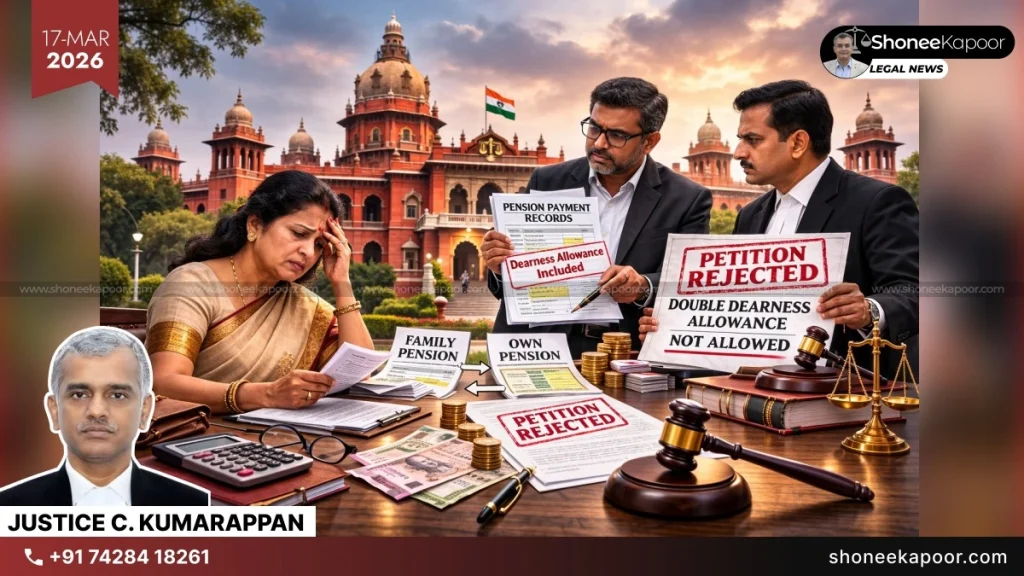
The Madras High Court held the claim was based on misunderstanding of records, confirmed DA was already paid, and dismissed it as double benefit is not allowed.
Double Dearness Allowance: In a recent judgment delivered by Justice C. Kumarappan of the Madras High Court, the Court examined a dispute where a retired woman employee claimed that she was not receiving dearness allowance on her regular pension after retirement.
The Court carefully reviewed the facts and found that the claim was based on a misunderstanding, as records clearly showed that she had been receiving pension along with dearness allowance continuously.
The petitioner had been appointed on compassionate grounds after her husband’s death and later retired from service. She was receiving both family pension and her own pension, but she approached the Court stating that dearness allowance was not being paid on her regular pension. However, the respondents produced records showing that pension along with dearness allowance had been paid continuously.
After reviewing the material, the Court clearly observed:
“The petitioner without taking into consideration of commutation of pension amount, under misconception, she preferred the writ petition, as if she receives no Dearness Allowance for the pension.”
The Court further emphasized the settled legal position and quoted:
“The ratio of the decision in the case of Union of India … is, that a pensioner cannot draw two dearness reliefs — one on the salary and the other on pension.”
Considering both the facts and the law, the Court found no fault in the decision taken by the authorities. It concluded that the claim had no merit and therefore refused to interfere.
Accordingly, the writ petition was dismissed, and the Court upheld the existing pension payment as valid under law.
Explanatory Table: Laws And Provisions Involved
| Law / Section | Purpose | How Applied in This Case |
| Article 226 of the Constitution of India | Gives High Courts power to issue writs like Certiorari and Mandamus | The petitioner filed this writ seeking to quash an order and claim additional pension benefits |
| Rule 20A – Tamil Nadu State Transport Corporation Employees Provident Fund Rules | Regulates payment of dearness allowance to pensioners | Used to examine whether the petitioner was entitled to dearness allowance on more than one pension |
| Rule 75(21) – Railway Services (Pension) Rules, 1993 | Restricts dearness relief when a pensioner is re-employed | Referred for legal interpretation to support the principle that double benefit is not allowed |
| Supreme Court Judgment (Union of India case) | Establishes that double dearness relief cannot be claimed | Relied upon by the Court to conclude that one person cannot receive two dearness allowances simultaneously |
Case Details
- Case Title: P. Vanajakshi vs The Metropolitan Transport Corporation & Others
- Case No.: Writ Petition No. 36589 of 2015
- Court: High Court of Judicature at Madras
- Bench: Justice C. Kumarappan
- Neutral Citation: 2026:MHC:836
- Dates:
- Judgment Reserved On: 05-02-2026
- Judgment Pronounced On: 27-02-2026
- Counsels:
- For Petitioner: Mr. G. Vijay Priyan for Mr. R. Krishnaswamy
- For Respondents No. 1: Mr. C. Gauthamaraj
- For Respondent No. 2: Mr. C.S.K. Sathish (R2)
Key Takeaways
- Courts are strictly applying financial discipline — double benefits are not allowed even if multiple entitlements exist.
- Misunderstanding of financial records can lead to unnecessary litigation, showing how individuals are often pushed into legal battles without clarity.
- The principle is clear — one person, one dearness allowance — highlighting how the system avoids duplication of monetary benefits.
- This case reflects how legal claims are tested against records, not emotional or assumed entitlement, something men often face in financial disputes.
- Courts rely on established law and precedent, not sympathy, which is critical in ensuring fairness in financial claims.
This Could Change Your Case-Get FREE Legal Advice-Click Here!
Disclaimer: The views and opinions expressed in this article are those of the Indian courts and do not necessarily reflect the official policy or position of “ShoneeKapoor.com” or its affiliates. This article is intended for informational and educational purposes only. The content provided is not legal advice, and viewers should not act upon this information without seeking professional counsel. Viewer discretion is advised.