
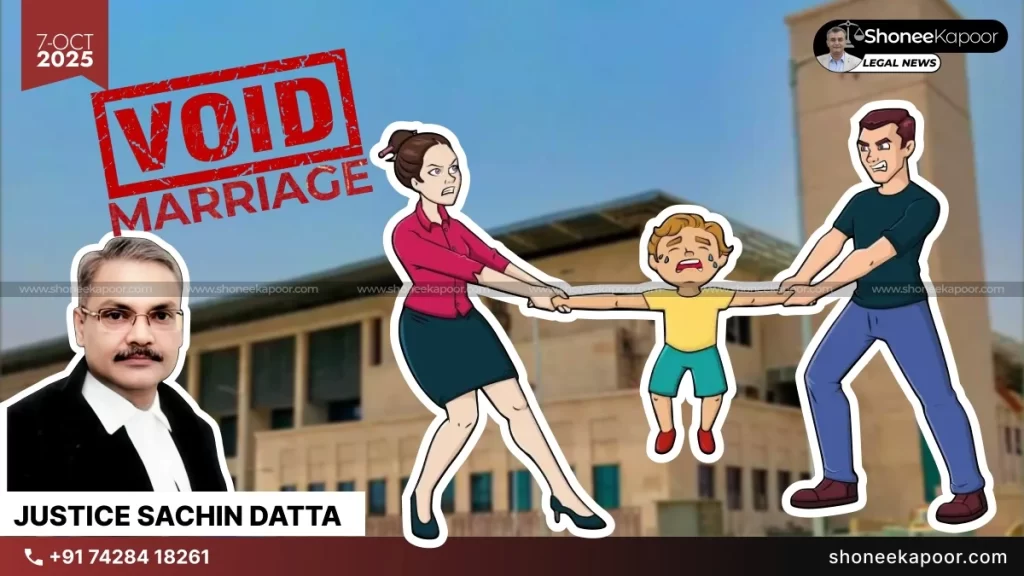
The Andhra Pradesh High Court declared that even a child born from a void marriage Has Full Legal Right to Father’s Property Hindu law. The Court gave the son a 5/6th share in his father’s property, protecting his inheritance rights.
Amaravati: In a major judgment protecting the inheritance legal right of children born from void marriages, the Andhra Pradesh High Court has ruled that such a son is legitimate under Section 16(1) of the Hindu Marriage Act, 1955 and is also entitled to inherit his father’s property as per Section 16(3) read with Section 8 and Schedule-I – Class-I heir of the Act.
The case came before the High Court through an appeal filed under Section 96 of the Code of Civil Procedure (CPC) by the plaintiff, who challenged an earlier judgment and decree related to recovery of property and cancellation of a compromise decree.
A Division Bench of Justice Ravi Nath Tilhari and Justice Maheswara Rao Kuncheam observed,
“So, by applying the legal provision the marriage was void under Section 11 read with Section 5(i) of the H.M. Act, 1955. Plaintiff would therefore be illegitimate son of Ch. Keshava Rao but conferred with legitimacy under Section 16(1) of the H.M.Act and also entitled to succeed to the property of his father Ch. Kesava Rao, as per Section 16(3) of the H.M.Act read with Section 8 and Schedule-I – Class-I heir.”
The Bench further added,
“The plaintiff being the son of Chennupati Kesava Rao, would be entitled to succeed to the estate of Pushpavathi under Section 15 (1) (b) and Section 15 (2) (b) of the Hindu Succession Act, as the legal heir (son) of Chennupati Kesava Rao, i.e the pre-deceased husband of Pushpavathi.”
The Court clarified that the plaintiff could not be called illegitimate even under the proviso to Section 3(1)(j) of the Hindu Succession Act, stating,
“On points-‘C’ & ‘D’, we hold that the plaintiff-appellant is not the absolute owner, but has 5/6th share and the defendant-respondent has 1/6th share in the estate of Ch. Keshava Rao, ‘A’ schedule property of O.S.No.197 of 2009 and ‘A’ schedule property of O.S.No.552 of 1994 taken together.”
One Chennupathi Kesava Rao was married to Chennupathi Pushpavathi, but they had no children. Later, Kesava Rao married Manikyamba @ Mani, and from this marriage, Naga Venkata Krishna (the plaintiff) was born.
Kesava Rao died intestate in 1990. The defendant, Jagan Mohan, is the son of Kesava Rao’s elder brother.
The plaintiff claimed that after his father’s death, the defendant took advantage of his mother’s lack of education and his minority, and fraudulently managed the estate, even obtaining signatures under false pretenses in the name of maintenance. It was also alleged that a compromise decree was obtained through fraud when the plaintiff was still a minor. When he attained majority, he discovered the fraud and filed a suit to cancel the compromise decree.
The defendant denied the second marriage and even the plaintiff’s paternity, claiming that the earlier case had already been settled by paying ₹5,50,000 as full and final settlement. The Trial Court partially accepted the plaintiff’s claims — it set aside the compromise decree but declared that he was entitled to only 1/3rd share as an illegitimate son. Dissatisfied, the plaintiff moved the High Court.
The Bench elaborated that when a compromise involving a minor is made without the Court’s permission, it is voidable once the minor becomes an adult. The Court explained:
“We are of the view, in the present case that, the plaintiff being minor at the time of the compromise which was entered without leave of the court, he on attaining the majority, within the period of limitation, could file the suit for cancellation of the compromise decree, as such a compromise decree would be voidable at the instance of the minor.
In our view the suit for cancellation of a compromise decree, without leave of court, by a minor on attaining majority, would be maintainable and Order 23 Rule 3A CPC would not come in the way of filing a suit for cancellation of such a compromise decree. The remedy to apply to recall in the same suit may be open but that would not bar filing of the suit. So, O.S.No.197 of 2009 was not barred by Order 23 Rule 3A CPC.”
The Court relied on the Supreme Court judgment in Revanasiddappa and others vs. Mallikarjun and others (2023), where it was held that the legitimacy given by Section 16 of the Hindu Marriage Act extends to property rights under the Hindu Succession Act.
The Apex Court had clarified that such a child is covered under the phrase “related by legitimate kinship” in Section 3(1)(j) of the Hindu Succession Act and cannot be regarded as illegitimate for inheritance purposes.
Applying this principle, the High Court reiterated that the plaintiff, though born from a void marriage, was Legal Right under the law and entitled to inherit his father’s estate. It noted that since Kesava Rao died intestate, his legal heirs were his son (plaintiff), mother (Ravamma), and wife (Pushpavathi), each getting 1/3rd share as Class-I heirs. Later, with the deaths of Ravamma and Pushpavathi, the plaintiff inherited their shares too.
Accordingly, the Court calculated that:
- From his father: 1/3rd share
- From his grandmother Ravamma: 1/6th (½ of her 1/3rd share)
- From his stepmother Pushpavathi: 1/3rd share under Sections 15(1)(b), 15(2)(b), and Section 16 of the Hindu Succession Act.
Thus, the plaintiff became entitled to 5/6th share, and the defendant got 1/6th share in the estate.
Finally, the Division Bench concluded by partly allowing the appeal and affirming the trial court’s decree that had set aside the compromise decree.
Explanatory Table of All Laws & Sections Mentioned
| Law / Act | Section(s) | Subject / Provision | Explanation in Context of Case |
| Code of Civil Procedure, 1908 (CPC) | Section 96 | Appeals from original decrees | Basis for filing the appeal against the trial court’s judgment. |
| Order 23 Rule 3A | Bar to separate suit challenging a compromise decree | Discussed whether a separate suit to cancel a minor’s compromise decree is maintainable (Court held it is maintainable if minor had no court leave). | |
| Order 32 Rule 7 | Compromise by guardian/next friend | Held that a compromise entered on behalf of a minor without court permission is voidable, not void, and can be challenged upon attaining majority. | |
| Hindu Marriage Act, 1955 | Section 5 | Conditions for a valid Hindu marriage | Marriage invalid if either party already has a living spouse. |
| Section 11 | Void marriages | Declares marriages violating Section 5(i) (bigamy) as null and void. | |
| Section 16 | Legitimacy of children of void/voidable marriages | Court held plaintiff (born from void marriage) is Legal Right for inheritance from parents, but not from other relatives. | |
| Hindu Succession Act, 1956 | Section 3(1)(j) | Definition of “related” | Clarifies “related by legitimate kinship,” with special note on illegitimate children and mothers. |
| Section 8 | Rules of succession for males | Used to determine inheritance from father’s estate. | |
| Section 15 | Rules of succession for females | Applied to discuss property devolution from deceased female relatives (mother & stepmother). | |
| Schedule I | Class-I heirs | Used to determine legal heirs under intestate succession. | |
| Indian Succession Act, 1925 | Section 63(c) | Execution and attestation of wills | Referenced when discussing whether alleged wills in favor of the defendant were valid. |
| Indian Evidence Act, 1872 | Section 68 | Proof of execution of documents required by law to be attested | Held that the alleged wills must be proved through attesting witnesses — which was not done, rendering them invalid. |
Case Summary
- Case Title: Chennupati Naga Venkata Krishna v. Chennupati Jagan Mohan Rao
- Court: High Court of Andhra Pradesh, Hyderabad
- Case Number: Appeal Suit No. 841 of 2015 & Cross-Objection (SR) No. 1549 of 2016
- Date of Judgment: 26 September 2025
- Coram / Bench: Hon’ble Sri Justice Ravi Nath Tilhari & Hon’ble Sri Justice Maheswara Rao Kuncheam
- Appellant: Chennupati Naga Venkata Krishna, S/o Kesava Rao, R/o Patamata Center, Vijayawada, Krishna District
- Respondent: Chennupati Jagan Mohan Rao, S/o Madhava Rao, R/o Patamata Center, Vijayawada, Krishna District
- Counsel for Appellant: Sri N. Subba Rao, assisted by Ms. Kamireddy Divya
- Counsel for Respondent: Sri K.S. Gopala Krishnan, assisted by Sri Sumanth Amirapu
- Trial Court Case: O.S. No. 197 of 2009 (XII Additional District Judge, Krishna at Vijayawada)
- Trial Court Judgment Date: 26 March 2015
- Key Issue: Validity of compromise decree obtained without court’s permission when the plaintiff was a minor; inheritance rights of a child from a void Hindu marriage
- Appeal Filed Under: Section 96 of the Code of Civil Procedure, 1908
- Result: Appeal partly allowed — Compromise decree set aside; plaintiff recognized with limited inheritance rights under Section 16 of Hindu Marriage Act
- Significance: Clarified that minors can challenge void compromise decrees made without court approval; reaffirmed partial inheritance rights for children born from void Hindu marriages
Key Case Laws Referred
| Case Name | Citation | Relevance |
| Bishundeo Narain v. Seogeni Rai | 1951 SCC OnLine SC 34 | Explained that a compromise without court leave for a minor is voidable, not void. |
| Kaushalya Devi v. Baijnath Sayal | AIR 1961 SC 790 | Clarified that such a compromise is only voidable at the minor’s option. |
| Manjunath Tirakappa Malagi v. Gurusiddappa Tirakappa Malagi | 2025 SCC OnLine SC 835 | Distinguished — dealt with adult compromise; used to contrast minor’s right to challenge. |
| Revanasiddappa v. Mallikarjun | AIR 2023 SC 4707 | Landmark precedent expanding inheritance rights of children from void marriages. |
| Ramesh Chand v. Suresh Chand | 2025 INSC 1059 | Clarified the proof standards for wills under Section 68 Evidence Act. |
This Could Change Your Case-Get FREE Legal Advice-Click Here!
Disclaimer: The views and opinions expressed in this article are those of the Indian courts and do not necessarily reflect the official policy or position of “ShoneeKapoor.com” or its affiliates. This article is intended for informational and educational purposes only. The content provided is not legal advice, and viewers should not act upon this information without seeking professional counsel. Viewer discretion is advised.