
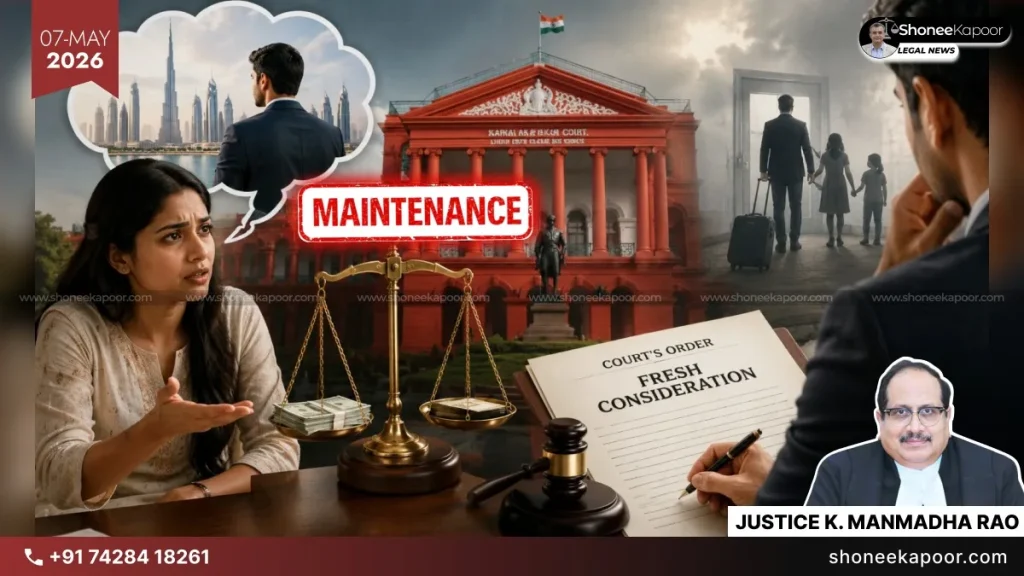
Can A Short Marriage Automatically Defeat Maintenance Claim?
The Karnataka High Court held that mere short duration of marriage cannot justify rejecting interim maintenance without examining the financial capacity of both spouses.
BENGALURU: The Karnataka High Court, while hearing a matrimonial dispute under Section 24 of the Hindu Marriage Act, made important observations on interim maintenance and the need for proper financial scrutiny before burdening a husband with maintenance liability.
Justice Dr. K. Manmadha Rao passed the order in a case where a wife had sought Rs.50,000 per month as interim maintenance and Rs.1 lakh towards litigation expenses from her husband, who was alleged to be working in Dubai as an accountant.
The Family Court had earlier dismissed the wife’s application mainly because the couple had lived together only for about 6 to 7 months. Challenging that order, the wife approached the Karnataka High Court claiming that she was unemployed and studying B.Com, while alleging that the husband was earning around Rs.8 lakh per month abroad.
The husband, however, disputed these claims and argued that the wife was financially stable and gainfully employed. He also contended that despite repeated requests, she refused to join him in Dubai.
While examining the matter, the Karnataka High Court discussed the true purpose of Section 24 of the Hindu Marriage Act and clarified that maintenance proceedings cannot be decided casually or mechanically.
The Court observed that:
“The primary objective of maintenance pendente lite and litigation expenses under Section 24 of the Hindu Marriage Act, 1955, is to provide financial support to the claimant spouse, enabling them to maintain themselves and sustain the legal proceedings.”
At the same time, the Court stressed that judicial discretion cannot be exercised arbitrarily while deciding maintenance applications. The Court clearly stated that:
“The Court’s discretion is judicial and not arbitrary in nature.”
The High Court further noted that courts are required to examine the income and earning capacity of both spouses before passing maintenance orders. The Court said that:
“The court considers the income of the spouse who has made the application for interim maintenance and the income of the other spouse who is required to pay such interim maintenance and expenses.”
Importantly, the Court emphasized that interim maintenance proceedings are only summary proceedings and not full-fledged trials. The Court observed:
“Under Section 24 of the HMA, 1955, a matter is contemplated as a summary enquiry and not a full-fledged trial at length.”
The Karnataka High Court also listed the factors that must be considered before granting interim maintenance, including :
“The duration of the marriage”, “The means and conduct of the spouses”, “The ability of the spouse to earn”, and “The educational qualifications of the claimant.”
These observations become significant in cases where educated and employable spouses seek heavy maintenance without complete financial disclosure.
Finally, the High Court found fault with the Family Court’s reasoning and observed that:
“The Family Court has not followed the object and scope of the law with regard to Section 24 of the Act.”
The Court therefore set aside the earlier order and sent the matter back to the Family Court for fresh consideration after examining affidavits of assets and liabilities of both parties.
Explanatory Table: Laws And Sections Involved
| Law / Section | Purpose | Relevance In This Case |
| Section 24, Hindu Marriage Act, 1955 | Allows either spouse to seek interim maintenance and litigation expenses during pendency of matrimonial proceedings if they do not have sufficient independent income | Wife sought interim maintenance and litigation expenses under this provision |
| Article 227, Constitution of India | Gives High Courts supervisory powers over subordinate courts and tribunals | Wife approached Karnataka High Court challenging the Family Court order under this Article |
| Maintenance Pendente Lite | Temporary financial support granted during ongoing matrimonial litigation | Core issue before the Court |
| Affidavit of Assets and Liabilities | Financial disclosure document showing income, expenses, properties, and liabilities of parties | High Court directed fresh consideration after examining these disclosures |
| Judicial Discretion | Power of the court to decide matters fairly based on facts and law, not arbitrarily | High Court emphasized that maintenance decisions must be reasoned and balanced |
| Summary Enquiry | A limited preliminary examination instead of a full detailed trial | Court clarified that Section 24 proceedings are summary in nature |
Case Details
- Case Title: Smt. Sahana K v. Sri. Santhosh S Gowda
- Court: High Court of Karnataka
- Case Number: Writ Petition No. 34389 of 2025 (GM-FC)
- Bench: Justice Dr. K. Manmadha Rao
- Neutral Citation: NC: 2026:KHC:21864
- Date of Judgment: 22 April 2026
- Counsels:
- For Petitioner: Sri. J.S. Halashetti, Advocate
- For Respondent: Sri. Sanketh for Sri. K.V. Keshava, Advocates
Key Takeaways
- Short duration of marriage alone cannot automatically make a husband liable for interim maintenance.
- Courts must examine the wife’s actual income, employment status, qualifications, and earning capacity before burdening the husband financially.
- Maintenance proceedings are meant to be summary enquiries, not emotional or one-sided assumptions against men.
- Financial affidavits and income disclosures of BOTH spouses are important before passing maintenance orders.
- Judicial discretion cannot be arbitrary — maintenance cannot become an automatic tool for financial pressure on husbands.
This Could Change Your Case-Get FREE Legal Advice-Click Here!
Disclaimer: The views and opinions expressed in this article are those of the Indian courts and do not necessarily reflect the official policy or position of “ShoneeKapoor.com” or its affiliates. This article is intended for informational and educational purposes only. The content provided is not legal advice, and viewers should not act upon this information without seeking professional counsel. Viewer discretion is advised.