
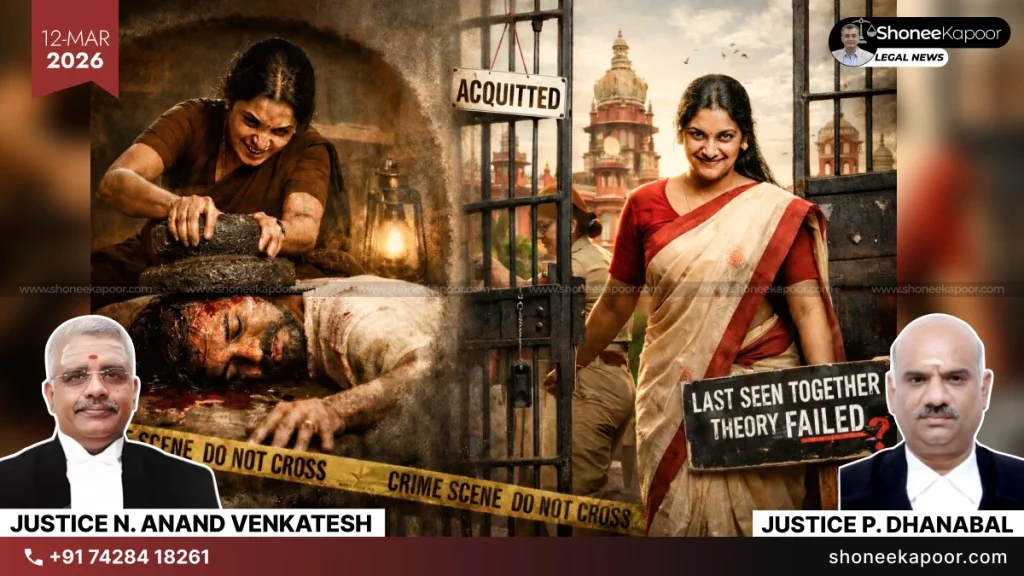
The Madras High Court acquitted the woman after finding the prosecution failed to prove the “last seen together” link. While the court rightly insisted on proof rather than assumptions, the same strict standards are rarely seen when men face accusations in such Case.
Husband Murder Case: The Madras High Court (Madurai Bench), in a judgment delivered by Justice N. Anand Venkatesh and Justice P. Dhanabal, set aside the conviction of a woman who had earlier been sentenced to life imprisonment for the alleged murder of her husband. The Court held that the prosecution failed to establish the chain of circumstances required in a case based purely on circumstantial evidence.
The case arose from an appeal filed by Selvi challenging the trial court’s decision, which had convicted her under Section 302 IPC and sentenced her to life imprisonment. The prosecution alleged that Selvi had an illicit relationship with another man and that this led to disputes with her husband. It was claimed that she attacked him inside the house during the night.
During the trial, several witnesses did not support the prosecution, and many turned hostile. Because of this, the prosecution relied mainly on circumstantial evidence and argued that since the accused and the deceased were living together, the accused had the responsibility to explain what happened.
The trial court relied on Section 106 of the Indian Evidence Act and convicted her. However, the High Court found serious gaps in the prosecution’s case and noted that the most important link — the “last seen together” theory — was never proved.
The Court clarified that Section 106 cannot be used to shift the burden onto the accused when the prosecution itself has not proved the basic facts. The judgment stated:
“It is now too well settled that Section 106 of the Act is not intended to relieve the prosecution from discharging its duty to prove the guilt of the accused.”
The judges further observed:
“The prosecution must discharge its primary onus of proof and establish the basic facts against the accused person in accordance with law and only thereafter Section 106 of the Act can be resorted to depending upon the facts and circumstances of each case.”
Emphasising that criminal cases cannot be decided on assumptions, the Court stated:
“Just because the parties happened to be husband and wife, the Court cannot assume that they will always be seen together.”
The judgment further added, “Even in such a relationship, it is not a question of assumption and in law, it is a question of fact.”
While the High Court acquitted the previously convicted wife due to lack of proof, such cases also highlight a broader concern often raised in discussions around gender and criminal law. When allegations are made against men in matrimonial disputes, courts and investigative agencies frequently proceed with immediate arrests, social stigma, and prolonged trials. In contrast, when the accused is a woman, the courts often show greater caution before confirming guilt.
Explanatory Table: Laws And Sections Involved
| Law / Section | Purpose | How Applied in This Case |
| Section 302 IPC | Punishes the offence of murder. | Trial court convicted the accused wife under this section; High Court later set aside the conviction. |
| Section 374(2) CrPC | Allows appeal to High Court against Sessions Court conviction. | The accused used this provision to challenge the life sentence. |
| Section 106 Indian Evidence Act | Burden to explain facts within special knowledge. | Trial court relied on it, but High Court ruled it cannot apply without basic proof by prosecution. |
| Section 8 Indian Evidence Act | Makes conduct of accused relevant evidence. | Prosecution relied on the accused’s conduct after the incident. |
| Section 161 CrPC | Police record witness statements during investigation. | Witness statements were collected during investigation under this section. |
| Section 313 CrPC | Court questions accused to explain evidence against them. | The accused denied the allegations when examined by the trial court. |
| Section 207 CrPC | Ensures accused receives prosecution documents before trial. | Copies of evidence and documents were supplied to the accused. |
Case Details
- Case Title: Selvi vs The State
- Court: Madras High Court, Madurai Bench
- Case Number: Criminal Appeal (MD) No. 428 of 2023
- Neutral Citation: 2026:MHC:961
- Date of Judgment: 04 March 2026
- Bench: Justice N. Anand Venkatesh and Justice P. Dhanabal
- FIR Number: Crime No. 177 of 2017
- Police Station: Aviyur Police Station
- Counsels:
- For Appellant: Mr. M. Jothibasu
- For Respondent: Mr. A. Thiruvadikumar, Additional Public Prosecutor
Key Takeaways
- Criminal law must be based on evidence, not assumptions. In many matrimonial disputes, men are often presumed guilty simply because of the relationship, which goes against the basic principles of justice.
- The prosecution must prove the entire chain of circumstances beyond doubt. Laws like Section 106 of the Evidence Act should not be misused to shift the burden onto the accused, something that men frequently face in matrimonial litigation.
- The “last seen together” theory must be supported by clear evidence. Courts cannot assume guilt merely because a husband and wife lived together.
- Matrimonial conflicts often produce narratives driven by personal disputes rather than facts. This is why courts must scrutinize allegations carefully instead of accepting claims at face value.
- The principle applied here should be consistently applied in all matrimonial cases, especially where men are frequently presumed guilty without complete evidence.
This Could Change Your Case-Get FREE Legal Advice-Click Here!
Disclaimer: The views and opinions expressed in this article are those of the Indian courts and do not necessarily reflect the official policy or position of “ShoneeKapoor.com” or its affiliates. This article is intended for informational and educational purposes only. The content provided is not legal advice, and viewers should not act upon this information without seeking professional counsel. Viewer discretion is advised.