
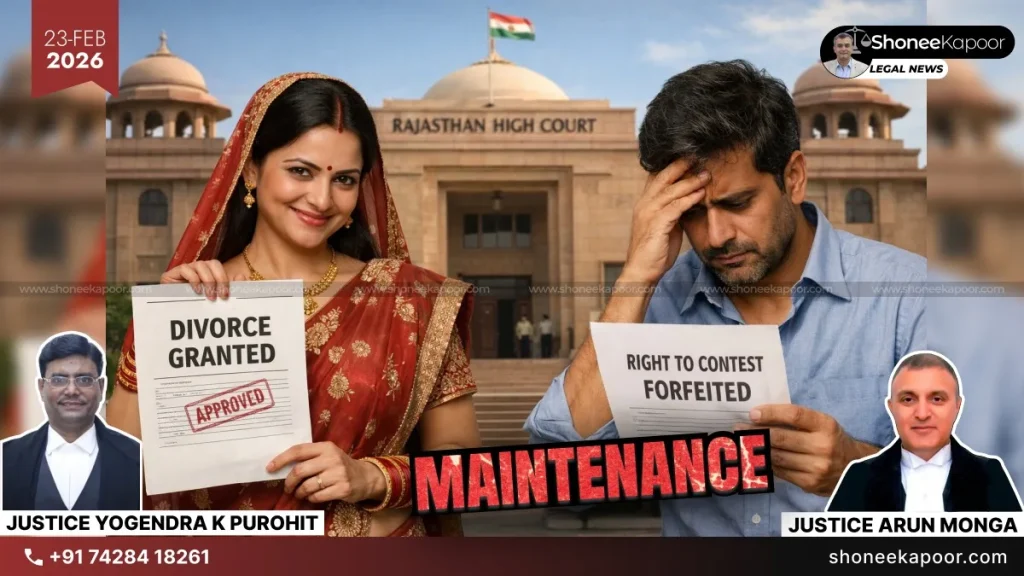
The Rajasthan High Court granted divorce to the wife, holding that the husband’s repeated court absence and failure to pay maintenance amounted to mental cruelty.
Does treating procedural default as cruelty overlook the real hardships men face with multiple cases, financial strain, and legal burdens?
JODHPUR: The Rajasthan High Court at Jodhpur, in a ruling by Hon’ble Mr. Justice Arun Monga and Hon’ble Mr. Justice Yogendra Kumar Purohit, granted divorce on the ground of mental cruelty after examining the conduct of the husband across multiple proceedings.
The Court held that persistent absence from court and non-compliance with judicial directions can legally amount to cruelty.
The marriage took place in 2018 and disputes later arose, with allegations of cruelty and dowry harassment followed by criminal litigation. The wife’s divorce petition was earlier dismissed by the Family Court for lack of proof.
However, the High Court reassessed the entire record and noted repeated non-appearance by the husband in maintenance and domestic violence proceedings, including failure to comply with recovery warrants for unpaid maintenance.
The judges recorded:
“The conduct of the respondent, as borne out from the record of multiple judicial proceedings, unequivocally constitutes mental cruelty of a grave and continuing nature.”
The Bench further observed that:
“The cumulative effect of the respondent’s conduct—namely, repeated non-appearance before courts, persistent non-payment of court-ordered maintenance, deliberate violation of judicial directions, and total abandonment of legal proceedings—has subjected the appellant to prolonged mental agony, financial distress, and social humiliation.”
The Court emphasized that cruelty must be evaluated from the overall circumstances and found that the Family Court had failed to properly appreciate evidence, including consistent testimony and judicial records. It observed:
“Taking an overall and holistic view of the matter, we are of the considered opinion that the deliberate and intentional abandonment by the respondent–husband, both of his matrimonial obligations and of the legal proceedings arising therefrom—amounts to a forfeiture of his right to contest the matter.”
Allowing the appeal, the Bench concluded:
“Consequently, the appeal filed by the appellant–wife is allowed. Her petition under Section 13 of the Hindu Marriage Act, 1955 stands decreed and marriage between the parties is dissolved.”
The ruling highlights that courts place strong reliance on conduct during litigation. Non-participation in proceedings, ignoring maintenance orders, and failure to defend cases can seriously weaken a husband’s position and may be interpreted as mental cruelty. The judgment reinforces that matrimonial disputes are decided on evidence, procedural compliance, and overall behavior rather than allegations alone.
Explanatory Table: Laws And Sections Involved
| Law / Section | Purpose | How applied in this case |
| Section 13, Hindu Marriage Act, 1955 | Provides grounds for divorce including cruelty | Wife filed divorce on ground of mental cruelty |
| Section 9, Hindu Marriage Act, 1955 | Restitution of conjugal rights | Husband filed RCR petition which was dismissed |
| Section 498A, IPC | Cruelty by husband or relatives | Criminal complaint alleging cruelty and harassment |
| Section 406, IPC | Criminal breach of trust | Allegations relating to dowry articles / stridhan |
| Section 323, IPC | Voluntarily causing hurt | Allegations of physical cruelty |
| Section 34, IPC | Common intention | Applied against husband and family members |
| Section 125, CrPC | Maintenance for wife and child | Maintenance proceedings pending against husband |
| Section 125(3), CrPC | Enforcement and recovery of maintenance | Recovery warrant issued for non-payment |
| Section 125C, CrPC | Recovery of interim maintenance | Proceedings for arrears of interim maintenance |
| Section 23, Domestic Violence Act, 2005 | Interim relief and maintenance | Interim maintenance order passed against husband |
| Domestic Violence Act proceedings | Protection and relief against domestic violence | Husband’s repeated absence considered as conduct evidence |
Case Details
- Case Title: Smt. Khusboo v. Manohar Lal
- Case Number: D.B. Civil Misc. Appeal No. 2708/2024
- Court: High Court of Judicature for Rajasthan at Jodhpur
- Neutral Citation: 2026:RJ-JD:6106-DB
- Date of Order: 03 February 2026
- Bench: Hon’ble Mr. Justice Arun Monga | Hon’ble Mr. Justice Yogendra Kumar Purohit
- Counsels:
- For Appellant: Mr. Rahul Vyas
- For Respondent: No effective appearance
Key Takeaways
- Courts closely evaluate litigation conduct; repeated absence and failure to contest proceedings can severely weaken a husband’s defence and may be treated as adverse conduct.
- Non-payment of court-ordered maintenance, especially despite recovery warrants, can be interpreted as neglect of matrimonial obligations and may contribute to a finding of mental cruelty.
- Divorce decisions are based on cumulative circumstances; multiple pending cases and procedural defaults can collectively influence judicial findings.
- Men must actively participate in mediation, trial hearings, and compliance with interim orders, as abandonment of proceedings may be viewed as implied acceptance of allegations.
- In matrimonial disputes, disciplined legal strategy, regular court presence, and strict compliance with judicial orders are essential safeguards for any litigant.
This Could Change Your Case-Get FREE Legal Advice-Click Here!
Disclaimer: The views and opinions expressed in this article are those of the Indian courts and do not necessarily reflect the official policy or position of “ShoneeKapoor.com” or its affiliates. This article is intended for informational and educational purposes only. The content provided is not legal advice, and viewers should not act upon this information without seeking professional counsel. Viewer discretion is advised.