
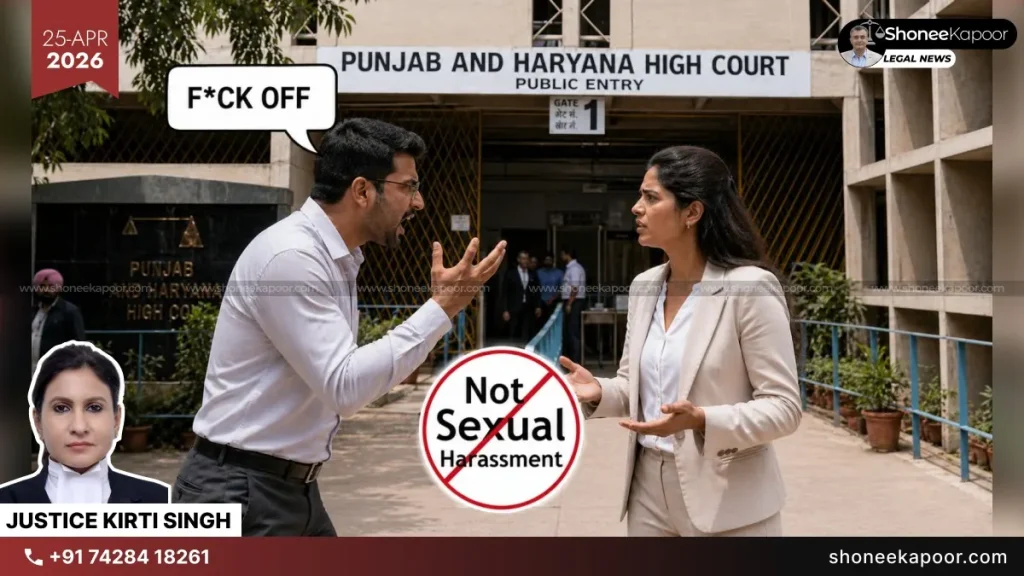
Can rude office language become a criminal sexual harassment case? Punjab & Haryana High Court gives an important answer that may surprise many readers.
CHANDIGARH: The Punjab & Haryana High Court has ruled that using the words “f*** off” during an office dispute may be rude and unacceptable, but it does not automatically become sexual harassment unless there is sexual intent or sexual meaning behind it.
The Court made it clear that criminal law cannot be used in every workplace argument, especially when the issue is linked to work-related conflict and not gender-based misconduct.
Justice Kirti Singh said:
“It is also pertinent that the context of the communication in the present case prima facie arises out of a work related interaction. No doubt the standards of decorum ought to be maintained in every such correspondence, yet at the same time, a solitary instance of an abusive remark, in the absence of any element of sexual intent or pattern of conduct, would not meet the threshold of criminal culpability under the penal provision intended to address gender-based harassment.”
The case was filed by a man who was Director of a private company. He asked the High Court to cancel an FIR registered in 2019 at Women Police Station, Gurugram under Section 354-A IPC.
The woman complainant was working as a Business Manager in the company. Before a company event in October 2018, she applied for medical leave. After this, email exchanges took place between her and the Director regarding her absence.
During the email conversation, the man allegedly used abusive words including “f*** off”. The woman resigned the same day and the resignation was accepted.
Later, disputes started regarding notice period, salary and alleged contract breach. Both sides sent legal notices to each other. Nearly four months after resignation, the woman filed the FIR claiming harassment and insulting language.
The man argued before the Court that the FIR was filed as a reaction to legal notices already sent in the contract dispute. He said the words were used during a professional disagreement, not with any sexual motive. He also pointed out there was no allegation of physical contact, sexual demand, sexual favour request or any sexual act.
After examining the case, the High Court said even if the allegations are accepted fully, the basic requirements of Section 354-A IPC are missing.
The Court said:
“Trite to say that where the uncontroverted allegations and the material collected fail to disclose the basic ingredients of the offences alleged, the continuation of criminal proceedings would not serve any useful purpose, but would amount to abuse of the process of law,”
The Court explained that Section 354-A IPC mainly applies in cases involving unwelcome physical contact, sexual advances, demand for sexual favours, showing pornography or sexually coloured remarks.
According to the Court, the words used in this matter were rude and improper, but they had no sexual tone and were not aimed at the woman’s modesty or sexuality.
The Court also noted that the complaint was filed after more than four months and there were already money and employment disputes between both parties. This became an important factor while judging whether criminal law was being misused in a workplace conflict.
Relying on settled legal principles and the famous judgment in State of Haryana v. Bhajan Lal, the Court said”
“If allegations do not disclose the basic ingredients of an offence, proceedings must be quashed, Continuation of such proceedings would amount to abuse of process of law.”
Finally, the High Court cancelled the FIR, the charge-sheet and all further criminal proceedings against the man. However, the Court directed him to deposit Rs. 20,000 in the Poor Patient Welfare Fund of PGIMER Chandigarh within one month.
Explanatory Table Of All Laws / Sections Mentioned
| LAW / SECTION | FULL NAME | MEANING | RELEVANCE IN CASE |
| Section 354-A IPC | Sexual Harassment and Punishment for Sexual Harassment | Covers sexual advances, sexual favours, pornography, sexually coloured remarks | FIR was registered under this section |
| IPC | Indian Penal Code | Criminal offences law | Alleged offence invoked |
| Section 482 Cr.P.C. | Inherent Powers of High Court | High Court can quash FIR/proceedings to prevent misuse and secure justice | Petition filed under this section |
| Cr.P.C. | Code of Criminal Procedure | Procedure governing criminal cases | Used for quashing petition |
| Section 164 Cr.P.C. | Recording of Statement before Magistrate | Victim/witness statement before Magistrate | Complainant statement recorded |
| Section 156(1) Cr.P.C. | Police Power to Investigate Cognizable Offence | Police investigation powers | Mentioned in Bhajan Lal principles |
| Section 155(2) Cr.P.C. | Magistrate Order for Non-Cognizable Cases | Needed before police probe in non-cognizable matter | Mentioned in Bhajan Lal principles |
| Sexual Harassment of Women at Workplace Act, 2013 | POSH Act | Civil/internal remedy against workplace harassment | Mentioned in arguments |
| Challan / Final Report | Police charge-sheet | Investigation report filed in court | Also quashed by Court |
Case Details
| PARTICULARS | DETAILS |
| Case Title | Abhikshek Shah vs State of Haryana and another |
| Case Number | CRM-M-36953-2019 (O&M) |
| Court | High Court of Punjab & Haryana at Chandigarh |
| Bench | Hon’ble Ms. Justice Kirti Singh |
| Reserved On | 08.04.2026 |
| Date of Decision | 18.04.2026 |
| Neutral Citation | 2026:PHHC:058348 |
| Petitioner | Abhikshek Shah |
| Respondents | State of Haryana and another |
| Final Outcome | FIR Quashed qua petitioner subject to Rs.20,000 deposit |
| FIR Number | 35 dated 10.03.2019 |
| Police Station | Women Police Station, Gurgaon, District Gurugram |
Counsels Appearing
| SIDE | COUNSEL |
| For Petitioner | Mr. Kunal Dawar, Senior Advocate with Mr. Jagjot Singh, Advocate |
| For State of Haryana | Mr. Anmol Malik, DAG, Haryana |
| For Respondent No.2 | Mr. H.S. Randhawa, Advocate (Legal Aid Counsel) |
Key Takeaways
- Not every rude word spoken to a woman becomes sexual harassment. Law needs facts, not feelings.
- The Court clearly held that without sexual intent or sexual overtone, Section 354-A IPC cannot be misused against men.
- Delayed FIR after salary, notice period and legal disputes strongly indicated a pressure tactic against the man.
- Many men are dragged into criminal litigation because ordinary workplace conflicts are falsely painted as gender crimes.
- This judgment is a warning that criminal law is for real harassment, not revenge, extortion or career disputes.
This Could Change Your Case-Get FREE Legal Advice-Click Here!
Disclaimer: The views and opinions expressed in this article are those of the Indian courts and do not necessarily reflect the official policy or position of “ShoneeKapoor.com” or its affiliates. This article is intended for informational and educational purposes only. The content provided is not legal advice, and viewers should not act upon this information without seeking professional counsel. Viewer discretion is advised.