
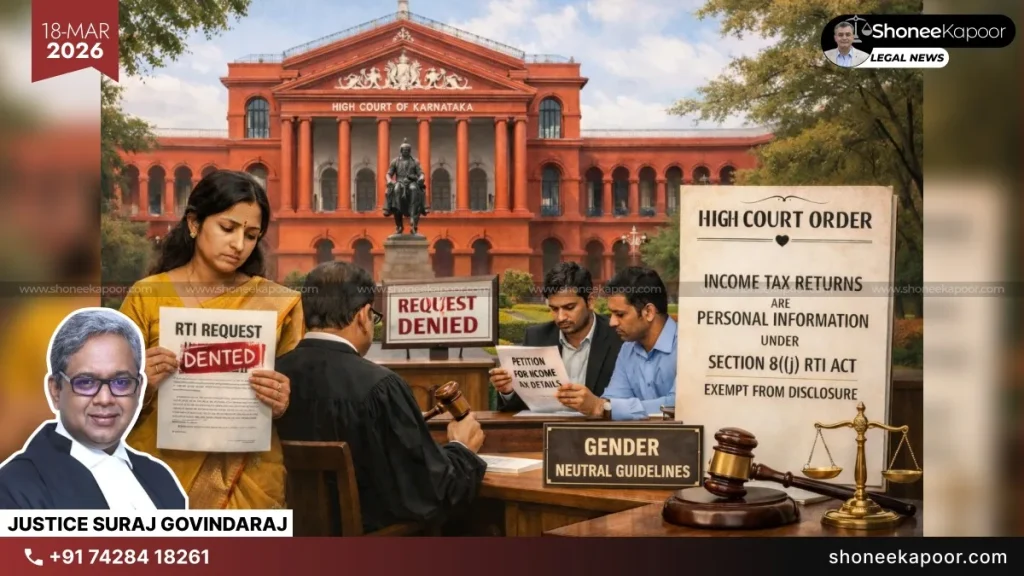
Think you can pull your spouse’s income details through RTI to win a maintenance case? The High Court just shut that door & brings “gender-neutral” rules.
But the new court route raises a bigger question: who really controls financial narratives in such disputes?
BENGALURU: The Karnataka High Court, in a significant ruling by Justice Suraj Govindaraj, has clarified that a spouse cannot access the other spouse’s income tax returns through the RTI Act and has issued detailed guidelines for courts to obtain such financial records legally in maintenance cases.
The case arose from a matrimonial dispute where one spouse had sought the other’s income tax returns through RTI to prove actual income for claiming maintenance. The Income Tax Department rejected the request, stating that such financial data is private. While the Central Information Commission had earlier allowed disclosure, the matter reached the High Court, which had to decide whether RTI can be used to access personal financial information in such disputes.
The court clearly held that income tax returns and financial records fall under personal information and are protected under the law. It was observed that such details cannot be shared under RTI as they are covered under privacy protections.
“Such information constitutes ‘personal information’ under Section 8(1)(j) of the RTI Act, exempt from disclosure.”
However, the court also recognized a practical problem—many maintenance cases fail because one spouse hides true income, and the other spouse cannot prove financial capacity. To solve this issue, the High Court laid down a structured legal process for courts to obtain financial records directly instead of relying on RTI.
The court issued uniform guidelines which will apply to all Magistrate Courts, Family Courts, Sessions Courts, and Appellate Courts in Karnataka dealing with maintenance or alimony matters. These guidelines also bind the Income Tax Department within the state.
Importantly, the court made it clear that these rules apply equally to both men and women.
“…These guidelines are gender-neutral. They apply equally to applications filed by a wife seeking financial information of the husband, and to applications filed by a husband seeking financial information of the wife. The pronouns used in these guidelines are for convenience only and shall be construed to include all genders”
The court clarified that financial records include income tax returns, assessment orders, Form 16/16A, Form 26AS, AIS, TDS certificates, profit and loss accounts, balance sheets, capital gains details, and bank-related information.
Under the new process, a spouse must apply before the court to seek such details. The other spouse will be given 7 days to respond. The court will check whether the request is necessary, relevant, and cannot be obtained through simpler means like voluntary disclosure.
The request must be limited and proportionate, covering only relevant records and time periods. If satisfied, the court will pass a reasoned order within 14 days. Any production order must clearly mention the documents required, assessment years, PAN details, and compliance timeline.
The Income Tax Department must submit records to the court in a sealed cover to maintain confidentiality. Only relevant portions will be shared to avoid exposing third-party financial information.
The court also imposed strict conditions:
“….Before any disclosure is made, the Court shall obtain an undertaking from the Applicant Spouse (and his or her advocate) that the information obtained shall be used solely for the purpose of the pending maintenance proceedings and shall not be disclosed to any third party or used for any other purpose whatsoever”
After the case ends, all such information must be returned or destroyed.
The Income Tax Department must appoint a Nodal Officer and comply with orders within 21 working days. If records are unavailable, an affidavit must be filed. Any objections must be raised within 7 days.
Overall, the system balances privacy with fairness by preventing misuse of RTI while ensuring courts get the necessary financial data.
Explanatory Table: Laws & Sections Involved
| Law / Section | Purpose | How Applied in This Case |
| Section 8(1)(j), RTI Act, 2005 | Protects personal information from disclosure unless larger public interest exists | Used to deny access to income tax returns as they are private financial details |
| Section 8(1)(e), RTI Act | Protects information held in fiduciary relationship | Income tax data held by department was treated as confidential and not shareable |
| Section 11, RTI Act | Procedure for disclosure of third-party information | Notice was issued to the husband as a third party before considering disclosure |
| Section 2(n), RTI Act | Defines “third party” | Husband was treated as a third party even though the applicant was the wife |
| Section 138, Income Tax Act, 1961 | Governs disclosure of income tax information by authorities | Considered as a special law overriding RTI for tax-related disclosures |
| Articles 226 & 227, Constitution of India | Gives High Court power to issue writs and supervise authorities | Petition was filed challenging CIC order under these constitutional powers |
| Section 12, Domestic Violence Act, 2005 | Provides for seeking maintenance and relief | Wife sought financial records to support her maintenance claim |
Case Details
- Case Title: Income Tax Officer and CPIO, Income Tax Department vs Smt. Gulsanober Bano Zafar Ali Ansari & Anr.
- Court: High Court of Karnataka at Bengaluru
- Bench: Hon’ble Mr. Justice Suraj Govindaraj
- Neutral Citation: NC: 2026:KHC:11056
- Case Number: Writ Petition No. 34625 of 2019 (GM-RES)
- Date of Judgment: 21 February 2026
- Counsels:
- For Petitioner (Income Tax Department): Sri M. Dilip, and Sri Y.V. Raviraj
- For Respondent No.1: Sri Kemparaju
- For Respondent No.2 (Central Information Commission): Sri Shanthi Bhushan, DSGI
Key Takeaways
- RTI route to access spouse’s income details is now clearly blocked—this stops misuse of legal tools to pressure or harass either party in matrimonial disputes.
- The court has created a proper legal process through “production orders,” ensuring financial disclosure happens only under judicial supervision, not through shortcuts.
- Strong emphasis on privacy—financial records are protected, and only relevant portions can be shared, preventing unnecessary exposure of personal and third-party data.
- Guidelines are strictly gender-neutral—both men and women must follow the same legal route, removing one-sided advantage in maintenance litigation.
- Balance restored—courts get accurate financial data for fair maintenance decisions, while individuals are protected from fishing inquiries and misuse of financial information.
This Could Change Your Case-Get FREE Legal Advice-Click Here!
Disclaimer: The views and opinions expressed in this article are those of the Indian courts and do not necessarily reflect the official policy or position of “ShoneeKapoor.com” or its affiliates. This article is intended for informational and educational purposes only. The content provided is not legal advice, and viewers should not act upon this information without seeking professional counsel. Viewer discretion is advised.