
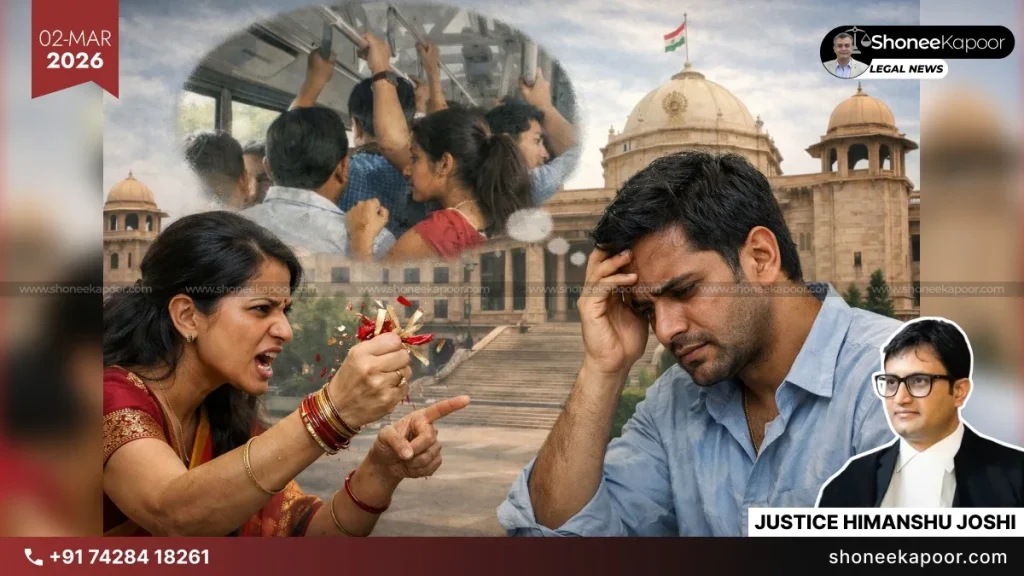
The Madhya Pradesh High Court quashed the FIR under Sections 74, 75(1)(i) and 296 BNS against a government officer, citing lack of independent witnesses, no medical corroboration, and doubtful allegations, holding that continuation would be an abuse of process of law.
JABALPUR: In an order dated 13 February 2026, Justice Himanshu Joshi of the Madhya Pradesh High Court at Jabalpur quashed an FIR registered against Pankaj Mishra under Sections 74, 75(1)(i) and 296 of the Bharatiya Nyaya Sanhita.
The allegations arose from an incident in a crowded public bus, where the complainant accused him of inappropriate physical contact and breaking her bangles.
The Court noted that the bus was heavily crowded and observed that:
“In such a situation, incidental physical contact between passengers cannot be said to be unnatural.”
It also found serious gaps in the investigation, especially the failure to record statements of the bus driver and conductor, who were important independent witnesses.
The medical report did not support the allegation of forceful grabbing. The Court clearly stated that “The complete absence of any such medical corroboration materially weakens the prosecution version.”
It further added that:
“While it is true that every allegation of assault may not necessarily result in visible injury, the inconsistency between the narrative of forceful physical contact and the unremarkable medical findings assumes significance in the overall evaluation of prima facie credibility.”
Importantly, the Court cautioned against misuse of criminal law and said:
“Criminal law, particularly provisions designed to safeguard the dignity and bodily autonomy of women, is a solemn legislative trust meant to redress genuine grievances and deter real transgressions; it is not intended to be wielded as a weapon to settle scores, gratify wounded pride, or exert undue pressure.”
The Court also warned that:
“Courts, therefore, must be vigilant to ensure that the process of law does not itself become an instrument of injustice.”
Holding that continuation of the case would amount to abuse of process, the High Court exercised its inherent powers under Section 528 BNSS and quashed the FIR. The judgment reinforces that serious allegations must be supported by solid evidence and that criminal law cannot be used to destroy reputation and career without proper proof.
EXPLANATORY TABLE: LAWS AND SECTIONS INVOLVED
| Law / Section | Purpose | How Applied in This Case |
| Section 528, Bharatiya Nagarik Suraksha Sanhita, 2023 | Gives High Court inherent powers to prevent abuse of process and secure ends of justice (similar to old Section 482 CrPC) | Invoked by the petitioner to seek quashing of FIR; Court used this power to quash proceedings |
| Section 482, Code of Criminal Procedure, 1973 | Earlier provision granting inherent powers to High Courts | Mentioned as corresponding provision to Section 528 BNSS |
| Section 218, Bharatiya Nagarik Suraksha Sanhita, 2023 | Protection for acts done in discharge of official duty | Petitioner claimed protection; Court held it was not applicable as alleged act was not part of official duty |
| Section 74, Bharatiya Nyaya Sanhita, 2023 | Punishes assault or criminal force to outrage modesty of a woman | Alleged offence in FIR based on complaint of physical misconduct in bus |
| Section 75(1)(i), Bharatiya Nyaya Sanhita, 2023 | Deals with sexual harassment | Applied in FIR alleging inappropriate touching |
| Section 296, Bharatiya Nyaya Sanhita, 2023 | Penalises obscene acts in public places | Invoked as alleged incident occurred inside a public bus |
CASE DETAILS
- Case Title: Pankaj Mishra Versus The State of Madhya Pradesh and Others
- Court: High Court of Madhya Pradesh, Jabalpur Bench
- Case Number: Misc. Criminal Case No. 978 of 2026
- Bench: Hon’ble Shri Justice Himanshu Joshi
- Date of Order: 13 February 2026
- Neutral Citation: 2026:MPHC-JBP:15046
- FIR Details: Crime No. 72/2025, Police Station Baikunthpur, District Rewa
- Counsels:
- For Petitioner: Shri Ajay Pal Singh, Advocate (through V.C.), Shri Shashank Shrivastava, Advocate
- For Respondent/State: Shri Swatantra Pandey, Panel Lawyer
KEY TAKEAWAYS
- Mere allegation in a crowded public place is not enough; courts will examine whether the essential ingredients of the offence are actually made out.
- Failure to examine key independent witnesses, such as driver and conductor, can seriously weaken the prosecution case.
- If medical evidence does not support claims of force or injury, courts may doubt the credibility of exaggerated accusations.
- Inherent powers of the High Court under Section 528 BNSS can be used to stop criminal proceedings that amount to abuse of legal process.
- Serious penal provisions meant to protect women cannot be misused to target men without solid, corroborated evidence.
This Could Change Your Case-Get FREE Legal Advice-Click Here!
Disclaimer: The views and opinions expressed in this article are those of the Indian courts and do not necessarily reflect the official policy or position of “ShoneeKapoor.com” or its affiliates. This article is intended for informational and educational purposes only. The content provided is not legal advice, and viewers should not act upon this information without seeking professional counsel. Viewer discretion is advised.